The contemporary image is no longer confined to the visible. Increasingly, artists are using digital technologies to access forms of life, matter and experience that exceed ordinary human perception – from subterranean root systems to the acoustic worlds of whales. Marshmallow Laser Feast has pursued this expanded field for more than a decade, creating immersive environments. Recent projects including YOU:MATTER in Bradford and Of the Oak at Kew Gardens demonstrate an increasingly ecological practice, one concerned less with technological spectacle than with the systems that connect bodies to their environments. This autumn, that enquiry moves underwater with Seeing Echoes in the Mind of the Whale and Plankton Temple, two works forming the centre of the MIT Museum’s Sensing Oceans exhibition.
Immersion is often associated with escape – an opportunity to leave the physical world temporarily through projection, sound and virtual space. Marshmallow Laser Feast reverses that proposition, using immersion to make the physical world harder to take for granted. Their environments ask viewers to inhabit scales and sensory conditions that are normally unavailable: the molecular, the subterranean, the oceanic and the astronomical. Data becomes a bridge between scientific knowledge and bodily experience, while the gallery becomes less a place for looking at objects than a site in which relationships are staged.
Bradford provided an unusually expansive context for this thinking. Created for the National Science and Media Museum as part of Bradford 2025, YOU:MATTER unfolded as a seven-part journey through interconnected systems, moving from the origins of the universe towards the conditions of life on Earth. Its scale was deliberately ambitious, encompassing cosmic events, planetary processes and the biological systems of the human body through projection, sound and interactive environments. Rather than treating scientific knowledge as a sequence of facts, the installation translated it into a spatial experience, making visitors physically conscious of their place within a much larger chronology. The effect was to collapse distances that normally organise scientific thought: billions of years could sit alongside a human breath, while planetary processes became perceptible through the body.
That movement between scales is crucial to understanding the collective’s recent work. YOU:MATTER does not simply tell audiences that everything is connected – a proposition so familiar within ecological discourse that it risks becoming empty. Instead, its environments attempt to make scale itself unstable, moving attention between the immense and the intimate. The Bradford commission also gained meaning from its civic setting, embedding an expansive planetary narrative within a city whose cultural programme was explicitly concerned with participation and public access. Here, immersive art becomes a form of mediation between specialist knowledge and everyday experience, raising a question that runs throughout Marshmallow Laser Feast’s practice: can technology make complexity felt without reducing it to spectacle?
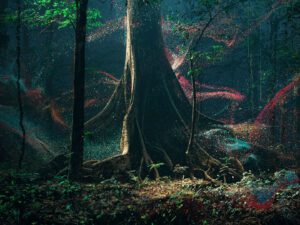
At Kew Gardens, that question became rooted in a single organism. Of the Oak, presented as Kew’s first outdoor digital art commission, centred on a Lucombe oak and used technologies including LiDAR, photogrammetry, CT scanning and ground-penetrating radar to investigate structures hidden from ordinary view. Roots, cavities and subterranean relationships became source material for a work that extended the tree beyond its familiar silhouette. The oak emerged not as a picturesque emblem of longevity but as a living system – exchanging, storing, responding and adapting across timescales that exceed human attention. Placed within Kew’s botanical landscape, the work also complicated the institution’s traditional relationship with observation, classification and display.
That institutional setting matters. Kew is a place where plants have historically been collected, named, studied and represented, and Of the Oak introduces a different logic of attention – one less concerned with isolating the specimen than with revealing its relationships. The work consequently sits within a broader shift in ecological thought from the individual organism towards networks of dependency. A tree is not simply a tree, but a concentration of exchanges between soil, fungi, water, atmosphere, microorganisms and other organisms. Marshmallow Laser Feast’s technology gives these otherwise imperceptible relationships a visual and sonic presence, although the critical question remains whether making the invisible visible necessarily produces greater ecological understanding, or whether it risks turning complexity into another form of aesthetic consumption.
Contemporary artists working with science and technology have repeatedly confronted this tension. Semiconductor’s films and installations transform astronomical, geological and atmospheric data into moving images that resist the straightforward authority of scientific visualisation. Alexandra Daisy Ginsberg, by contrast, often exposes the assumptions built into technological attempts to engineer ecological futures, asking who gets to design nature and according to whose priorities. Jana Winderen’s immersive sound works take yet another route, bringing underwater and animal frequencies into human spaces and revealing acoustic environments that remain largely inaccessible to us. Marshmallow Laser Feast shares these artists’ interest in extending perception, but their distinctive emphasis lies in constructing environments through which audiences encounter knowledge bodily.
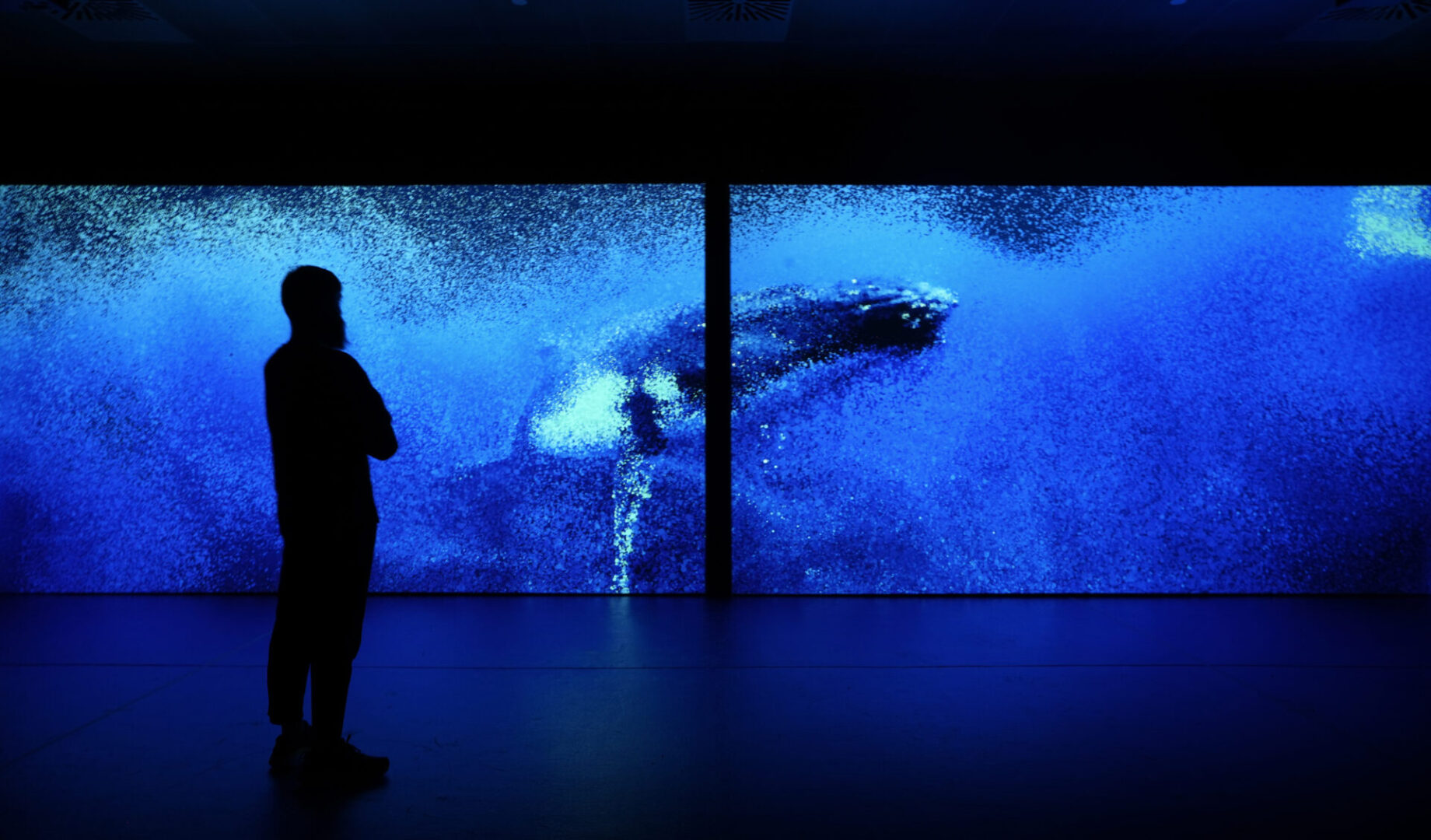
The distinction becomes particularly important with Seeing Echoes in the Mind of the Whale, which will receive its US premiere at the MIT Museum. The large-scale video installation follows whales and dolphins through underwater environments, considering how these animals navigate worlds structured by sound, movement and forms of perception fundamentally different from our own. Rather than simply presenting marine life as an object of observation, the work asks audiences to reconsider the assumptions built into looking itself. Technology becomes a prosthetic for imagination, allowing viewers to approach sensory territories, while remaining conscious of the distance between human and non-human experience.
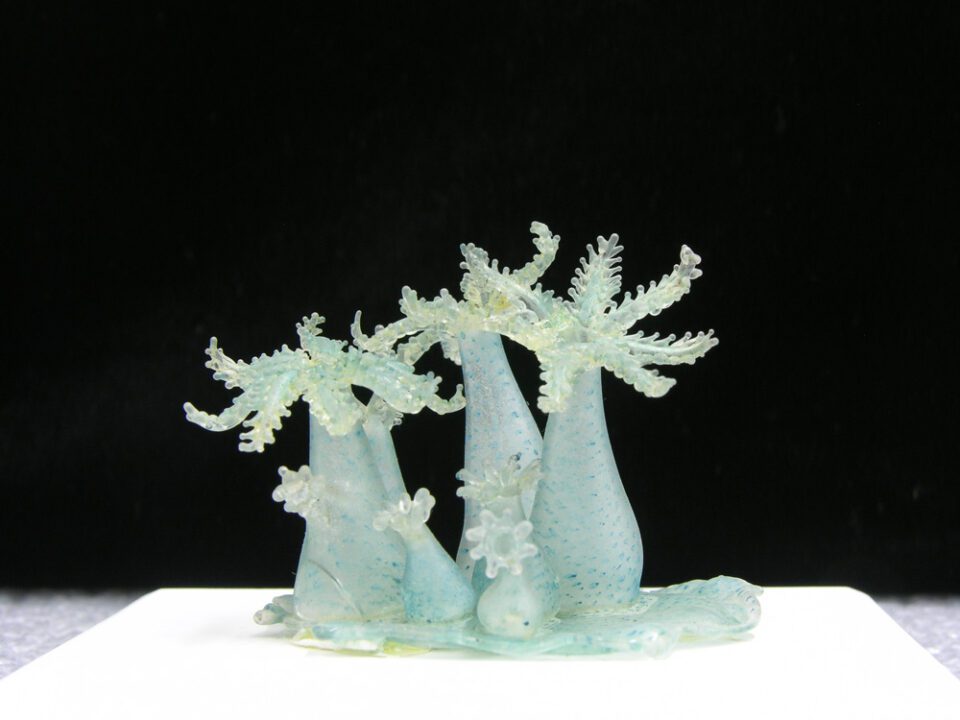
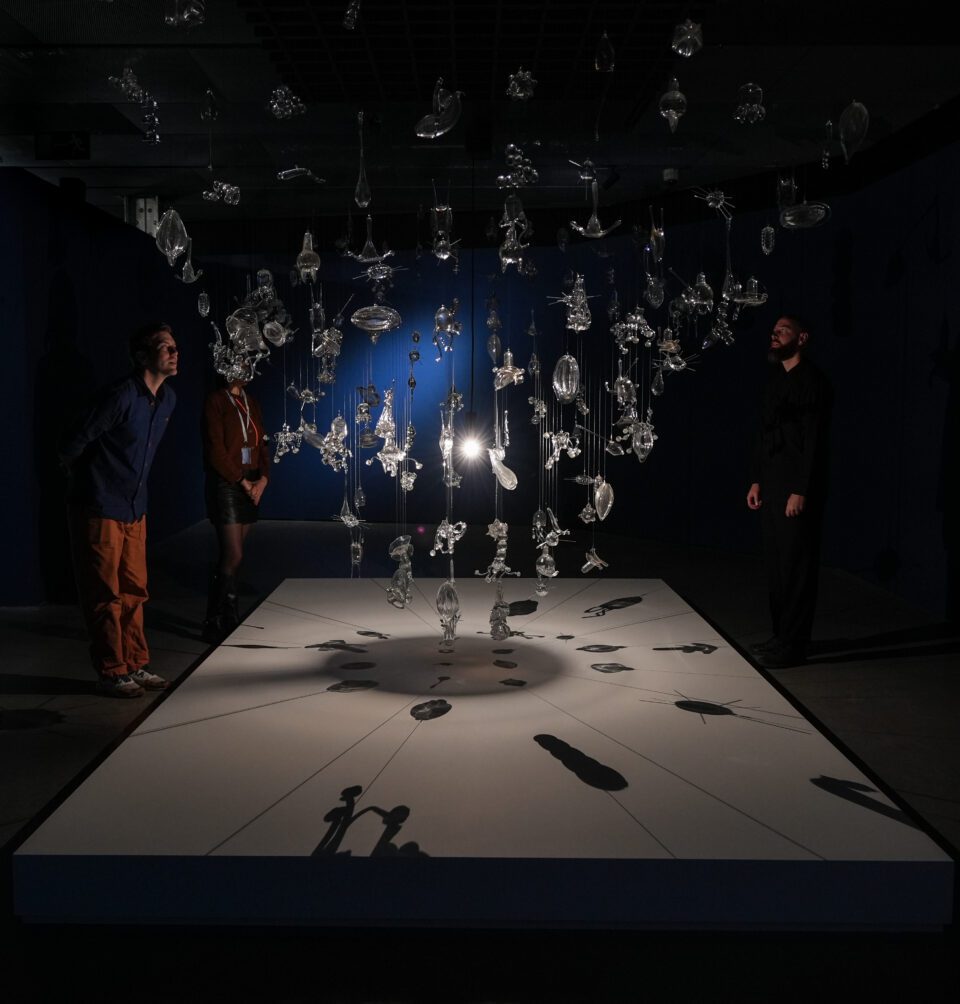
At the other end of the scale, Plankton Temple turns towards organisms almost entirely absent from conventional visual culture. Constructed through light, glass and sound, the kinetic installation draws attention to planktonic life and the intricate structures and movements that underpin marine ecosystems. Its title is significant: a temple implies attention, ritual and reverence, but also raises questions about the cultural value assigned to different forms of life. Whales tend to command emotional and visual attention; plankton rarely does, despite their foundational role in oceanic systems. By placing these organisms within an aesthetic environment, Marshmallow Laser Feast asks whether art can redistribute attention towards forms of life that human culture has historically struggled to see.
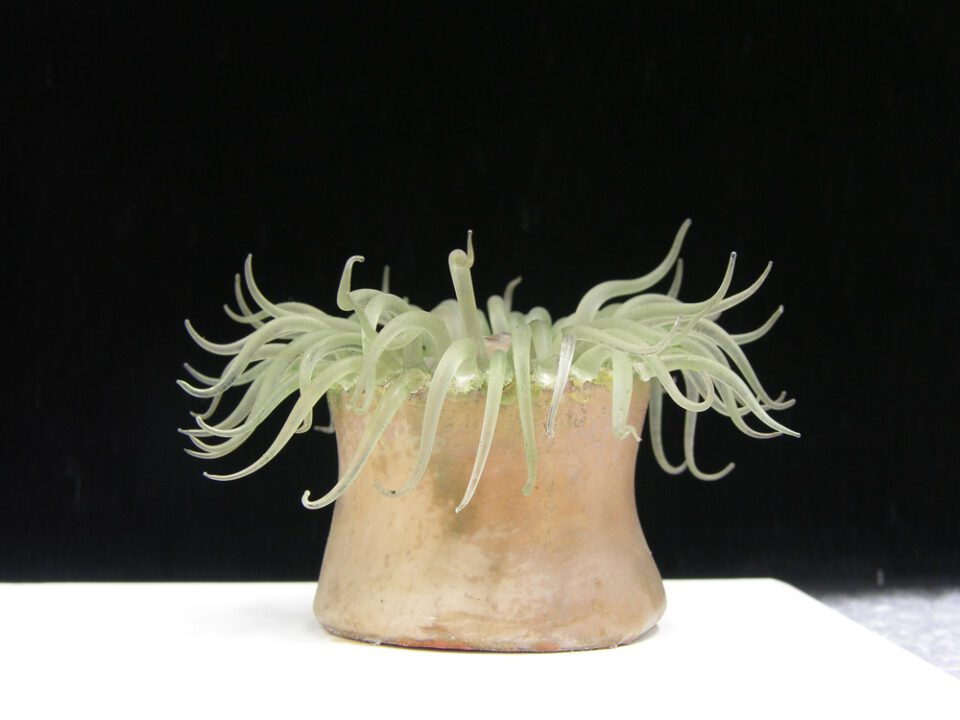
The curatorial framework of Sensing Oceans makes these questions more pointed. Opening at the MIT Museum this September, the exhibition brings contemporary art into dialogue with science and history to examine how technologies, senses and media have shaped knowledge of the ocean. Marshmallow Laser Feast’s installations therefore sit alongside a larger investigation into the instruments and systems through which an environment becomes perceptible in the first place. This is more than an interdisciplinary gesture: it challenges the conventional hierarchy in which science produces knowledge and art subsequently illustrates it. Instead, the exhibition suggests that both scientific instruments and artworks participate in constructing the ways an ocean can be imagined, measured and understood.
Such an approach belongs to a longer history of questioning the human as the unquestioned centre of representation. Donna Haraway’s writing on situated knowledge and multispecies relations, alongside subsequent posthumanist and new-materialist thought, has challenged the idea of a self-contained human subject standing apart from its environment. Marshmallow Laser Feast translates some of these theoretical concerns into sensory form, but the practice is most interesting when it resists offering an easy resolution. Immersion can generate empathy, yet empathy itself can become anthropocentric if audiences are encouraged to believe that technology has given them direct access to another species’ experience. The gap between representation and reality therefore remains productive – perhaps the most valuable thing an immersive artwork can reveal is not what we can now see, but what remains beyond our reach.
Across Bradford, Kew and now Cambridge, the trajectory is clear. YOU:MATTER expanded perception from the human body into cosmic and planetary time; Of the Oak moved beneath the surface of a single tree; Seeing Echoes in the Mind of the Whale enters an underwater sensory world; and Plankton Temple reduces the field further still, towards organisms that structure marine life while escaping everyday notice. What connects these projects is not simply their use of advanced technology, but an attempt to unsettle the habits through which humans organise attention. In that sense, Marshmallow Laser Feast’s most compelling subject is not nature, science or technology alone, but perception itself – and the possibility that changing how we see might also change what, and whom, we consider worth seeing.
Sensing Oceans is at MIT Museum, Cambridge from 30 September – 21 February: mitmuseum
Words: Simon Cartwright
Image Credits:
1&5. Marshmallow Laser Feast, Seeing Echoes in the Mind of the Whale, 2024, DHub Barcelona, photo by Sandra Campione.
2. Courtesy of the Museum of Comparative Zoology, President and Fellows of Harvard College.
3. Marshmallow Laser Feast, Plankton Temple, 2025, courtesy of the artist.
4. Courtesy of the Museum of Comparative Zoology, President and Fellows of Harvard College.