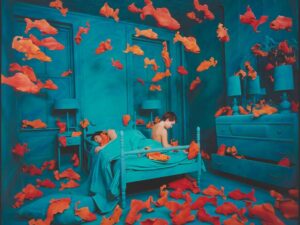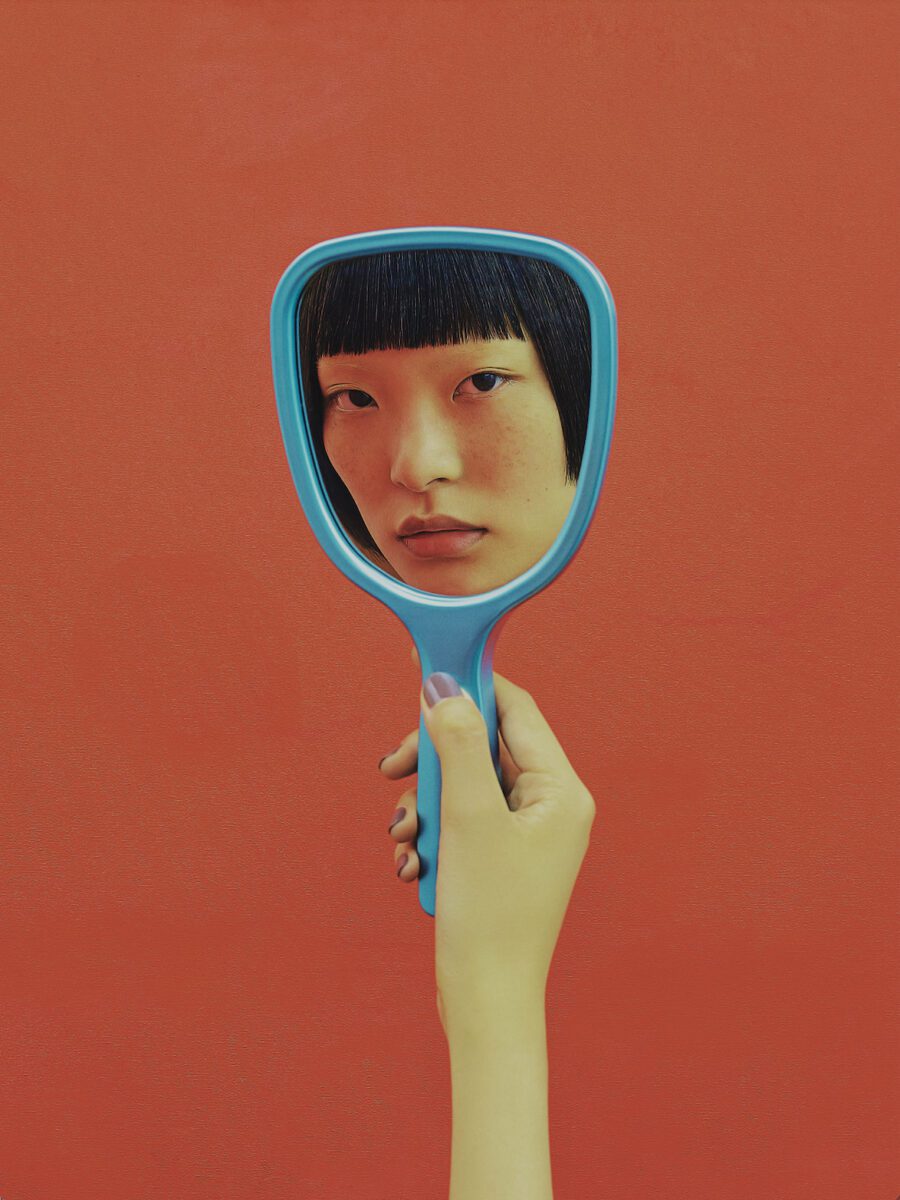
Memory is not a stable archive. It shifts with time, distance and the stories told around it, transforming photographs from records of the past into active sites of reconstruction. One Another, the second edition of Fotomuseum Winterthur’s series bringing its collection into dialogue with a contemporary artist, places Nhu Xuan Hua’s practice alongside photographs spanning different generations and approaches to image-making. Diaspora, inheritance, intimacy and representation become connecting threads, over fixed themes imposed upon the works. The exhibition asks what happens when a set photographic series is encountered through an artist whose practice is concerned with what images preserve, distort and leave behind.
Photography has always carried this contradiction. Its documentary status encourages the belief that an image can secure a moment against disappearance, however, every photograph is already shaped by choices about what to frame, retain and remember. Hua’s work embraces this tension rather than attempting to resolve it. Family photographs become material to manipulate, restage and reconsider, allowing the gaps within an archive to become as significant as the information it contains. Tropism, Consequences of a Displaced Memory (2022), her first photobook, draws on images from family albums that she digitally alters, creating surreal compositions in which personal history begins to blur into invention.
Diasporic memory gives this process particular urgency. Hua’s French-Vietnamese background informs a practice concerned with the ways emotional histories travel between generations, even when the original circumstances have become fragmented or inaccessible. Works including Má, Archive from the Year ‘88, Les Oubliées, Archive from the Year ‘70 and The Fireplace, the Tulips and the Glass Table – Archive from the Year ‘80 treat the family album as an incomplete inheritance. Their manipulated surfaces undermine the assumption that an archival photograph must remain materially intact to retain its own truth. What is of more importance is the recognition that memory itself is mutable – shaped by absence, technology, imagination and the desire to recover something that can no longer be fully retrieved.
This idea gives the exhibition its curatorial logic. Instead of presenting Fotomuseum Winterthur’s collection as a sequence of established photographic achievements, One Another creates relationships between works that might otherwise belong to very different histories. Nobuyoshi Araki, Nan Goldin, Rinko Kawauchi and Duane Michals, among others, become part of a shifting conversation around intimacy, ritual, autobiography and photographic construction. The collection is therefore not treated as a closed archive but rather as something capable of being reactivated by contemporary concerns.
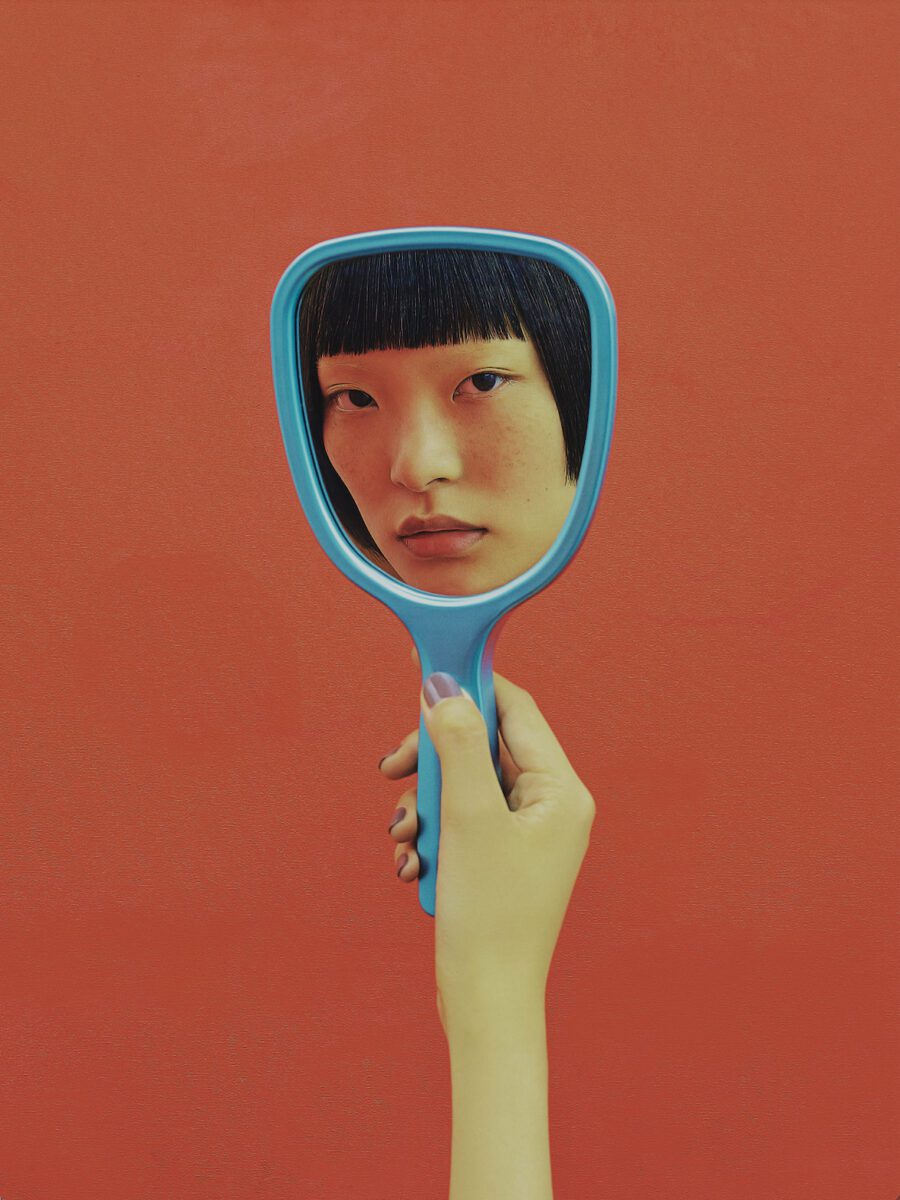
Representation provides another route into Hua’s work. Her career across fashion and fine-art photography reflects a wider reconsideration of who constructs images and whose perspectives are permitted to shape visual culture. Commissions for Dior, Maison Margiela, Kenzo and Gucci sit with her more personal narrative practice, while publications including Vogue, TIME and Dazed Beauty have provided platforms for her distinctive visual language. Like Nadine Ijewere and Tyler Mitchell, Hua works within a changing fashion-image landscape in which established ideas of beauty, identity and visibility are increasingly being questioned. Rather than leaving the conventions of fashion photography, she turns its quality into a tool, using stylisation and performance to expose the instability of representation.
Questions of intimacy become more charged in Nan Goldin’s Lil Laughing, Swampscott, MA (1996). Goldin’s photographs are rooted in relationships with friends, lovers and family, making the camera part of the social worlds it records rather than an impartial observer positioned outside them. Her mother, Lil, sits on a bed holding a blue ball in each hand, her expression caught between laughter and anguish. Saturated colour and harsh flash intensify the psychological tension, giving an apparently ordinary domestic moment an almost theatrical force. Goldin’s practice shows how an image can hold contradictory experiences – affection and vulnerability, pleasure and grief – without resolving them into a single interpretation.
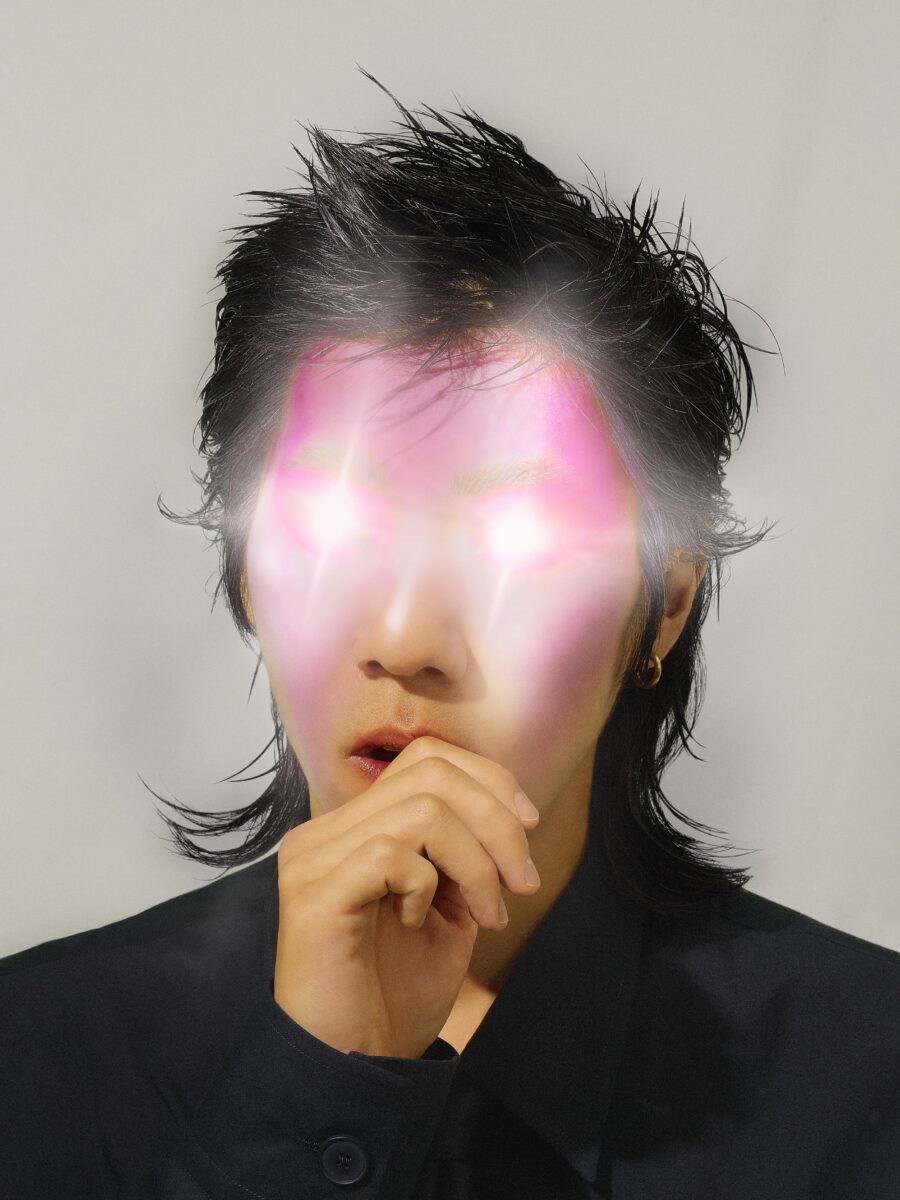
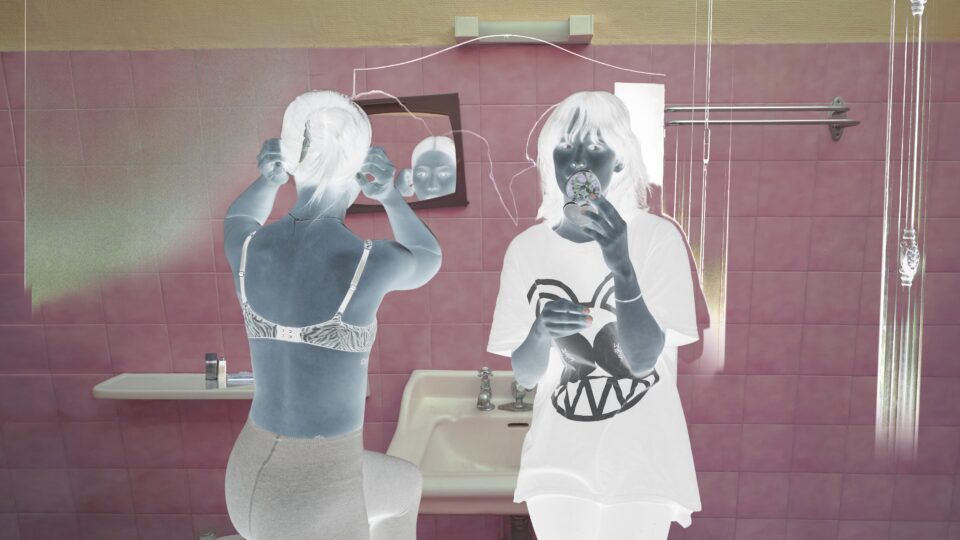
Hua approaches familial intimacy through a more constructed register. Let the Horses Ride (2025), created for the historic Hôtel de la Lauzière in Arles and commissioned by Éditions Louis Vuitton, uses friends to portray members of her family, bringing biological and chosen forms of kinship into the same visual space. In Gossip 1 and 2, inverted colour and brightness values make the figures appear almost illuminated from within. The effect is deliberately uncanny: these are people connected to the artist, yet they appear as figures emerging from another temporal register. Such images suggest memory is not necessarily an act of faithful retrieval but a process in which people, places and relationships are continually reconstructed.
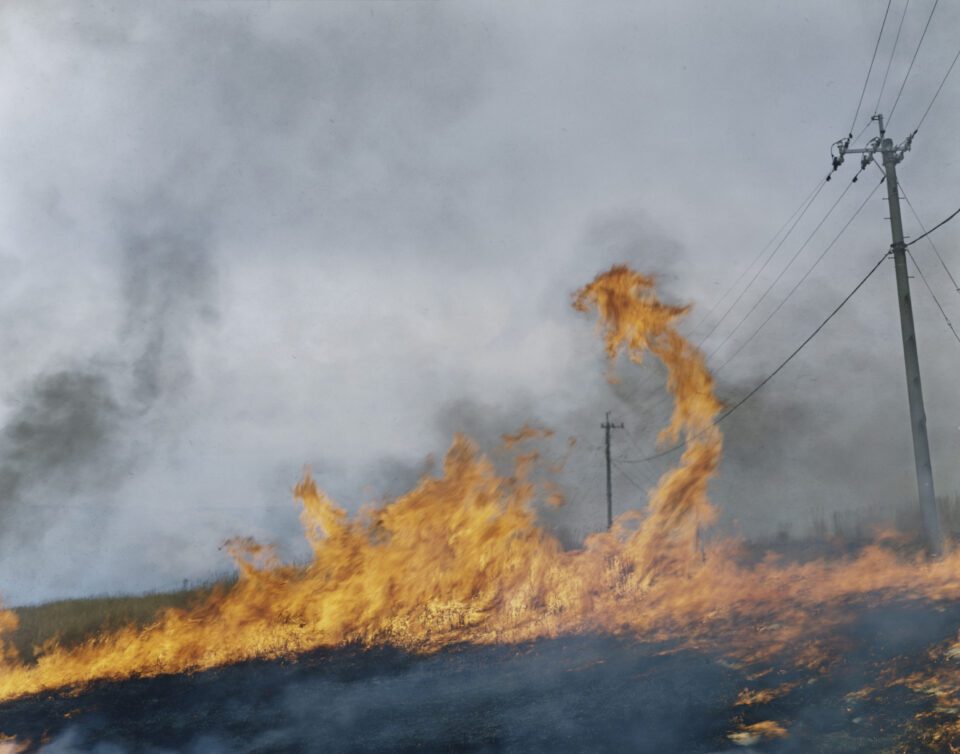
Rinko Kawauchi extends the exhibition’s exploration of inheritance beyond the family. Her Ametsuchi (2012) series turns towards nature, ritual and the repeated practices through which cultural knowledge is carried forward. In the selected Untitled, fire appears simultaneously destructive and regenerative, connecting the image to yakihata, the Japanese tradition of controlled slash-and-burn farming that dates back around 1,300 years. Kawauchi’s attention to seemingly minor phenomena reflects her interest in what she calls the “small voices” of the world – details that can become significant through sustained attention. Placed in dialogue with Hua, the photograph suggests that memory can be embedded not only in albums and portraits but also in ceremonies, landscapes and inherited relationships with place.
Questions about photography’s ability to offer a reliable account of reality are at the heart of this show. Duane Michals’s Things Are Queer (1972) makes that scepticism explicit, constructing a sequence of nine photographs that loops back upon itself. Objects and figures recur at changing scales, creating the impression of an endlessly extending visual space. The work reveals how easily photographic sequencing can manipulate perception, turning apparently straightforward images into a deliberately constructed narrative. Michals therefore provides a conceptual counterpart to Hua’s digitally altered photographs: both expose the photograph as an active form of storytelling over a transparent window onto the world.
Nobuyoshi Araki’s Akt-Tokyo (1971–1991) introduces another form of autobiographical instability. Across an extraordinarily prolific career, Araki has repeatedly returned to images, reusing and repositioning photographs so that their meanings change through context. The six works selected for the exhibition include photographs connected to his wife Yoko, who died young, and their cat Chiro, with some images also appearing in his well-known project Winter Journey. Personal grief sits alongside observations of everyday life, collapsing distinctions between the monumental and the mundane. That movement between private experience and photographic construction makes the work particularly resonant within an exhibition exclusively concerned with how photographs become the carriers of memory.
Such encounters point towards a larger debate around the status of the photographic archive. Museums traditionally confer stability upon images by collecting, preserving and categorising them, yet contemporary artistic practice increasingly questions whose histories those structures have privileged. Archives are being revisited through perspectives shaped by migration, gender, race, family history and lived experience, revealing that preservation is never culturally neutral. One Another engages with this discourse without reducing the selected works to a single political framework. Instead, its strength lies in allowing different forms of photographic knowledge to coexist, showing how an image can acquire new meanings when it is removed from its original context and placed in relation to another practice.
Hua’s role within the exhibition is therefore not simply that of a contemporary artist contributing new work to an established collection. Her practice provides a different way of looking at what is already there. The questions she brings – about displacement, inheritance, chosen family, representation and the unreliability of memory – become a lens through which historical works can be reconsidered. At the same time, the collection complicates Hua’s concerns by placing them alongside artists who have approached intimacy, ritual and photographic truth through radically different methods. The resulting exchange is less about establishing similarity than allowing correspondence and difference to remain in productive tension.
That approach reflects Fotomuseum Winterthur’s wider engagement with photography as a cultural force rather than simply an artistic medium. Since its inauguration in 1993, the museum has examined photography’s influence on how individuals understand themselves and the world around them, presenting between three and five exhibitions each year alongside talks, workshops and digital programming. Its collection contains around 9,000 photographic objects dating from the 1960s to the present-day. Within that institutional context, One Another proposes a collection that is not finished simply because its objects have been acquired and catalogued. Instead, it remains capable of generating new readings as artists, curators and audiences bring different histories to the encounter.
The exhibition leaves the question of memory deliberately unresolved. Hua’s photographs suggest that remembering may require invention, while the works around them demonstrate how photography has repeatedly complicated the boundary between lived experience and constructed narrative. A family album, a staged portrait, a ritual landscape or a conceptual sequence can all become unstable forms of evidence. One Another productively uses instability, allowing images to speak across generations without forcing them into a single story. Fotomuseum Winterthur’s series emerges not as a static record of the past, but as a living structure, acquiring new meanings through the people, histories and images they encounter.
One Another: Nhu Xuan Hua and the Collection of Fotomuseum Winterthur runs until 11 October.
fotomuseum.ch
Words: Simon Cartwright
Image Credits:
1&5 NhuXuanHua_Chen Nhu Xuan Hua, Chen, 2016 © Nhu Xuan Hua, Courtesy of the Galerie Anne-Laure Buffard
2. Sammlung_Rinko Kawauchi Rinko Kawauchi, Untitled, from the series Ametsuchi, 2012 © Rinko Kawauchi, Courtesy of the Christophe Guye Galerie
3. NhuXuanHua_Gossip 2 Nhu Xuan Hua, Gossip 2, from the series Let the Horses Ride, 2025 © Nhu Xuan Hua
4. NhuXuanHua_Be a Super Nhu Xuan Hua, Be a Super, from the series Dear Wind, 2021 © Nhu Xuan Hua, Courtesy of the Galerie Anne-Laure Buffard