The history of modernism has often been written as a story of innovation, formal experimentation and artistic progress, yet many of its defining forms emerged from conditions of displacement, exclusion and forced movement. Noguchi to Asawa: Designing Postwar America at the Barnes Foundation examines this tension through the work of six Japanese American artists whose practices helped shape the visual language of the United States after the World War II. The exhibition considers how incarceration, migration and racial discrimination informed artistic decisions without reducing these figures to narratives of adversity. Furniture, sculpture, textiles and graphic design become evidence of a complex history – one in which personal experience, cultural exchange and material invention intersect. By bringing these artists into dialogue, curator Cindy Kang challenges accounts of 20th century modernism and asks how American design might be viewed differently when viewed through the experiences of those who helped create it.
Following Executive Order 9066 in 1942, approximately 120,000 people of Japanese ancestry were forcibly removed from the West Coast and incarcerated in camps across the United States, including around 80,000 American citizens. The consequences of this policy extended far beyond the years of imprisonment, affecting communities, livelihoods and artistic trajectories long after the camps closed. For artists such as Isamu Noguchi, George Nakashima and Leo Amino, who had already begun their careers before incarceration, the experience disrupted established practices and altered their relationship to place and belonging. For a younger generation including Ruth Asawa, Kay Sekimachi and S. Neil Fujita, the camps became unexpected sites of artistic education, where informal classes and creative communities offered ways of imagining different futures. Kang’s exhibition does not present incarceration as a single defining moment, but as one of many forces that shaped a broader story of artistic development.
Museums are currently reassessing how 20th century art history has been constructed, moving beyond the inclusion of overlooked artists towards a deeper examination of the structures that determined whose work entered the canon. Noguchi to Asawa reflects this wider curatorial shift by positioning Japanese American artists not as peripheral contributors to modernism, but as central participants in its formation. The exhibition’s structure, bringing together two generations across sculpture, furniture, fibre and graphic design, reveals networks of influence rather than isolated achievements. Archival research, family histories and critical scholarship expand the interpretation of each work, allowing objects to be understood simultaneously as aesthetic achievements and cultural records. This approach reflects a growing recognition that art history is shaped by the social conditions that make those objects possible.
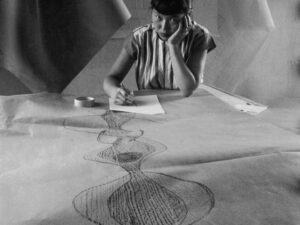
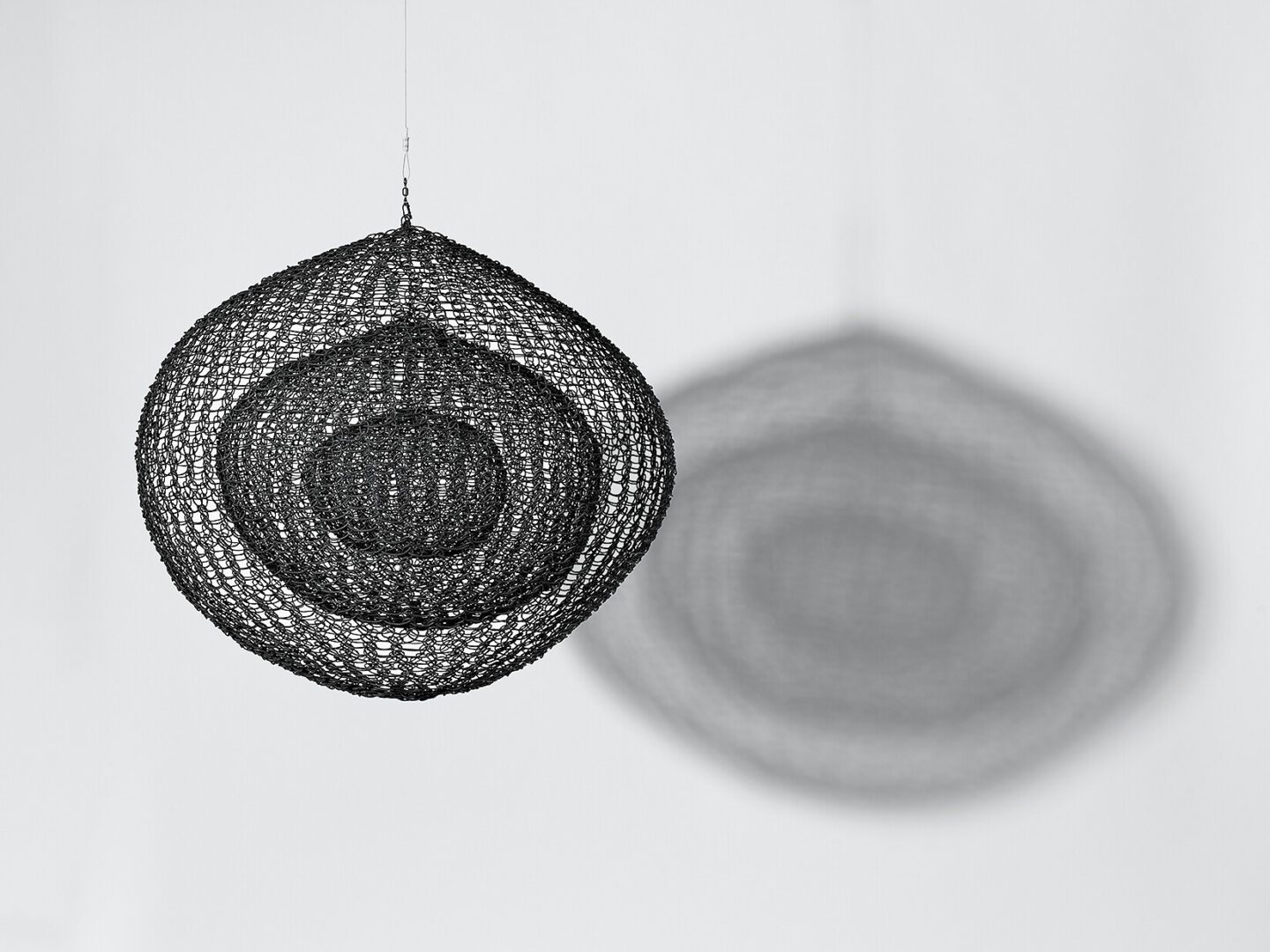
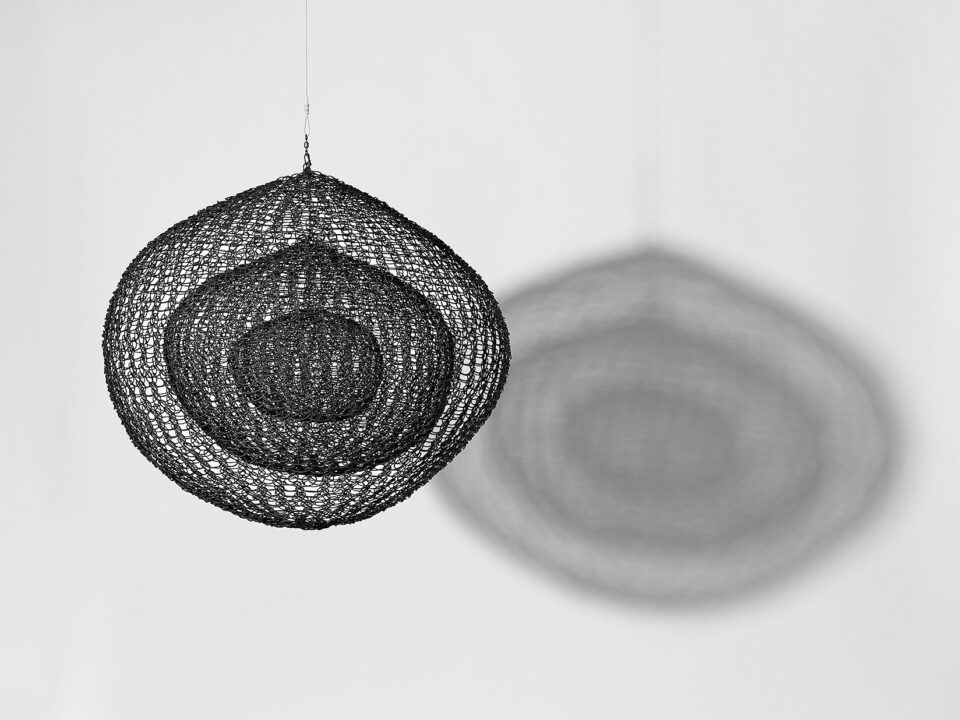
Ruth Asawa provides one of the clearest examples of how personal history and artistic innovation can exist together without one overshadowing the other. Born in California to Japanese immigrant farmworkers, Asawa was incarcerated as a teenager at the Rohwer camp in Arkansas, where she encountered art education before later studying at Black Mountain College. Her suspended wire sculptures have frequently been discussed through the influence of Bauhaus principles and her encounters with figures such as Josef Albers, yet their meaning extends beyond formal experimentation. The repetitive process of looping and weaving reflects broader histories of labour, agricultural work and making, while the use of wire inevitably carries associations with the structures of confinement experienced during the war. Asawa transformed an industrial material into delicate, organic forms that challenge ideas of permanence, revealing how abstraction can contain memory without becoming representational.
Material becomes a language of displacement and renewal throughout the exhibition. Isamu Noguchi’s My Arizona (1943), created after his time at the Poston incarceration camp, transforms the desert landscape into an abstract meditation on geography, isolation and belonging. Noguchi entered Poston voluntarily, hoping to contribute to improving conditions for those imprisoned there, but soon found himself subject to the same restrictions as the community around him. The sculpture does not illustrate incarceration directly; instead, its sparse surfaces and unusual forms evoke the psychological experience of being suspended between places. Noguchi’s work demonstrates that modernist abstraction was never separate from politics, but often provided artists with a way to explore uncertainty, identity and historical rupture.
These questions around memory, place and the aftermath of conflict extend beyond the Barnes exhibition and reflect a wider international reassessment of postwar cultural histories. At Japan House London, Kyotographie: Kawada Kikuji x Iwane Ai explores photography’s ability to register the traces of historical trauma, bringing together Kawada Kikuji’s reflections on postwar Japan with Iwane Ai’s contemporary engagement with landscape, community and identity. Although working across different contexts, the exhibition shares an interest in how histories remain embedded within images and environments. Such connections demonstrate a broader curatorial movement: institutions are increasingly examining not only what is represented, but how memory, politics and identity influence the ways histories are constructed.
George Nakashima’s furniture offers another perspective on how displacement could be transformed into creative practice. His Milk House Coffee Table (1944), produced after leaving the Minidoka incarceration camp and establishing a workshop in Pennsylvania, carries the traces of a disrupted life and a process of rebuilding. Using teak preserved by his friend Morris Graves, Nakashima created an object that connected personal history with the natural qualities of wood itself. His refusal to conceal knots, cracks and irregularities challenged industrial ideals of perfection, proposing instead that material variation could become a source of meaning. Within the exhibition, furniture is not treated as secondary to sculpture, but as an artistic language through which questions of identity, labour and modern living are negotiated.
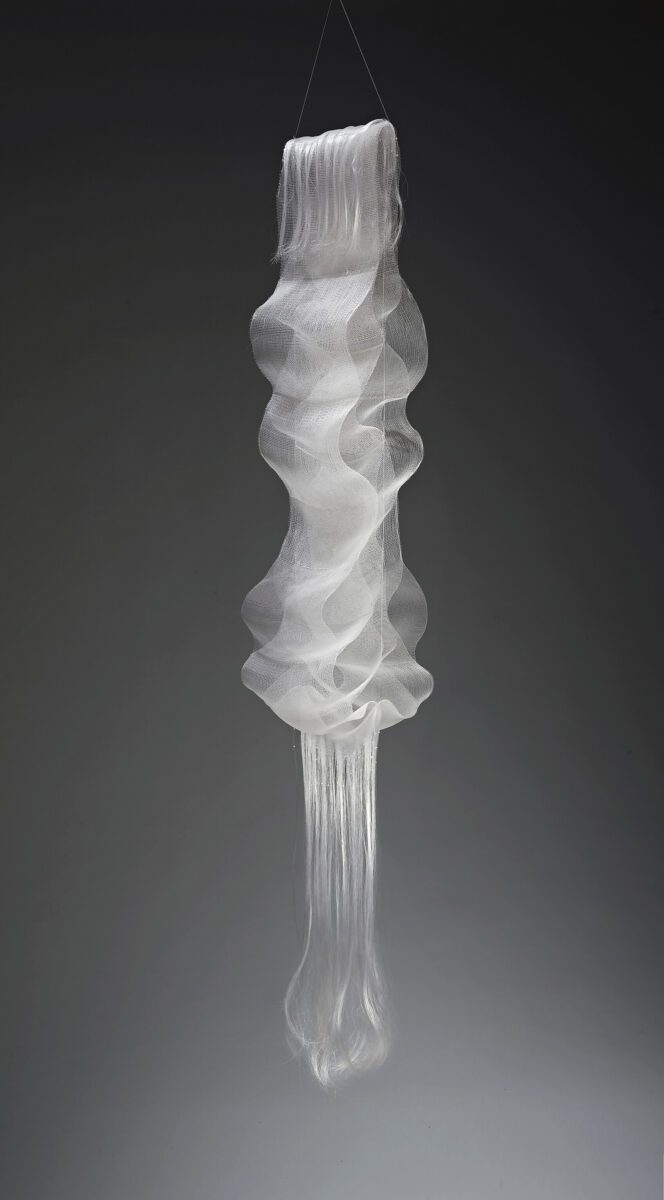
Craft has traditionally occupied an uncertain position within histories of modern art, often separated from sculpture, painting and other forms considered more culturally prestigious. Noguchi to Asawa challenges these distinctions by showing how fibre, furniture and domestic objects participated in the same experimental conversations as more established forms of modernism. Kay Sekimachi’s transparent monofilament weavings demonstrate this expanded understanding of material practice. Works such as Kunoyuki (c. 1968) create shifting structures that appear almost invisible, reflecting both formal concerns around space and wider questions of visibility within Asian American identity during the late 1960s. Sekimachi’s work suggests that subtlety and restraint can be radical artistic positions.
The relationship between design and popular culture is further explored through S. Neil Fujita, whose graphic work helped define the visual language of American music and publishing during the 20th century. His album cover for Dave Brubeck Quartet’s Time Out (1959) introduced modernist abstraction to a mass audience, combining geometric forms with influences drawn from his experiences of travel and military service in Asia and the Pacific. Fujita’s career demonstrates how Japanese American artists shaped everyday visual culture, not only within museums and galleries but through objects encountered in ordinary life. Alongside Leo Amino’s experimental use of plastics, his work expands the exhibition’s argument beyond fine art categories. Modernism appears here as something lived with and experienced.
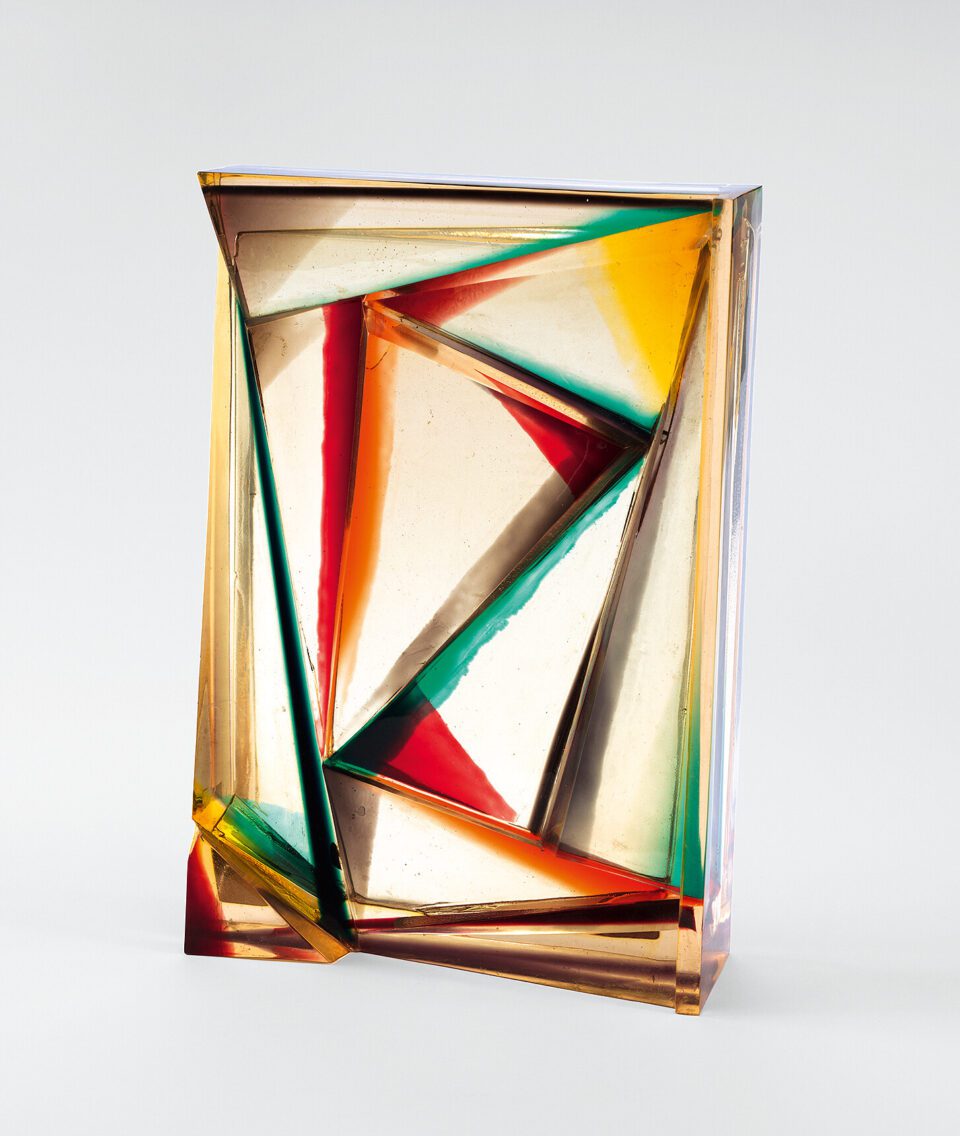
Amino’s sculptures also complicate familiar narratives of postwar abstraction by focusing on intimacy rather than monumentality. His Refractional series explores transparency, colour and perception through small-scale works that invite close engagement. Drawing upon synthetic materials developed through wartime industry, Amino connected artistic experimentation with scientific and technological change. His practice demonstrates that innovation did not always emerge through large gestures or ambitious scale, but through careful attention to material behaviour and visual experience. These works reinforce the exhibition’s wider argument that design history is shaped by diverse forms of experimentation.
The reassessment of Japanese American artistic contributions forms part of a larger reconsideration of whose voices have shaped modern culture. The Photographers’ Gallery in London’s presentation Japanese Women Photographers: From 1950s to Now similarly examines how established narratives of postwar photography have often overlooked significant practitioners. Rather than simply adding previously excluded artists to an existing framework, such exhibitions question the framework itself, revealing how gender, ethnicity and geography have influenced historical visibility. Viewed alongside Noguchi to Asawa, the exhibition reflects a broader institutional movement towards more complex and inclusive accounts of modernism. The focus is not only recovery, but revision.
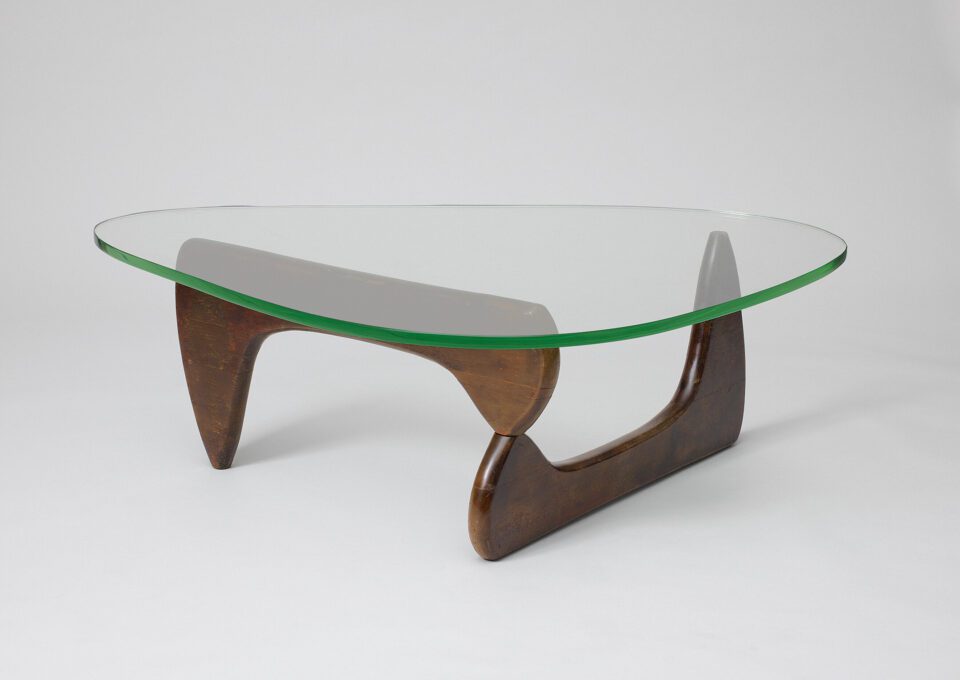
The significance of the Barnes exhibition lies in its refusal to separate Japanese American history from the wider story of the United States. The objects presented are not isolated cultural artefacts; they became part of everyday American experience, shaping domestic interiors, commercial design and public imagination. A coffee table, a woven sculpture, a record sleeve or a suspended form can therefore carry multiple histories at once – aesthetic, political and personal. Kang’s curatorial approach reveals how these artists contributed to American modernism while also challenging the assumptions through which that history has been understood. Their work was not produced outside the mainstream; it helped define it.
Noguchi to Asawa: Designing Postwar America offers a more expansive vision of modernism, one shaped by movement, adaptation and cultural exchange. The exhibition acknowledges the realities of incarceration and discrimination while refusing to allow those experiences to become the sole interpretation of these artists’ achievements. Instead, it presents creativity as a means through which individuals negotiated changing ideas of identity, belonging and place. At a moment when museums are reconsidering the histories they have inherited, the Barnes provides a model for how exhibitions can combine rigorous scholarship with a deeper understanding of lived experience. The result is not simply a reassessment of six important artists, but a reconsideration of how modern America itself was designed.
Noguchi to Asawa: Designing Postwar America is at Barnes Foundation, Philadelphia from 20 September to 10 January: barnesfoundation.org
Words: Anna Müller
Image Credits:
1&5. Ruth Asawa, Untitled 1952.
2. Lee Amino, Refractional 21.
3. Kay Sekimachi, Ogawa II.
4. Isamu Noguchi, Model IN-50 Coffee Table.