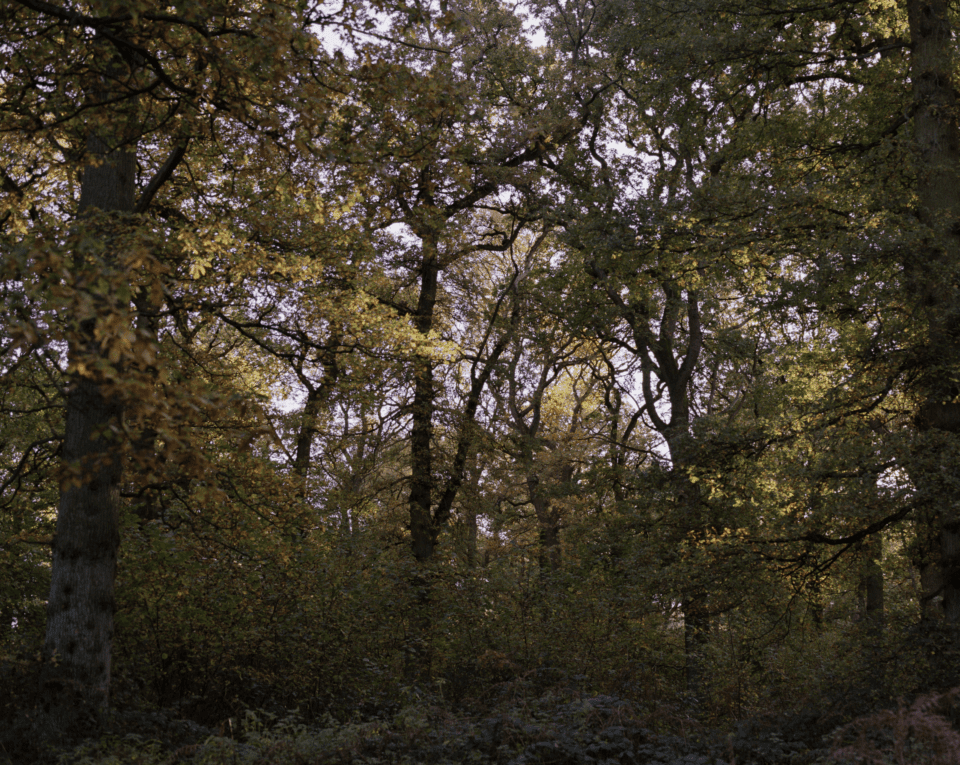
A recent study from the UK government found that loneliness in rural areas is getting worse. According to the University of Birmingham, “loneliness and social isolation are major contributors to ill health, both mental and physical.” Photographer Clare Hewitt’s latest project responds to this growing sense of disconnection. Everything in the forest is the forest celebrates trees and their remarkable ability to communicate and build communities. Setting up a studio with a circle of 12 oak trees, Hewitt documented the forest and its seasonal changes, exploring plant relationships through a range of sustainable photography techniques. The series is now on display at Midlands Art Centre in Birmingham. We caught up with the artist to discuss all things trees and find out what it means to put on a sustainable exhibition.
A: Everything in the Forest is the Forest was inspired by a government report that suggested loneliness was increasing in rural areas of the UK. How did this idea spark the project?
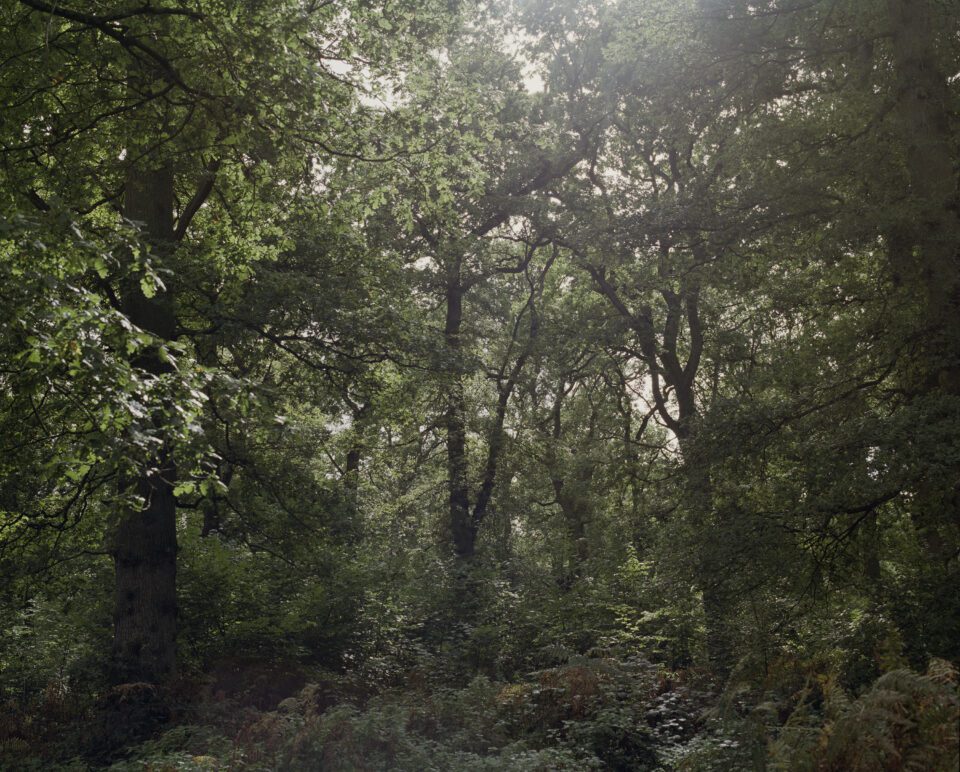
CH: At the same time I was researching issues of loneliness and isolation in the UK, I was also learning that trees thrive in communities and communicate through a range of methods that have evolved over time. I was interested in the idea that whilst people in rural areas were potentially increasingly disconnected, the forests and woodlands they lived around were flourishing through connection. I wondered what we could learn from the unity of the forest to improve social circumstances for ourselves. Writers such as Robin Wall Kimmerer, Isabella Tree, Peter Wohlleben, and later Suzanne Simard inspired me to want to study arboreal behaviour. I discovered The Birmingham Institute of Forest Research (BIFoR FACE), a Free Air Carbon Enrichment facility located in Staffordshire, which studies the impact of climate change on woodlands and trees, and began collaborating with them.
A: How did your collaboration with The Birmingham Institute of Forest Research shape the project?
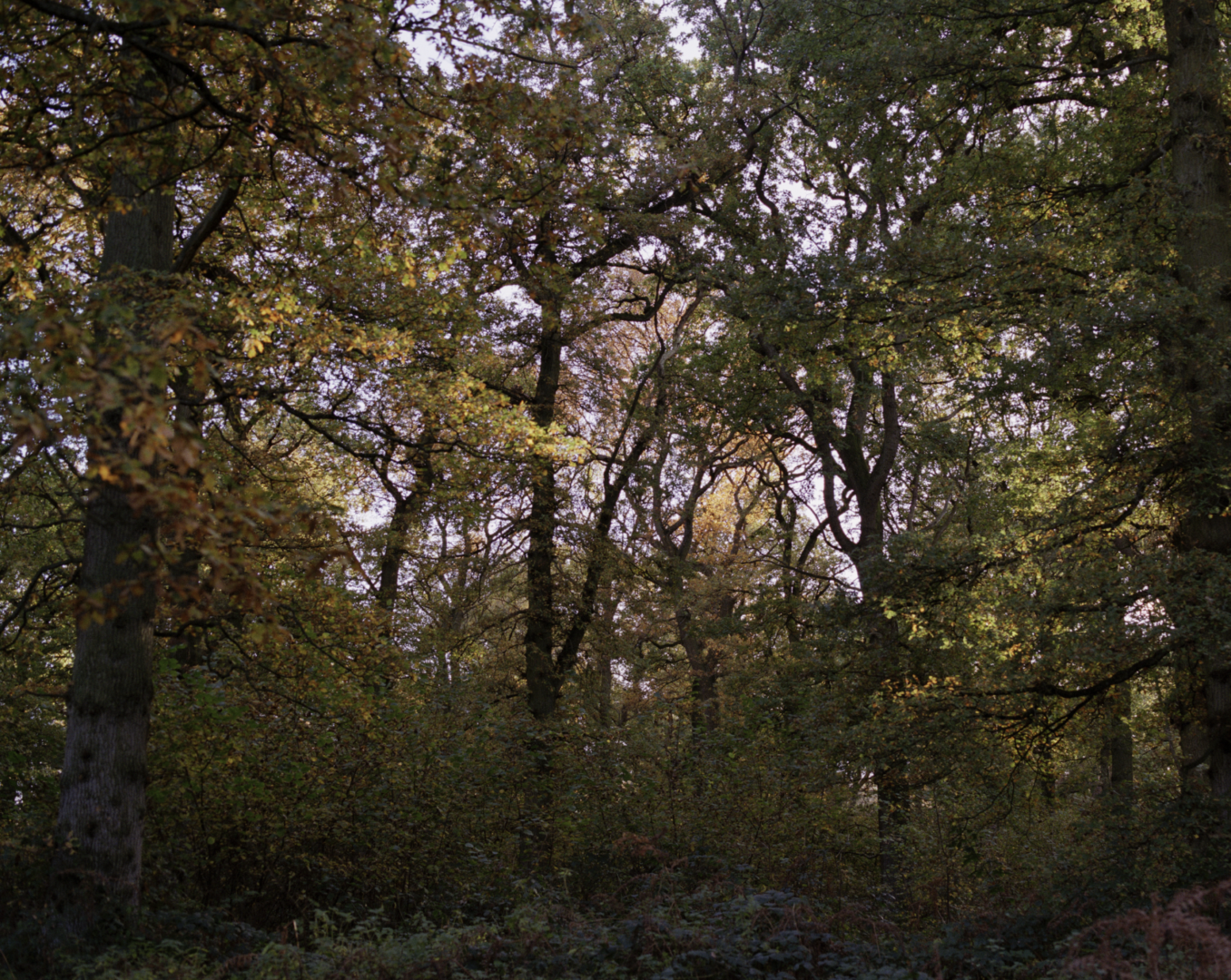
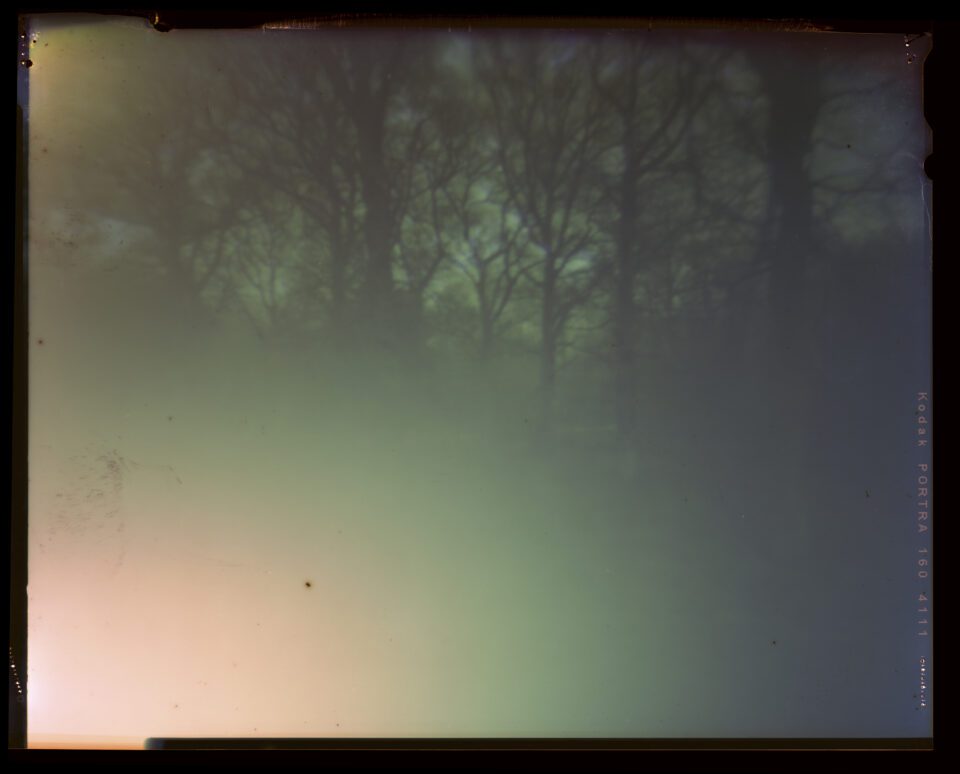
CH: I agreed with the staff at The Birmingham Institute of Forest Research that I would care for and sustain the ecosystem by not removing anything from it. Consequently, I worked entirely within a circle of 12 oak trees on the site, which encouraged me to be much more environmentally aware and considerate. It was important that the techniques I used could gently become a part of the forest. This included working with Birmingham City University’s STEAMhouse to design and make 24 wooden pinhole cameras, resembling birdboxes, and collaborating with tree surgeons to install two into each tree. The cameras each contained a piece of 5×4” large format film, and captured exposures from six-months to four-years in duration. In Isabella Tree’s book Wilding, I read that mature oak trees individually produce 700,000 leaves every year, which photosynthesise, and then drop to the floor in autumn to turn into mulch and soil that nourishes the tree. Then the cycle begins again. I wanted to honour this process, so I made hundreds of oak leaf lumen prints using expired darkroom paper. The leaves were returned to the environment after exposure. I also created soil chromatographs, panoramic images of the subterranean world using a minirhizotron camera, trail camera imagery and videos; branch paintings with oak gall ink; letters to the trees; a visual journal; and a 360° sound piece of the dawn chorus. I learnt to mirror the behaviour and values of the forest, and implemented those into my creative practice and personal life.
A: What can trees teach us about creating and nurturing a community?
CH: In the Foreword of Orion magazine’s publication, Old Growth, Robin Wall Kimmerer articulates this beautifully, writing: “We are not trees. We lack their stillness, their presence, the generosity that comes from spinning sunlight to sugar. To stand in stillness for centuries requires ingenuity in harnessing physical forces and genius for collaboration. They learned long ago that the key to life as a sessile being is to cultivate good relationships. That all flourishing is mutual, especially when you can’t run away.” Growing, living and dying in the same space, alongside the same neighbours for hundreds of years must create an understanding of community that we find challenging to comprehend. The perspective of the tree must be one rooted in interdependence, rather than choice. The community values that I noticed in the forest were based in circularity and longevity, recognising that trees honour the seed as well as the weak elder, and understand that the future of the forest depends on collective wellbeing, gift economies, resilience and adaptation. Everything is based on reciprocity, nourishment and shared survival, “we” rather than “I.”
A: Talk us through the practicalities of creating the series. What was it like to document the forest?
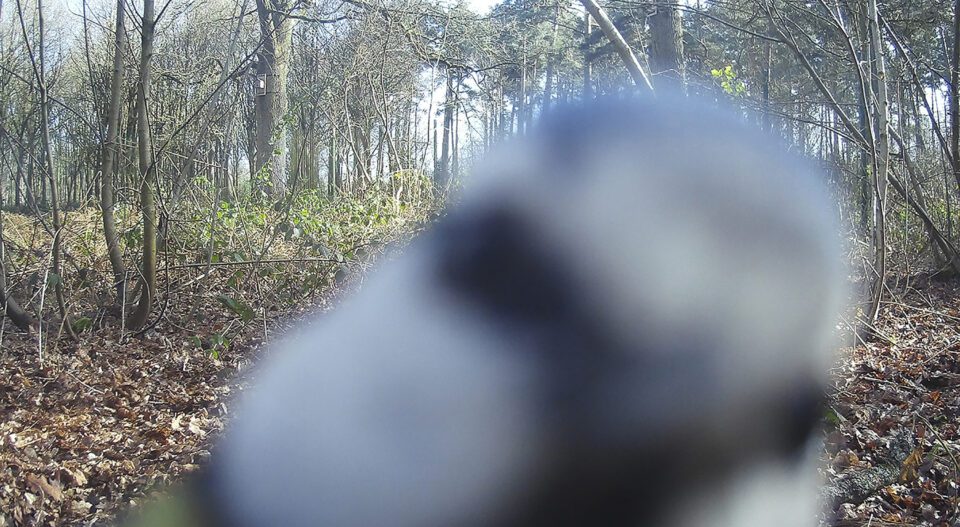
CH: At first, I found it challenging to know where to start. The ferns grow taller than me, and I was uncertain about navigating the space. I started writing to the trees to build a relationship. Reading other people’s experiences of spending time with the natural world helped me navigate my own situation. In The Living Mountain, Nan Shepherd discusses her experience of “being with” the Cairngorms in Scotland, so I visited as often as possible and began to embody my own understanding of “being with.” I made oak leaf lumen prints every time I went and photographed a scene from the same perspective, to give myself consistency. Now, I feel lucky to have got to know the space so well that I miss it when I’m not there.
A: How did sustainability guide the creation of this exhibition?
CH: Sustainability guided the exhibition at every stage, from the materials and processes I used, to the partnerships that helped bring the work into being. As I spent more time in the forest, I became increasingly interested in how its systems operate through reuse, regeneration, and interconnected relationships. I wanted the exhibition to embody those principles rather than simply represent them. The exhibition was first shown at Impressions Gallery in Bradford as part of UK City of Culture 2025 and has since toured to 20-21 Visual Arts Centre in Scunthorpe and the Midlands Arts Centre in Birmingham. Throughout its production, I worked with organisations committed to developing more sustainable approaches. For example, a wall of 300 oak leaf lumen prints was created on handmade paper produced by Fibrelab from 100% recycled cotton textile waste. I also collaborated with The Wood Shack, a Birmingham-based social enterprise that salvages and repurposes unwanted timber. Together with artist Jamie Murray, we worked with apprentices to make exhibition frames from reclaimed scaffolding boards, while additional frames were reused from previous Impressions Gallery exhibitions. Sustainability also informed the photographic processes. Bark portraits were hand-printed on expired darkroom paper and developed using homemade chemistry made from oak leaves and mint, from film processed in rosemary. Recyclable prints were produced with Generation Press, and reclaimed paint was used on the gallery walls. Equally important was the collaborative nature of the project. Working with people from different disciplines demonstrated how environmental responsibility can be embedded within exhibitions through shared knowledge and collective action. To support transparency and encourage wider change, all these decisions and processes were documented in a free publicly available report.
A: Your “birdbox” pinhole cameras remained attached to the trees for up to four years. What did those extended exposures reveal that a conventional photograph couldn’t?
CH: The cameras and the film became part of the forest’s environment. Spiders and moths nested in the cameras, and so they became a temporary home. Usually, we try to keep everything dry and clean, but the sheets of film in the cameras were impacted by moisture and heat, and this is clearly visible on the works. The patterns that have formed are spore-like. Sometimes the images are quite clear and at other times they are abstract, so the outcomes became experimental and uncertain. The images depict heartbeats in the lives of these 180-year-old oak trees, which were acorns when photography was born, and are a comment on the difference between human and arboreal experiences of time, place and history.
A: Your work suggests that trees hold memory, intelligence and even wisdom. Do you think contemporary society underestimates non-human life?
CH: Yes, absolutely. In Marchelle Farrell’s Uprooting, she discusses personally and profoundly how our inner landscapes are reflected in our external landscapes. It is no surprise then that when we are disconnected from the land, we forget how much we can learn from, learn with, and look after it in the same way that it nourishes and nurtures us as human beings. I find it devastating to observe and experience the negative impact we are having on our collective home.
A: What surprised you the most whilst making this project? Did you come across anything unexpected?
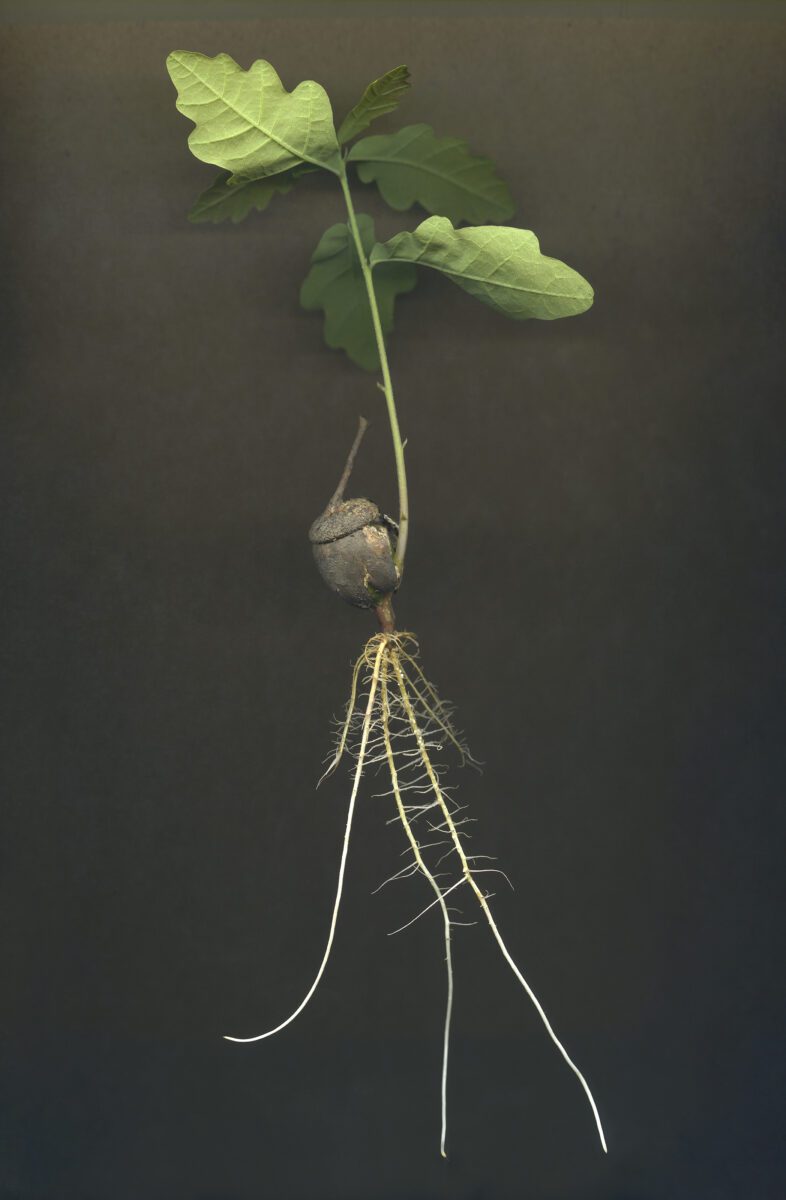
CH: I began the project thinking that I was making work about loneliness and isolation, and hoping to find some behaviours in the forest that could inspire change in our communities. What I’ve realised is that the forest holds the answers to so many of the problems we’re experiencing globally, from climate change to conflict. All we need to do is respect the natural world, spend time with it and learn from it.
A: Has existing so closely with the forest changed any of your own habits or behaviours?
CH: Yes, profoundly. It encouraged me to pay closer attention to the natural world and to recognise that the changes taking place around us are both remarkable and fleeting. On a practical level, it inspired changes in my daily life. I now have an allotment where my daughter and I grow food and flowers together, and I’ve learnt how to compost and work more closely with seasonal rhythms. I’ve developed a much deeper appreciation for each season and the subtle transformations they bring. The forest has also altered my creative practice. Rather than simply photographing these systems of reciprocity and regeneration, I began asking how my work could embody them. That led to the creation of a biodegradable photobook. Every element of the book was created using biomaterials developed specifically for the project, including paper containing birch polypore mushrooms, screen-printing ink made from oak galls and allotment-grown spun linen thread. Because the materials are seasonal and handmade, the edition size was determined by what could be produced responsibly, rather than by commercial demand. The piece separates into 12 individual mini-books that were designed to be borrowed, shared and passed on through a national community distribution network, rather than bought and owned. Like the forest itself, the project relies on reciprocity, encouraging new relationships and exchanges as each custodian shares it with others. The book also includes a collaboratively written text by Kerri ní Dochartaigh, Marchelle Farrell and Jessica J. Lee, whose contributions unfold sequentially, reflecting ideas of collective authorship and passing knowledge from one person to another. Ultimately, the book is designed to complete its own cycle and return safely to the earth, much like a leaf returning nutrients to the forest floor.
A: How do you want audiences to feel when they leave the show?
CH: I try to step out the way of people’s responses, but all I can hope is that the exhibition conveys the respect and compassion I’ve nurtured for those 12 oak trees and their ecosystem.
Clare Hewitt: Everything in the forest is the forest is at Midlands Art Centre, Birmingham until 31 August: macbirmingham.co.uk
Words: Emma Jacob & Clare Hewitt
Image Credits:
1&6. The Peace Tree: Autumn © Clare Hewitt.
2. The Peace Tree, Summer © Clare Hewitt.
3. Camera trap images, Blue Tit collecting spiders webs to build their nest © Clare Hewitt.
4. Six month to four year long exposure made in birdbox pinhole camera © Clare Hewitt.
5. Acorn Germination © Clare Hewitt.