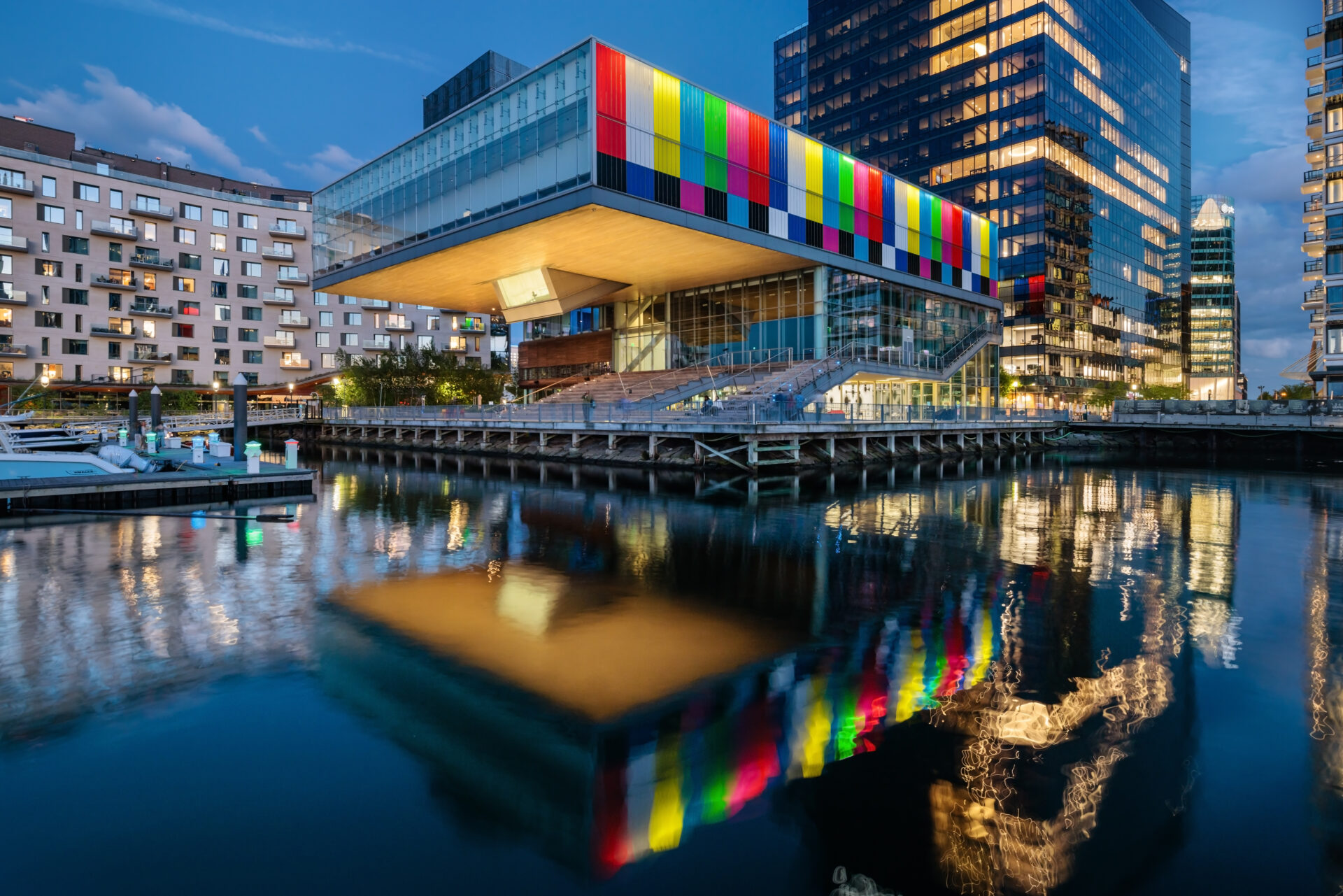
The waterfront in Boston has long functioned as a threshold between histories, industries and futures. Along the Seaport, glass-fronted developments rise beside the harbour’s shifting tides, creating a landscape where architecture and public life intersect with increasing ambition. At the centre of this evolving district sits the Institute of Contemporary Art/Boston, its cantilevered structure projecting dramatically over the water and serving as one of the city’s most recognisable cultural landmarks. Since opening its waterfront home in 2006, the museum has transformed the area into more than a destination for tourism and leisure; it has become a site for experimentation, civic engagement and contemporary cultural discourse. Against the backdrop of Boston Harbour, the ICA continues to explore how art can move beyond the gallery and into the everyday rhythms of urban life.
The ICA has emerged as one of the defining voices in contemporary art intertwined with urban renewal and cultural reinvention. Over the past two decades, its programme has established an international reputation for championing ambitious artistic practices and amplifying urgent cultural conversations. Through exhibitions, performances and educational initiatives, the museum has consistently foregrounded artists at pivotal moments in their careers, often presenting projects that resonate far beyond New England. Its influence extends across an increasingly interconnected cultural landscape, contributing to wider discussions around identity, community and artistic innovation. In doing so, the ICA has become a model for how museums can operate simultaneously as cultural incubators and civic platforms. Its latest commission extends this vision into the public realm with renewed confidence.
Today, that commitment to expanding the possibilities of contemporary art reaches beyond the gallery walls and into the city itself. The ICA’s first major façade commission invites multidisciplinary artist Derrick Adams to transform the museum’s exterior into a monumental artwork visible across the waterfront. Presented in conjunction with the survey exhibition Derrick Adams: View Master, the project reimagines the institution’s iconic building through a bold adaptation of the Society of Motion Picture and Television Engineers (SMPTE) test pattern, more commonly recognised as television colour bars. Stretching across the façade, the installation introduces a vibrant chromatic presence to the harbour skyline. Complementing the intervention are Adams’s Funtime Unicorn riders, a series of interactive sculptures positioned near the entrance that encourage visitors to engage, play and participate. Together, the works dissolve traditional distinctions between architecture, sculpture and public encounter.
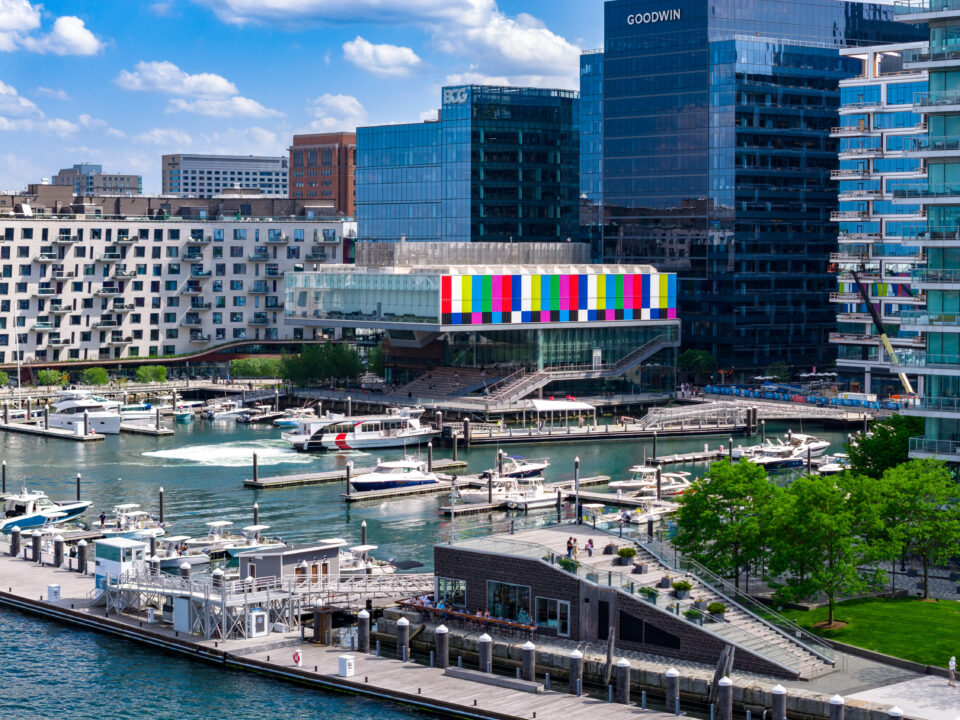
Beneath the work’s striking visual immediacy is a deeper enquiry into the mechanics of representation. For more than a decade, Adams has returned to the visual language of broadcast television, examining its role in constructing cultural narratives and public identity. The façade commission draws upon this ongoing investigation, transforming a familiar technical image into a platform for reflection and dialogue. “Television was my first classroom. Since 2014, I have incorporated colour bars into my work as background and wall treatment to explore pivotal shifts and moments in Black television from the 1970s through the 1990s,” said Adams. The statement reveals the conceptual foundations underpinning the project, situating it within a broader exploration of visibility and cultural memory. By scaling the motif to architectural proportions, the artist transforms a once-functional graphic into a powerful public gesture.
What initially appears as a graphic intervention soon reveals itself as a meditation on the systems through which culture is transmitted and understood. “The colour bars signal that something has been switched ‘on.’ Wrapping the ICA’s facade in this vibrant pattern sparks a necessary dialogue about representation in contemporary culture and the systems that shape how we see,” Adams explains. The observation points towards one of the commission’s central achievements. While the installation is undeniably exuberant, it also prompts reflection on the mechanisms that determine whose stories are seen, shared and remembered. Colour bars traditionally signify transmission and connectivity; here they become metaphors for cultural access and recognition. Installed on one of Boston’s most prominent waterfront sites, the work transforms the building into both beacon and conversation starter.
The project signals more than a new chapter for Adams’s public practice; it also reflects a broader evolution in the museum’s ambitions. As cultural institutions increasingly seek meaningful forms of public engagement, the ICA positions itself at the forefront of this conversation. “Whether through intimate portraits or large-scale public projects, Adams offers compelling narratives of affirmation and celebration. His engaging and uplifting work, including the first major artwork to occupy the ICA’s facade, invite audiences from across the city to experience Adams’s joyful and visionary practice,” said Nora Burnett Abrams, Ellen Matilda Poss Director at the ICA. Her remarks highlight the artist’s ability to navigate multiple scales while maintaining a commitment to accessibility and optimism. The commission demonstrates how contemporary art can foster dialogue without sacrificing visual immediacy.
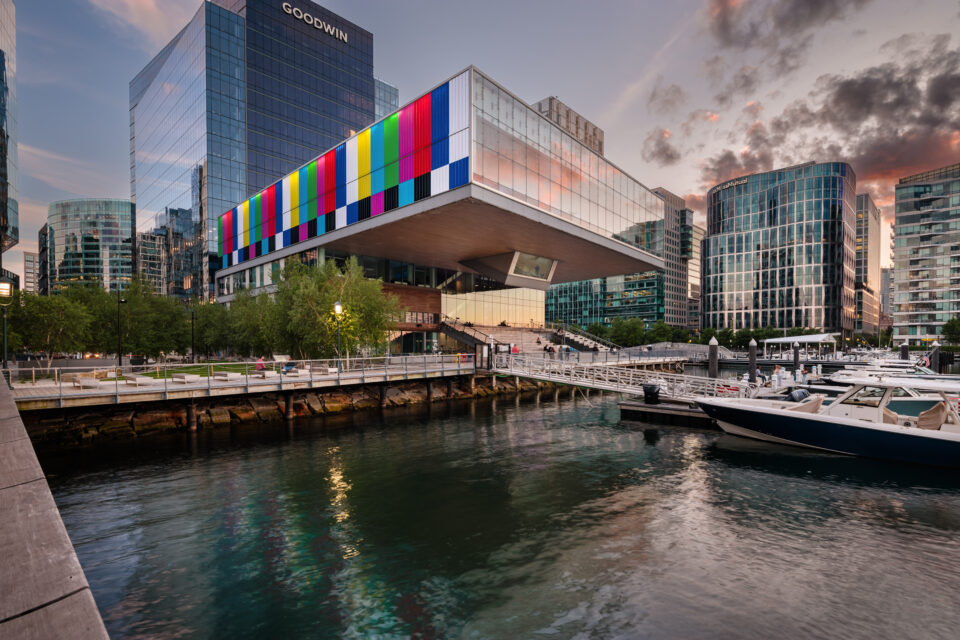
Seen in this context, the façade commission functions as both artwork and manifesto. Looking beyond the immediate impact of the installation, the project points towards a wider institutional vision centred on openness and participation. “We envision this as the first of many exterior projects to come, bringing art outside the museum to expand our welcome and engage the public in new and meaningful ways,” Abrams continues. The statement reflects a significant shift occurring across the global museum sector, where institutions are increasingly reconsidering their physical and conceptual boundaries. Public space offers opportunities for engagement that traditional gallery environments cannot always provide. With its dramatic waterfront location, the ICA is uniquely positioned to explore these possibilities.
Adams’s intervention belongs to a broader lineage of artists who have transformed public space into a site of encounter, reflection and cultural critique. Through colour, scale and participation, these practitioners challenge audiences to reconsider their relationship to the built environment. One particularly compelling comparison can be drawn with Katharina Grosse, whose expansive interventions envelop architecture and landscape in sweeping fields of colour. Like Adams, Grosse uses chromatic intensity to alter perception and redefine the boundaries between artwork and site. Yet where Grosse often embraces abstraction, Adams anchors colour within specific histories of media representation and Black cultural experience. Both artists demonstrate the capacity of colour to function as a powerful social and psychological force.
Elsewhere, experiential installations have demonstrated how participation itself can become a medium. Olafur Eliasson has built an internationally celebrated practice through works that encourage viewers to become active participants rather than passive observers. His large-scale environments foreground experience, movement and collective encounter, transforming spectators into collaborators. Adams adopts a similar ethos through the Funtime Unicorn sculptures, which invite physical interaction and playful engagement. In both cases, participation becomes a means of generating dialogue and connection. The artwork exists not solely as an object but as a catalyst for shared experience.
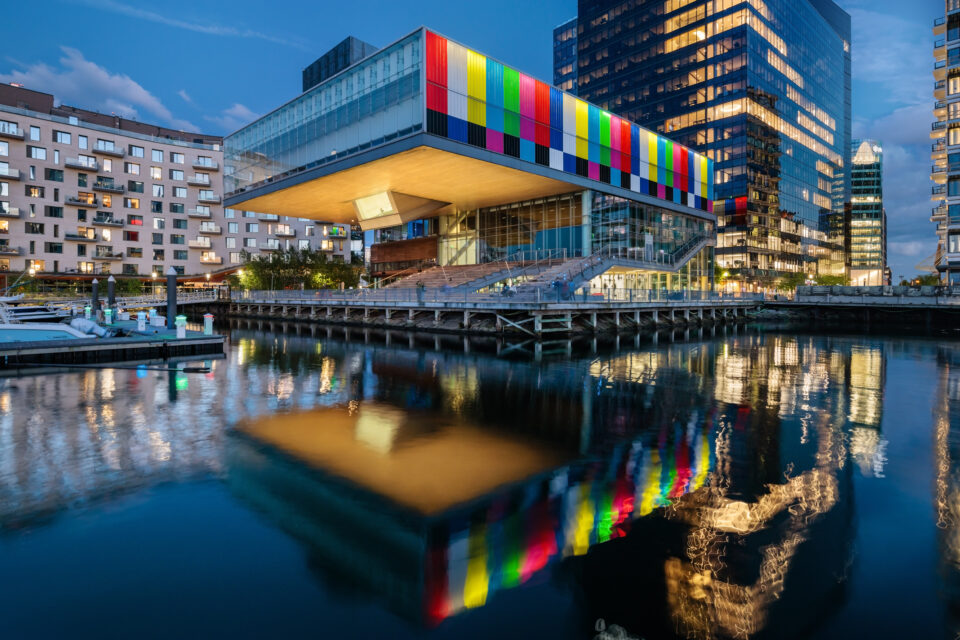
Questions of civic transformation offer another useful point of comparison. Theaster Gates has consistently explored how artistic interventions can reshape perceptions of place and generate new forms of communal engagement. His projects demonstrate the potential of culture to act as an agent of urban renewal and social cohesion. Adams’s commission operates within a different visual language, yet shares a comparable investment in visibility, accessibility and public participation. By occupying a highly visible site along the waterfront, the work reaches audiences who may never cross the threshold of a museum gallery. Its impact lies not only in what it represents but also in whom it invites into the conversation.
The waterfront commission gains additional resonance when considered alongside Derrick Adams: View Master, the artist’s major survey at the ICA. Bringing together more than 100 works spanning over two decades, the exhibition reveals the breadth of a practice committed to celebrating the richness and complexity of contemporary Black life. Across painting, sculpture, collage, performance, video and public projects, Adams has consistently transformed everyday moments into powerful cultural iconographies. The façade installation extends these concerns beyond the exhibition space and into the city itself, amplifying themes of joy, representation and visibility on an unprecedented scale. It transforms the museum from a container of art into an active participant within the urban landscape. In doing so, it demonstrates the capacity of contemporary art to shape civic experience.
More than a transformation of architecture, the commission proposes a new way of thinking about the relationship between art, public space and collective experience. At a moment when questions of visibility, access and representation continue to shape contemporary discourse, Adams offers a vision that is both celebratory and critically engaged. The project asks how institutions can become more porous, how public space can foster meaningful encounters and how cultural narratives might be expanded through acts of artistic intervention. By turning a familiar broadcast symbol into a monumental architectural statement, Adams creates a work that is simultaneously playful, provocative and deeply resonant. The installation redefines the ICA’s presence on the Boston waterfront whilst establishing a compelling model for public-facing museum practice. In the years ahead, its legacy may lie in demonstrating how art can activate both a building and a community, switching something on within the city itself.
Derrick Adams: View Master is at ICA, Boston Until 7 September: icaboston.org
Words: Shirley Stevenson
Image Credits:
1&4. Derrick Adams: View Master at ICA, Boston. Photo: Roberto Farren Photography.
2. Derrick Adams: View Master at ICA, Boston. Photo: Roberto Farren Photography.
3. Derrick Adams: View Master at ICA, Boston. Photo: Roberto Farren Photography.