For as long as humans have been making art, they have looked to celestial bodies for inspiration. The oldest example is the Nebra Sky Disk, believed to be 3,600 years old, dating from the Bronze Age. It is the world’s oldest map of the stars. Across centuries, artists have used the sun and the moon to explore power, divinity and emotion, from Egyptian recreations of the sun as the god Ra to Medieval Christian artists using sunlight to represent divine order. Romantic painters took the moon as the ultimate symbol of the sublime, such as in Caspar David Friedrich’s Two Men Contemplating the Moon (1825), whilst later Impressionists used the sun to capture fleeting moments, most famously in Claude Monet’s Impression, Sunrise (1872). Cut to the 21st century, and 2.2 million people visited Olafur Eliasson’s The Weather Project during its six-month run at Tate Modern. The immersive installation used mirrors to create the illusion of a sun.
Now, this rich strand of art history is the subject of a new show at Saatchi Gallery. The Sun and the Moon is a major exhibition exploring how the two most powerful and enduring phenomena in the sky have inspired creativity, curiosity and belief throughout human history and across different cultures. The show is truly impressive in scale, occupying two floors and nine major exhibition spaces in the gallery. Each area reflects a period of the day, with the experience unfolding like a 24-hour cycle, moving from dawn through daylight and into the depths of the night. Artworks explore themes like mythology, ritual, timekeeping, lunar exploration and spirituality, revealing how these celestial bodies shape our daily lives.
Works by Patrick Caulfield, Barbara Hepworth and Sinta Tantra introduce the exhibition before the journey begins at Dawn, which includes pieces exploring how early cultures rationalised the Sun and Moon as deities and cosmic forces. These celestial bodies were woven into myths and belief systems as symbols of power. Here, visitors encounter rare historical artefacts ranging from the Sol Invictus Celtic Bust, believed to be around 2,000 years old, to a faithful replica of the Nebra Sky Disc. These ancient items are placed in direct dialogue with emerging contemporary artists such as Sunju Jin, Jai Khanna and Lian Zhang.
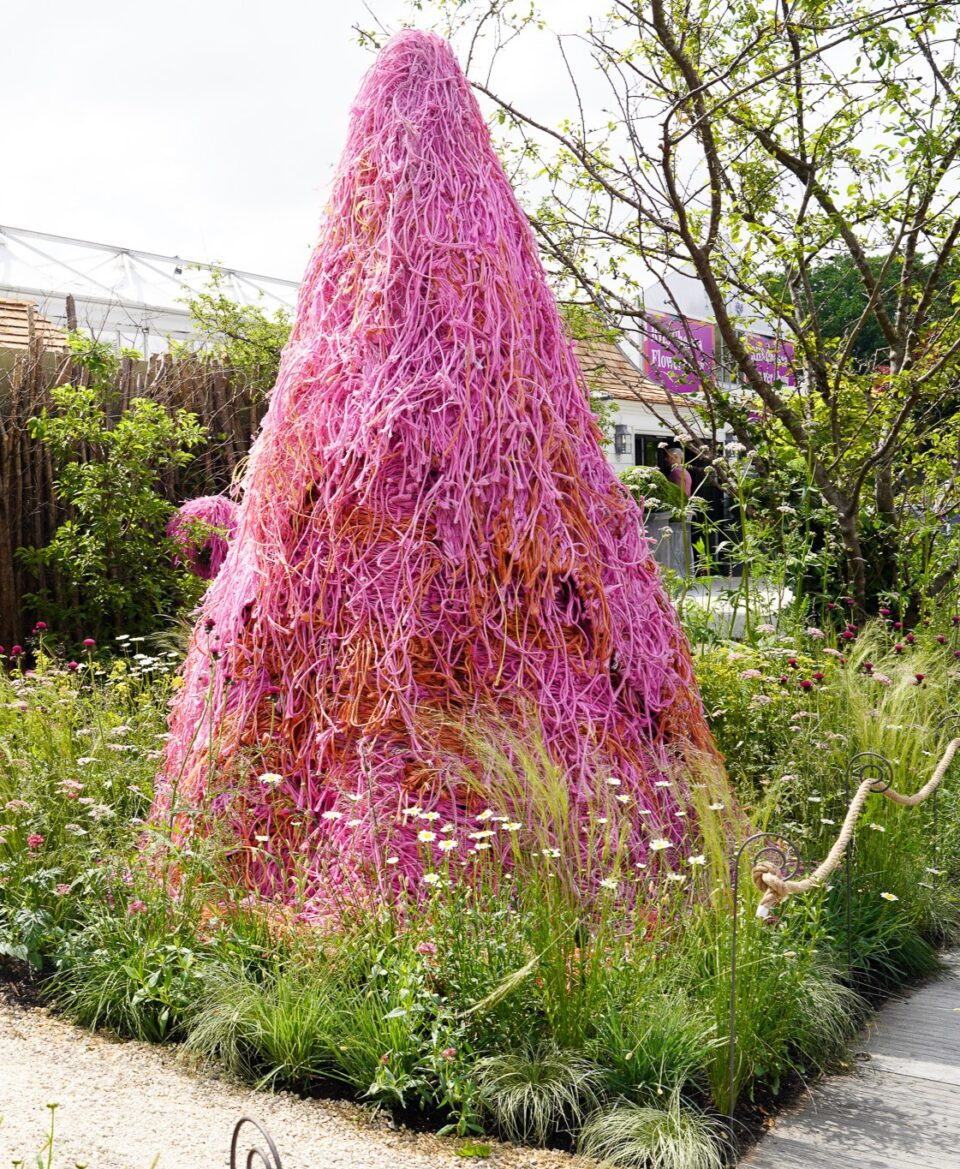
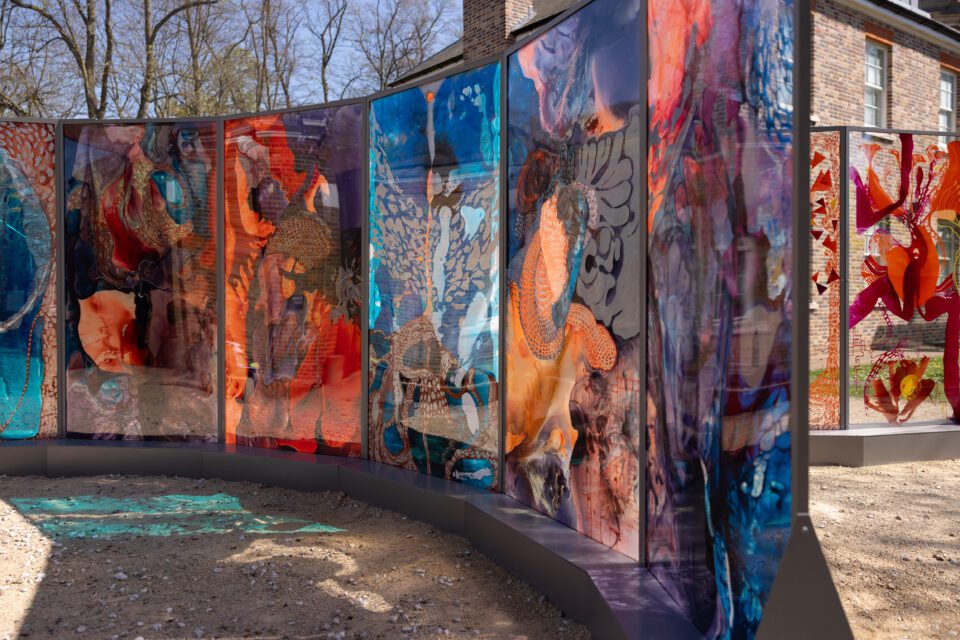
The second room, The Sun Rising, reflects on how the sun structures our sense of time and rhythm, shaping the cycles of seasons, agriculture and everyday ritual. At its centre is Darcey Fleming’s Totem, a sculpture crafted from baling twine previously used by farmers and referencing traditional celebrations connected to the land. Meanwhile, Zenith brings audiences into the height of the day, considering our fascination with sunlight, warmth and the rituals of sunbathing and summer culture. Works by Hannah Frank, Dindga McCannon, Otto Piene, Sam Riley, Jim Lambie and Yinka Ilori appear alongside vintage travel posters and fashion objects including swimsuits, fans and eyewear. At its centre, Bryony Ella’s My Body is a Sundial invites visitors to consider the body as a focus of solar intensity. Layers of embodied paintings are suspended between transparent panes held within a metal frame.
The bright light of day begins to give way in Setting Sun, where artists explore themes of beauty, transformation and reflection through landscapes, symbolic imagery and references to alchemy and astrology. There are some major names in this section, as Nancy Holt’s 1978 film Sun Tunnels takes centre stage. The 26-minute work is one of the most renowned and enduring example of Land Art, documenting the creation of Holt’s eponymous earthwork in the Great Basin Desert, Utah. The installation consists of four concrete cylinders arranged in an X formation across the landscape, each 18 feet long, perforated with constellations of small apertures that project patterns of light within the tunnels.
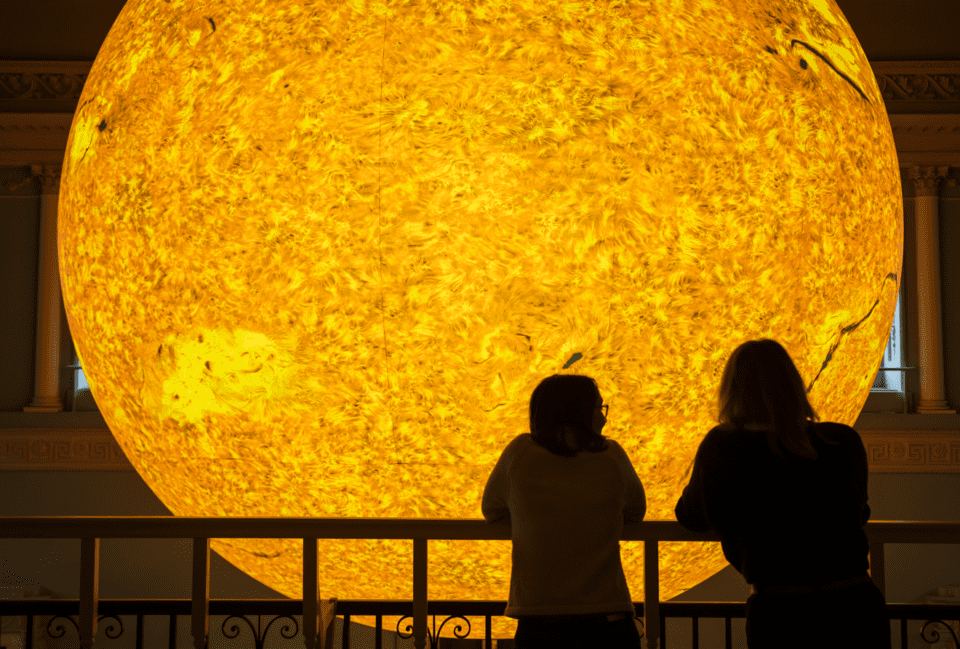
At the centre of the exhibition visitors encounter Helios, a monumental six-metre sculpture of the Sun by artist Luke Jerram. The spherical installation features detailed imagery of the Sun’s surface compiled from photographs by astrophotographer Dr Stuart Green and NASA observations. Presented at an approximate scale of 1:230 million – where each centimetre represents around 2,300 kilometres of the Sun’s surface – the work allows visitors to safely experience the extraordinary texture of our nearest star, revealing sunspots, spicules and vast solar filaments in remarkable detail. Jerram says: “As well as highlighting the science of the Sun, I hope that the artwork will inspire awe and wonder and prompt visitors to consider the importance of the sun in all our lives; for light, warmth, energy for our planet and how our nearest star has inspired culture and religion throughout history, all around the world.”
The second half of the exhibition commences with a transition into night. Evening switches attentions to the moon and its role in science and imagination, exploring its phases, observations through history and its enduring presence in literature, photography and science fiction. Meanwhile, Walking on the Moon reflects on humanity’s obsession with reaching the moon and what might be found there. The works focus on the cultural impact of the Apollo missions and the lesser-known stories behind space exploration, including the contributions of craftswomen and designers who helped make the mission possible. Moon Landing, a collaborative work by Margo Selby and composer Helen Caddick, combines an original score with a large textile installation. The piece celebrates the technical possibilities of weaving and the shared languages of mathematics, colour and rhythm found in both music and fabric.
The Sun and the Moon concludes with Darkest Hours, featuring immersive works by celebrated collective teamLab. This is an awe-inspiring endnote, where spheres of light and darkness appear to take form in the space, yet have no physical substance. teamLab comment: “The materials are light and the environment. And the subject of its creation is the viewer’s own body and perception. The spheres cannot exist on their own – its existence is a phenomenon created in relation to its environment. The phenomenon created by the environment is shaped for the first time by the dynamic body and perception of the viewer.”
Throughout human history, we have looked up in wonder and awe, admiring the beauty of the sky and imagining what it may be like to travel amongst the stars. The unifying power of the celestial is what makes this show so special. Across cultures and centuries, artists have been inspired by the sun and the moon, creating work that speaks to everyone. The Sun and the Moon brings together the most impactful from contemporary art, reflecting on the majesty of the universe.
The Sun and the Moon: Art Inspired by the Celestial is at Saatchi Gallery, London from 5 June – 8 September: saatchigallery.com
Words: Emma Jacob
Image Credits:
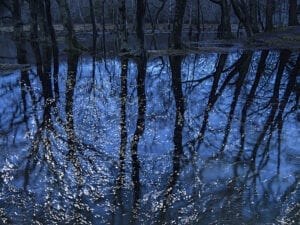
1. Ellie Davies, Ebb and Flow 6, 2025. Courtesy of Crane Kalman Brighton copyright Ellie Davies.
2. Darcey Fleming, Three Coverings 2025 at Saatchi Gallery Garden – RHS Chelsea Flower Show.
3. Bryony Ella, My Body is a Sundial, 2025. Installation image at Orleans House Gallery. Courtesy of the artist. Photography by Ewelina.
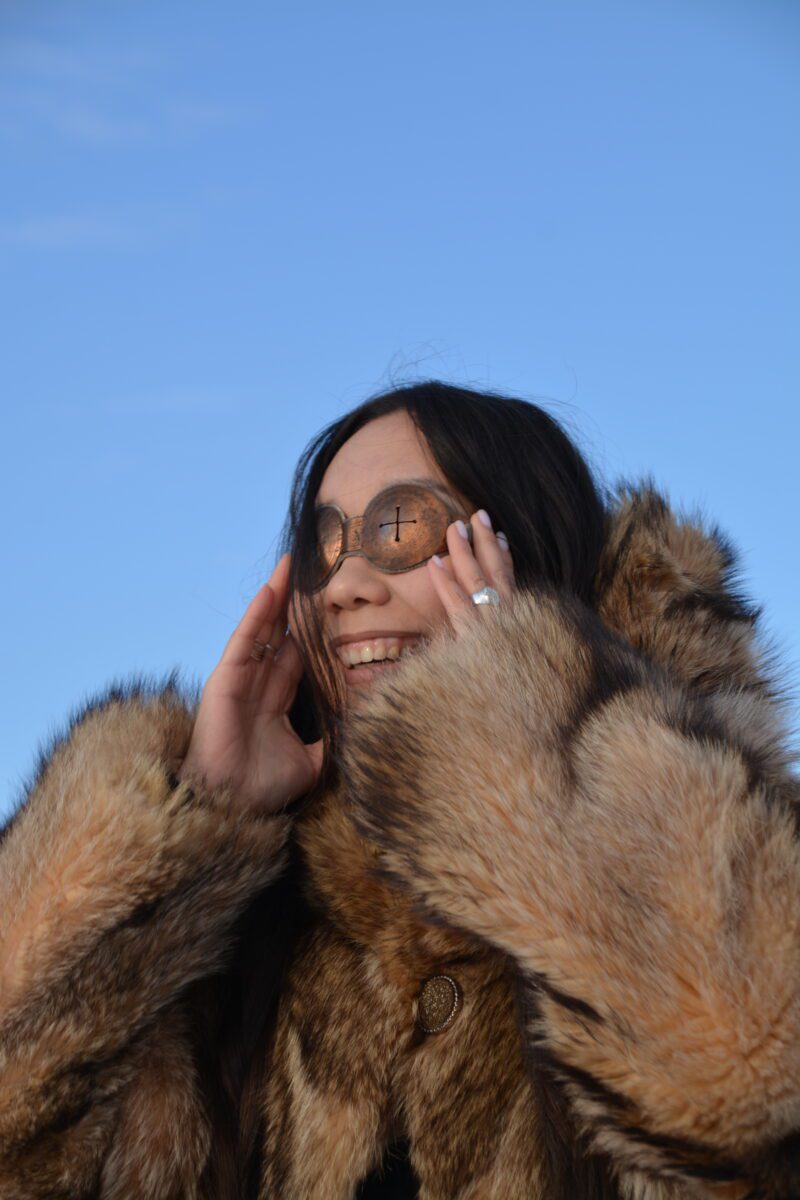
4. Aina Petrova (URSUUNA), Charapchy (Arctic Snow Goggles), 2026. Courtesy of the artist.
5. Luke Jerram, Helios at Bath Assembly Rooms, 2025. National Trust Images copyright Luke Jerram Photography by James Dobson.