Ai Weiwei needs no introduction. For more than three decades, the artist has occupied a singular position at the intersection of aesthetics and activism, reshaping the possibilities of contemporary art through an unwavering commitment to political truth. Works such as Sunflower Seeds (2010) and Remembering (2009) have become touchstones of 21st-century practice, confronting mass production, state violence and collective memory with both poetic restraint and monumental force. His 81-day secret detention by Chinese authorities in 2011 marked a defining rupture — one that transformed personal experience into a sustained artistic inquiry into surveillance, control and resistance. Since then, Ai has continued to challenge the infrastructures of power that govern visibility and voice, positioning art as active intervention. Few artists have so consistently insisted on the ethical urgency of making.
This summer, Factory International presents a landmark body of work at Aviva Studios in Manchester, anchored by a new 24-hour live performance. Titled Sewing a Button, the piece marks the 15th anniversary of Ai’s detention and, crucially, represents the first time he has revisited the experience through reenactment. As the press materials note, the work offers “an unflinching look at Ai Weiwei’s secret detention by Public Security in China in 2011,” positioning the performance as both testimony and confrontation. The work unfolds across a full day and night, with audiences invited to attend in timed intervals. The scale is deceptively minimal; the implications are anything but.
Within this confined architectural frame, the artist submits himself to a regime of observation that mirrors his original conditions of captivity. Visitors witness the banal yet psychologically charged routines of detention — sleeping, eating, washing, writing — punctuated by moments of interrogation. Surveillance is not merely implied but structurally embedded: CCTV cameras relay live footage throughout the building and beyond, extending the performance into a dispersed, global audience. The press release emphasises that viewers will be able to observe Ai “like the guards could,” a phrasing that implicates the spectator in the very systems of control the work seeks to expose. In this sense, Sewing a Button does not simply represent trauma; it redistributes it, asking where responsibility lies in the act of watching.
Running in parallel, Ai Weiwei: Button Up! expands these concerns into a vast exhibition that occupies the Warehouse at Aviva Studios. Described as “monumental in scale and ambition,” the show examines the entangled histories of British imperialism, Sino-British relations and the accelerating logic of globalisation. Among its centrepieces is Eight-Nation Alliance Flags, a newly commissioned series in which each flag is composed of half a million buttons — objects that quietly accumulate into symbols of geopolitical force. A further commission, History of Bombs, reimagined here on an unprecedented scale using over a million toy bricks, stages a disquieting convergence between play and destruction. In both works, repetition becomes a visual language through which systems of power are rendered tangible.
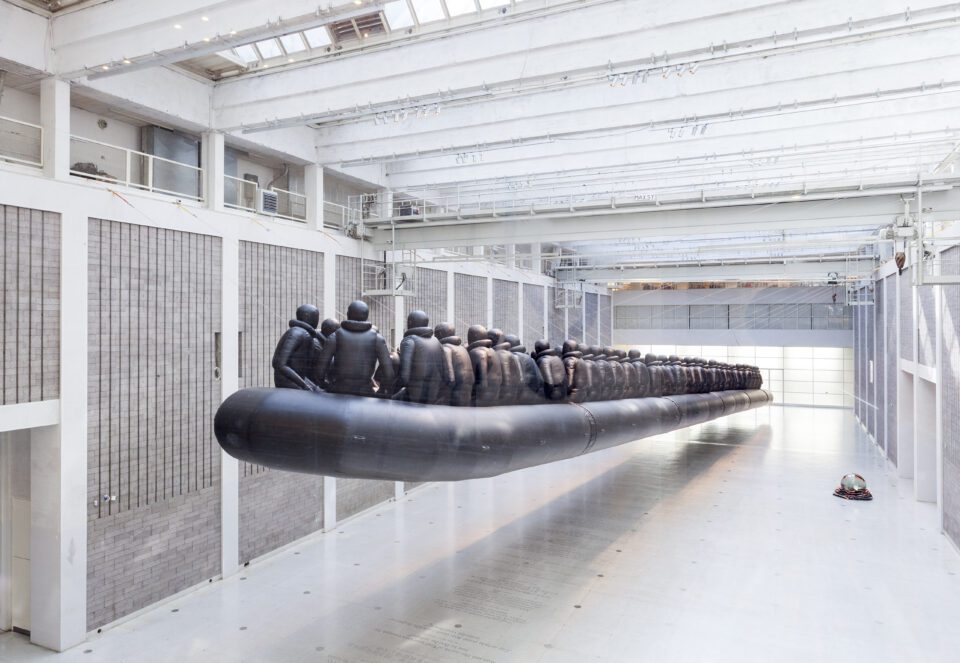
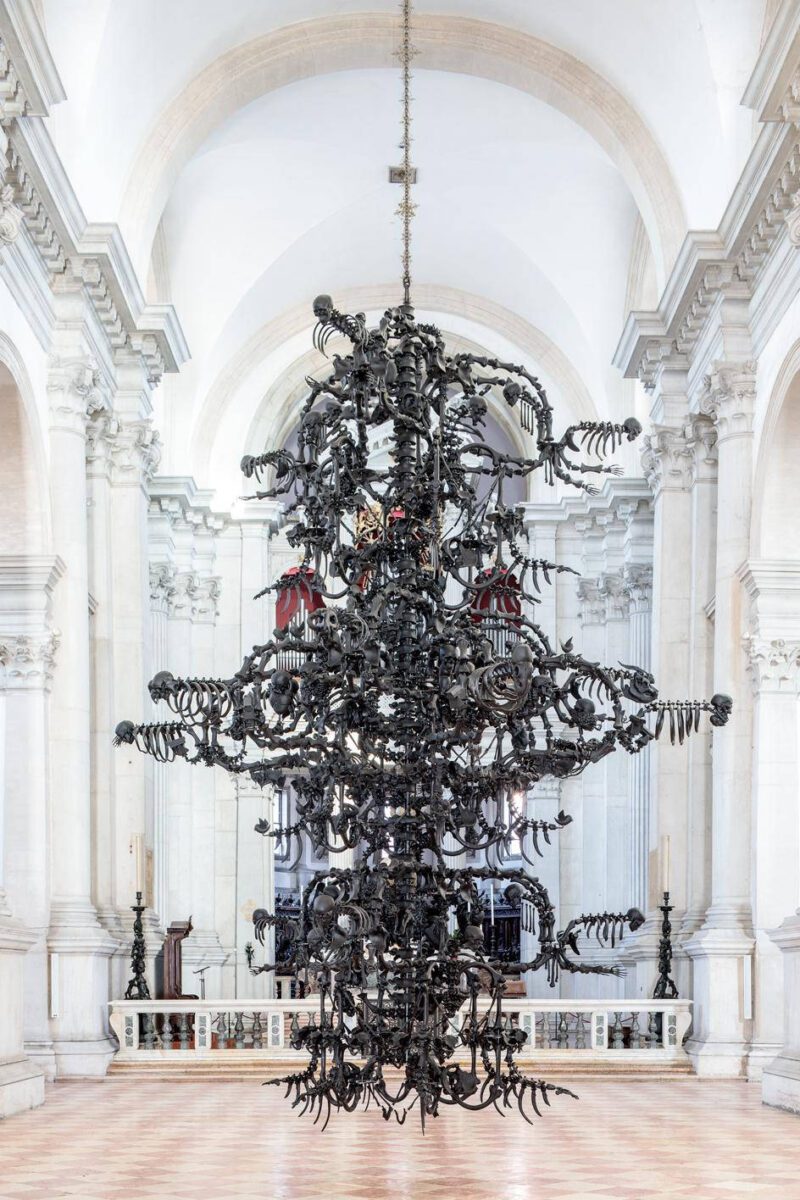
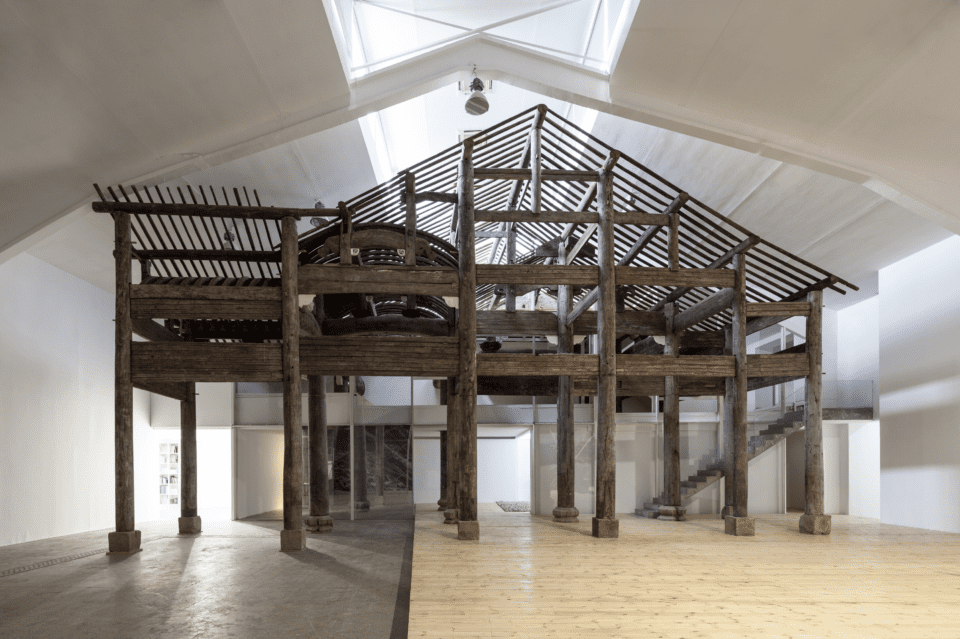
These new pieces are shown alongside major works rarely seen in the UK, creating a dialogue between past and present within Ai’s practice. Law of the Journey (2017), a vast inflatable vessel crowded with anonymous figures, remains one of the most affecting artistic responses to the global refugee crisis. Its sheer physical presence — 47 metres in length — confronts viewers with the scale of displacement, while resisting the reduction of human lives to statistics. Nearby, Wang Family Ancestral Hall (2015), reconstructed from 1,500 fragments of a Ming dynasty structure, reflects on the fragility of cultural heritage in the face of modernisation. Meanwhile, La Commedia Umana (2017–21), a towering Murano glass chandelier, fuses artisanal tradition with theatrical excess, and Circle of Animals/Zodiac Heads (2010) revisits questions of cultural ownership and restitution through a contemporary lens.
What emerges across the exhibition is not simply a survey of works, but a sustained meditation on the movement of objects, people and histories across borders. If the press release frames the exhibition in terms of globalisation, the works themselves complicate this narrative, revealing the uneven power dynamics that underpin it. There is a tension here between spectacle and critique: the grandeur of the installations risks aestheticising the very systems they interrogate. Yet, it is precisely this tension that gives the exhibition its critical edge, forcing viewers to confront their own position within these global networks.
Beyond the gallery spaces, Aviva Studios becomes an extension of the exhibition’s conceptual framework. A temporary Chinese tearoom invites visitors into a slower, more contemplative mode of engagement, while a programme of talks and workshops situates the work within broader cultural and political conversations. This layering of experiences reflects a wider ethos within Factory International, whose approach to programming resists the isolation of art objects in favour of immersive, socially engaged environments. Here, art is not confined to the visual; it unfolds across time, space and participation.
In recent years, the organisation has solidified its position as a leading force within the UK’s cultural landscape. Building on the legacy of the Manchester International Festival, it has consistently commissioned ambitious, large-scale works that challenge conventional exhibition formats. Its recent programme — spanning immersive installations, interdisciplinary performances and international collaborations — has redefined what a cultural institution can be in the 21st century. The impact is palpable not only within Manchester, but across the UK, where a renewed appetite for risk and experimentation is beginning to take hold. In this context, Factory International operates less as a venue than as a catalyst.
Returning to Sewing a Button, the work ultimately resists easy interpretation. It is, on one level, an act of remembrance; on another, a confrontation with the mechanics of power that continue to shape contemporary life. By restaging his own detention, Ai Weiwei transforms a private ordeal into a public encounter, collapsing the distance between past and present, self and other. The question is not simply what happened, but how it is seen — and by whom. In an era defined by ubiquitous surveillance, the work feels less like a reconstruction of history and more like a mirror held up to the present.
What lingers is the persistence of the human body under scrutiny. In this sense, Sewing a Button enters into a broader lineage of performance art that uses duration, vulnerability and presence as its primary materials — recalling, for instance, the work of Marina Abramović, whose own explorations of the limits of the body have long tested the boundaries between artist and audience. Yet Ai’s intervention is distinct in its insistence on political specificity: this is a reconstruction of state power made visible. The question that remains is less about what we witness than what we are willing to do with that witnessing — whether, in the face of such exposure, observation can ever remain a neutral act.
Ai Weiwei: Sewing a Button is at Factory International, Manchester 3-4 July: factoryinternational.org
Words: Anna Muller
Image Credits:
1&4. Ai Weiwei, La Commedia Umana. Murano glass and metal. Diameter 640cm. Height 840cm. Installation view at Palladian church, 2022. Image courtesy of Ai Weiwei Studio.
2. Ai Weiwei, La Commedia Umana. Murano glass and metal. Diameter 640cm. Height 840cm. Image courtesy of Ai Weiwei Studio.
3. Ai Weiwei, Law of the Journey, 2017. Reinforced PVC. 300 x 600 x 6000 cm. Installation view_ National Gallery, Prague, 2017. Image courtesy of Ai Weiwei Studio.
5. Ai Weiwei, Wang Family Ancestral Hall, 2015. Over 1,300 pieces of various wooden building elements from the late Ming dynasty with original carvings and painted replacements. 942 x 2100 x 1680 cm. Installation view, Tang Contemporary Art.