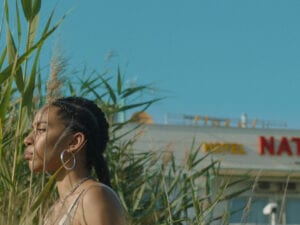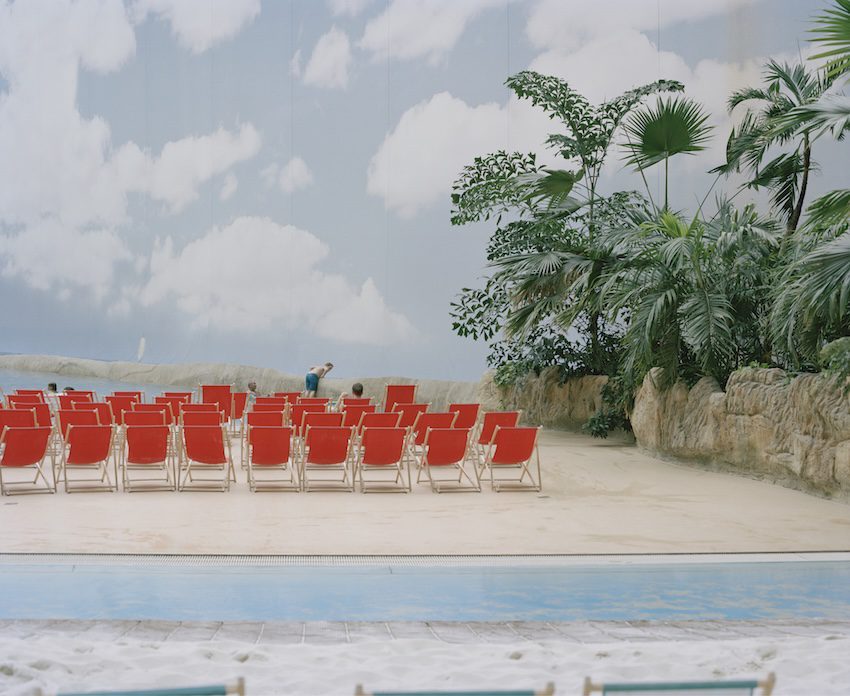
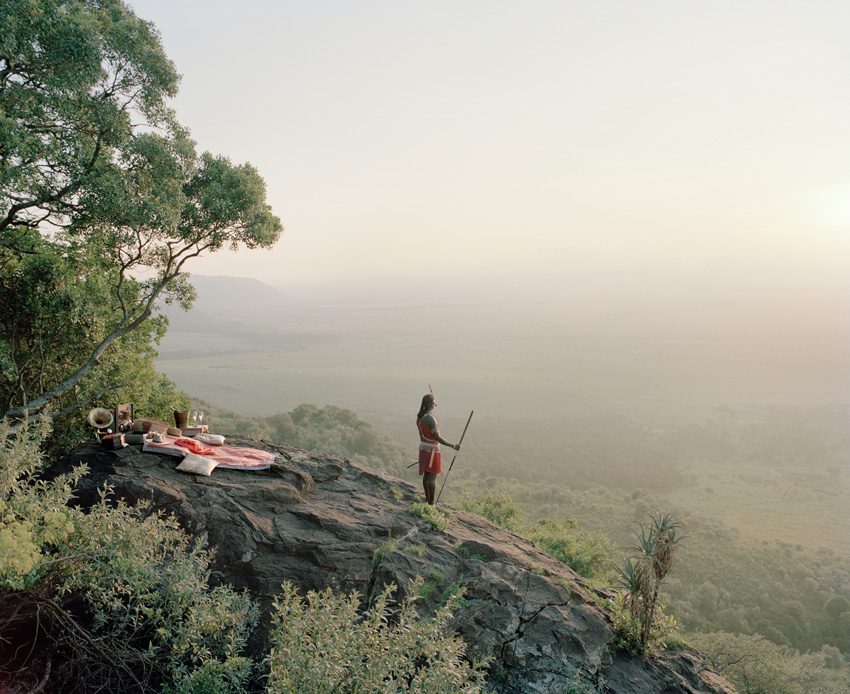
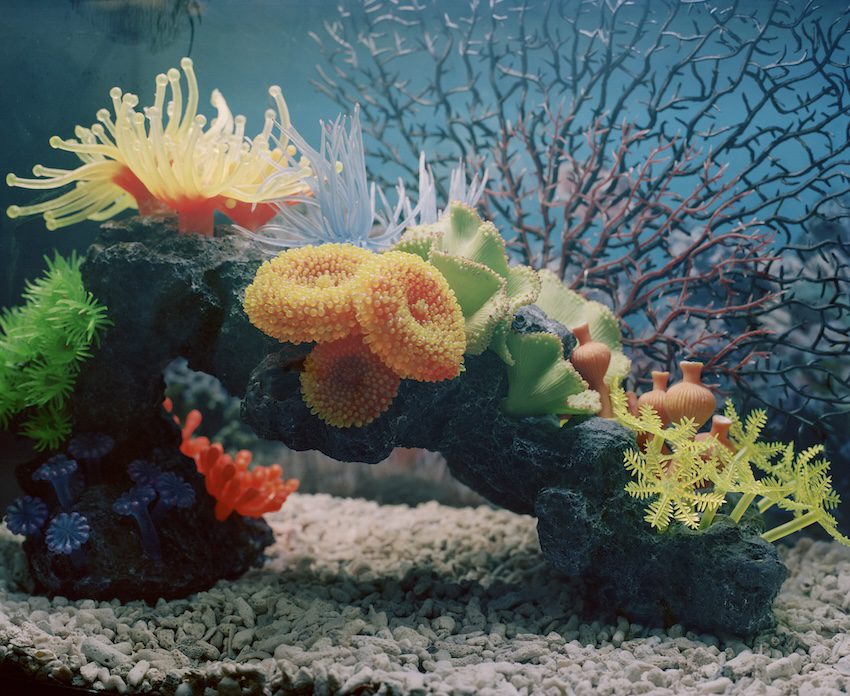
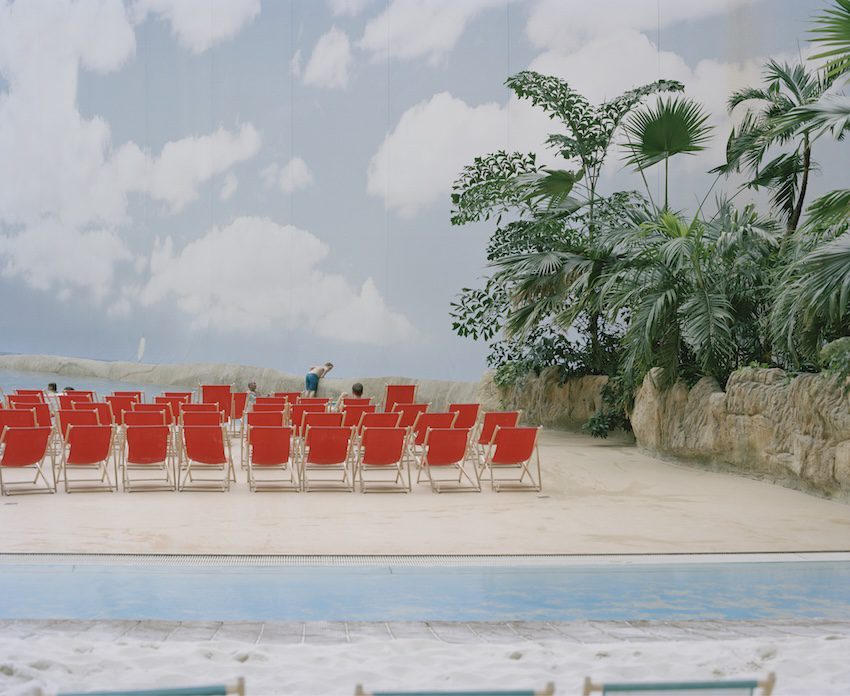
Just three percent of the world’s land remains ecologically intact, with healthy numbers of all its original animals and undisturbed habitat. According to WWF’s Living Planet Report, the average size of wildlife populations fell by a staggering 73% between 1970 and 2020, and a 2022 study warned that more than 1 in 10 species could be lost by the end of the century. Photographer Zed Nelson’s latest project asks the question: how did we let ourselves get here? The Anthropocene Illusion is the result of six years of travel, during which Nelson visited 14 countries across four continents to observe how humans immerse themselves in increasingly artificial landscapes. People holiday on synthetic beaches and ski on false snow, observe endangered animals in zoos and aquariums, or else take part in luxury experiences that encroach upon ecosystems and habitats. The Anthropocene Illusion saw Nelson named Sony World Photographer of the Year in 2025, and now, images from the series are on display at Somerset House. We caught up with the artist to chat about his reputation for looking society’s most pressing issues in the eye and what he hopes international audiences take away from The Anthropocene Illusion.
A: Take us back to the start. How did you begin working behind the lens?
ZN: I remember getting hold of an old Pentax camera when I was around 10 years old. I went out into the country and started photographing a cow. I had this strange feeling of being able to look at something that I’d previously ignored. Photography gave me not only the ability, but a reason, to examine the world around me. It was remarkable because suddenly I saw this cow in a different way. I got closer and closer to it and then started taking close-up shots of its eyes and face. I felt an entirely different relationship to the animal. That was probably my earliest meaningful interaction with photography.
A: You’ve dedicated most of your career to addressing some of contemporary society’s most pressing issues – gun control, the beauty industry, gentrification. What draws you to these topics?
ZN: I’ve worked on a lot of projects over the years. I started out with international reportage, photographing wars and famine. Over time, I began to feel like the mainstream media wasn’t interested in telling complex stories. I wanted to do something different. I’m often drawn to big questions of how we have been brainwashed by large industries or sold a certain narrative. For instance, I worked on a three-year project about American gun culture, which was an exploration of how the gun industry concocted a narrative to sell weapons. Somehow, they managed to equate the idea of guns with a patriotic symbol of freedom. Then suddenly, you have a country that is awash with weapons, has a huge death rate and nobody is willing to look at the truth of what’s really happening. That’s when it gets interesting to me, because then I feel like I’ve got something to say. I’d also been in Afghanistan and seen guns from America, Russia, China and Britain, superpowers who were producing guns and flooding other countries with them. I wanted to track back to the source. I also worked on Love Me, which was a five-year project that looked at how the western beauty ideal has been sold globally. Again, it’s a form of brainwashing. I wanted to interrogate how in every corner of the world, a largely Caucasian, blonde-haired, blue-eyed image has been held up as the ideal, in order to sell more products. I’ve also made a film about gentrification in Hackney. I grew up there, so I’d watched how house prices had rocketed, and property developers were profiting off that. I’m interested in working out how, as a photographer, I can tell a story about the things that matter to me in a way that’s useful, or that can play a role in a larger conversation. It’s about trying to have a voice.
A: How do you see art functioning as a form of activism?
ZN: When I started in photography, I thought I could change the world and that the camera had this enormous power. I felt that if you shone a light on injustice, that somehow the world would respond and everything would get better. That belief took a big hit, and I became more cynical and disillusioned. I reemerged from this negative state of mind with a new perspective, believing that there is a demand for more engaging, interesting and complex stories. One project can’t change the world, but it can contribute to a conversation that’s happening in our culture. When you break it down, I’m interested in storytelling. I use art, journalism, filmmaking – but it all comes back to storytelling. It’s not standing in the street with a placard, but it is a form of activism. I operate on the assumption that every single decision we make as humans is based on what we’ve learned and seen and experienced. That includes people who make horrible decisions and do awful things. I might have become a little disillusioned with the idea of individual power to change things, but I’m not disillusioned about the importance of how stories shape our actions.
A: How have people responded to your work? Does it differ depending on where you are in the world?
ZN: Very much so. When Gun Nation came out, it was published in 15 different European magazines, but it wasn’t until it was exhibited in America that I started to receive death threats. I’d been on TV shows like Good Morning America and The Charlie Rose Show, so that reached a very mainstream audience. I ended up doing a lecture tour at around 15 American universities, and most of them were good, respectful crowds. However, one of them drew 600 protestors from the National Rifle Association, who tried to disrupt the talk. The project had an extraordinary affect, and whilst I didn’t enjoy some of that, it was also quite exciting to see that I’d made something that had generated such a response. It gave me faith that I was saying something important. With the beauty industry, it was quite different. I had lots of reactions from young people, often women, saying that they’d seen the work in an exhibition and it had helped them understand the pressures they’d been put under by modern society. My film, The Street, which is about gentrification, had possibly the best response of all. I’ve had so many messages from people saying they were moved by it, or it had shaped their outlook in some way, which is really gratifying.
A: The Anthropocene Illusion was created over the course of six years, featuring 14 countries across 4 continents. How did the project develop over time?
ZN: The Anthropocene Illusion grew out of this idea that as we destroy the natural world, we are engaged in a process of creating ever more artificial versions of it. We make choreographed version of nature to retreat into, hide from ourselves and what we are doing. Any long-term project is not easy, because they’re expensive. I have to work slowly in order to raise funds for these trips. This also had a benefit, because you’re more thoughtful. I’m researching the whole time, looking for how I can expand the project. Lockdown happened in the middle of this, which made it really complicated. You’re constantly thinking: “does it make sense?” “is it worth doing?” “is it going to have any success?” These are all serious questions, but you can’t answer them. You can only hope they’ll work out. I always make a joke, particularly with filmmaker, where it’s like getting your sleeve caught in some machinery at a factory and it just sucks you in. There’s a point of no return, where it would be insane to give up but also feels impossible to continue, you just have to push on. Once you get through that barrier, you’re at the very heart of it.
A: You describe modern nature as a “stage-managed experience.” Can you tell us more about what this means? Was there a specific moment this idea became clear to you?
ZN: Sometimes you need several different things to overlap for them to lead you somewhere. I already had all of this background context of the serious issue of climate change, and spent a lot of time trying to understand the complexity of what’s happening and what can be done. Then I’d heard the term “Anthropocene,” which essentially means that we’re living in an epoch that is characterised by human activity driving environmental change. Scientists and geologists are saying that our impact on the planet is so devastating that in 200 years, we’ll be able to see it in the sedimentary rock under our feet. I chose to name the project The Anthropocene Illusion became at this time of catastrophic behaviour, we have chosen to create an illusion to hide from ourselves the reality of what we’re doing. The final, personal moment that this all clicked was when I was exhibiting Love Me in Tromsø, Norway, which is above the Arctic Circle and visited an ocean museum called Polaria. I went into this area downstairs and there were two bearded seals on a fibreglass rock with a little swimming pool. All around them were things made to look like the Arctic, with sodium lighting above them. These two creatures were living so close to their natural habitat, so why were they forced to be in there? In a way, it’s convenience. It’s like fast food. You don’t have to go to the coast and you don’t have to get your feet wet to look at seals. Here, they are brought to you in a kind of pretend world, it’s “stage-managed.” It’s not as though I stood there and all of a sudden, The Anthropocene Illusion was fully formed in my mind, but it was something that had an effect on me.
A: Talk us through your process. How do you plan a shoot?
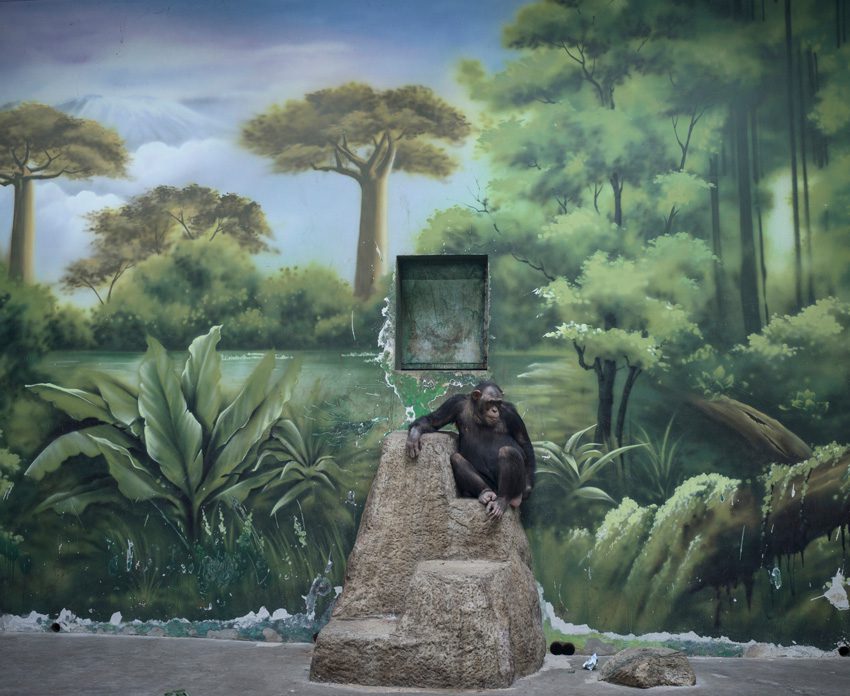
ZN: I do a lot of research, so by the time I go somewhere, I know where I’m going to visit and what I’m going to do. One good example of this is of a chimpanzee in a Chinese zoo, photographed against a painted backdrop. I’d seen photographs of that zoo online and I knew I wanted to visit. I could tell from their website that there would be a number of things that would potentially be interesting for the project. Once I’m there, it’s a matter of creating the best chance of getting a meaningful image. For me, that means time. I spent two days photographing the chimpanzee. It’s a matter of patience and focus, setting the camera up on a tripod and being still for long enough. I also use a medium format film camera, which is quite old-fashioned, so it forces you into a slightly more meditative way of looking. This project, more than any other, was the one I’d planned the most. It’s enjoyable having chance encounters and stumbling across things, but I didn’t have that luxury because this project was too geographically wide. I couldn’t just hope for the best.
A: Are there any particular scenes or photographs that have stuck with you as particularly poignant or impactful?
ZN: That chimpanzee is definitely one, when you sit still and observe not just a creature, but it’s setting, it can be really revealing. It’s also important to watch the humans and how they behave around the animal. The other picture that genuinely disturbs me to this day is of a polar bear in a fake environment. This was in China, in a sort of wildlife park, and there was very little space or ice for that bear. I found it very troubling. Again, I was there for several days, and its painful to think of that creature living its life out in that environment. What’s happening in places like this is an insatiable appetite for spectacle, for nature to be brought into these choreographed settings. It means that in places like China, there are polar bears in refrigerated, plastic worlds in shopping centres. In setting up this project, I didn’t want it to become just about cruelty to animals, even though that’s something that matters greatly to me. It’s about illusions, so I had to be careful that it didn’t become so depressing that audiences just didn’t want to look at the work.
A: How do you manage this balance between confronting audiences with the realities of how we’re treating nature, without them looking away?
ZN: Sometimes you do this by editing out images that were really great. I couldn’t put everything in, but that’s true of any good project. It becomes good in the editing. It’s only when you start taking out the truly great images, because there isn’t space, that you can reach a new level. In the curation, you have to ask: what story am I trying to tell? It can’t be everything to everyone. For me, it was important to focus on the illusory aspect, the psychological part of creating a world in order to hide from what we’re doing. So, in a way, if it was an image of such abject cruelty, it ceased to be an illusion and it was apparent what was happening. That’s a different project. At times, the editing for a project like this can be really challenging, as you’re covering a lot of ground, but it’s about constantly trying to find a balance. You’re finding a pace and a poetry, without repetition and with surprises. I like having juxtapositions, so you’re not quite sure what you’re looking at. The other thing about photography is that often it can feel like you’re being manipulated. I think it makes you want to shut it down. In dancing along the edges of huge topics, people are attracted to look at the works, but then find something unsettling or thought provoking. It leaves a sort of echo.
A: Your work sets out where humanity has gone wrong in our relationship with nature. How do we begin to set this right?
ZN: There are certain things that are just no brainers when you’re thinking about the environment, climate change or animal welfare. For instance, we can vote for better leaders. I’m thinking particularly of America, we have a vote, so we need to use it carefully. There’s a need for better education and storytelling, so that’s something that comes back to storytelling. We can demand change with our money and make better consumer choices. We can boycott brands that we’re starting to understand are unhelpful or harmful. You can, if you have the money, invest ethically. We can live better and reduce our impact – cut down on plastic use, have wild gardens, reduce meat consumption. I’m not a fan of putting blame on individual people, because it doesn’t help to be crippled with guilt. What we need to do is use this energy to demand change from industries and leaders. In the essay at the back of the book, it says: “Our future as a species depends on urgent new evaluations of humanity’s relationship with the natural world. We have divorced ourselves from nature, yet we crave a connection with the very thing that we have turned our back on. Surrounding ourselves with simulated recreations of nature paradoxically creates unwitting monuments to the very things that we have lost.” I’m trying to say that it will take a paradigm shift in our priorities and empathies, but it’s on an industrial and political level that change needs to happen. We already know what needs to be done, we just need to find the leaders who will do it.
A: What’s next for you? Anything we can look forward to?
ZN: I’m working something more positive, in a way, but continuing my focus on the environmental. It’s to do with how nature can be given legal rights. It’s a fascinating subject.
Zed Nelson: The Anthropocene Illusion is at Somerset House, London until 4 May: somersethouse.org.uk
Words: Emma Jacob & Zed Nelson
Image Credits:
All images: © Zed Nelson, The Anthropocene Illusion 2025.