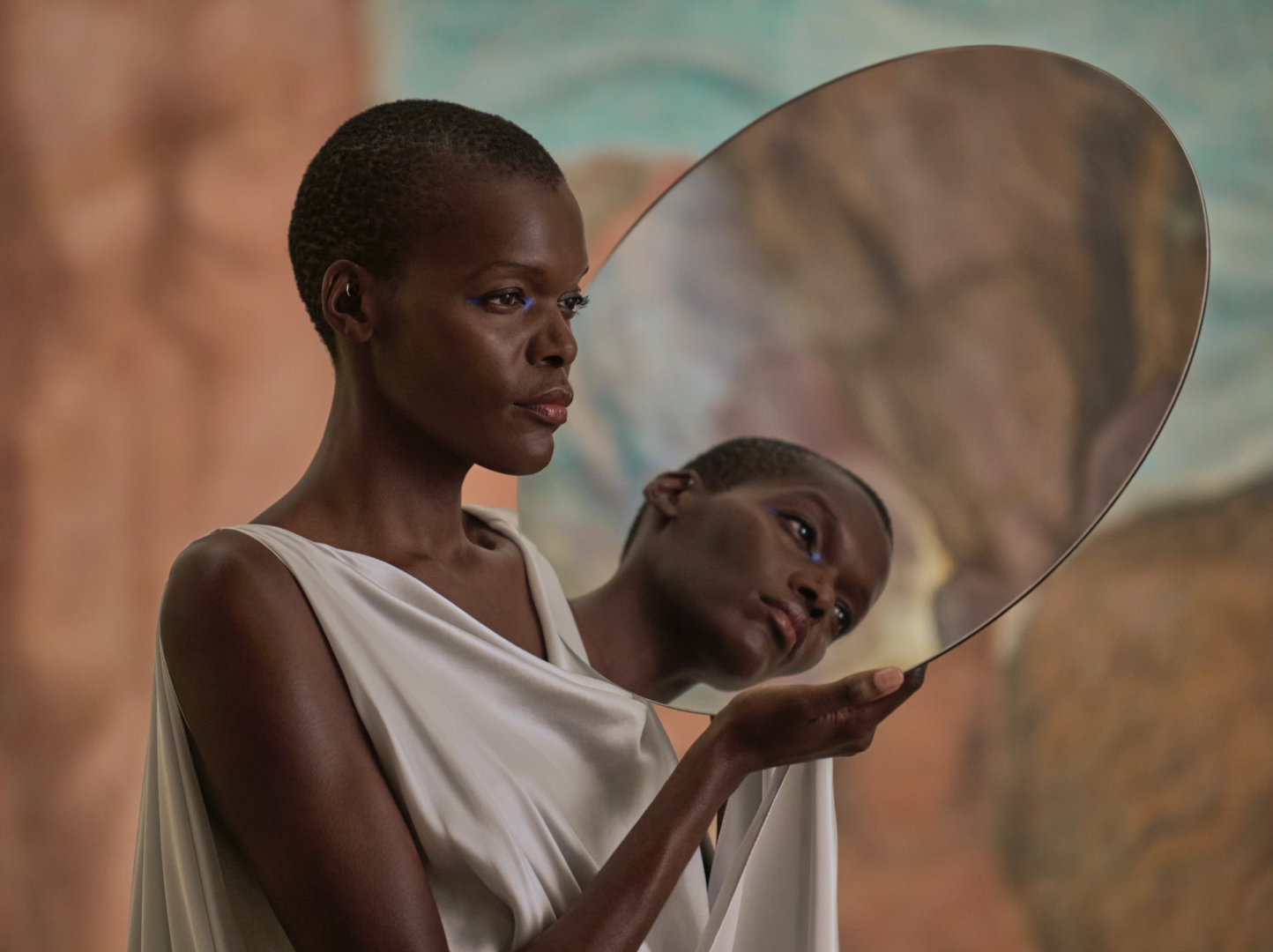
Few artists have redefined the moving-image with such enduring impact as Isaac Julien. Over four decades, his films and installations have traced the shifting contours of identity, memory and desire, creating spaces where history and imagination meet. Looking for Langston (1989) offered a poetic homage to the Harlem Renaissance while Ten Thousand Waves (2010) expanded into environmental and mythic territories, exploring how human and ecological life endure in moments of crisis. Each work demands the viewer’s presence, emphasising that identity is never fixed, and that cinema can enact transformation. Julien’s practice has always sought to blur boundaries between narrative and abstraction, self and society. This commitment to liminality makes his latest installation particularly compelling.
Early explorations of architecture and space have deepened these concerns. Lina Bo Bardi – A Marvellous Entanglement (2019) highlights the Brazilian architect’s fusion of modernist principles with social vision, turning built space into a lens for understanding cultural and ecological entanglement. Western Union: Small Boats (2007) situates human experience within global and historical crises, revealing resilience and vulnerability in equal measure. Across these works, liminality emerges as a guiding principle, a space where form and content, past and present, human and posthuman intersect. The viewer is drawn into these thresholds, witnessing transformation as both concept and lived experience. Immersion, rather than observation, becomes the medium’s most profound effect.
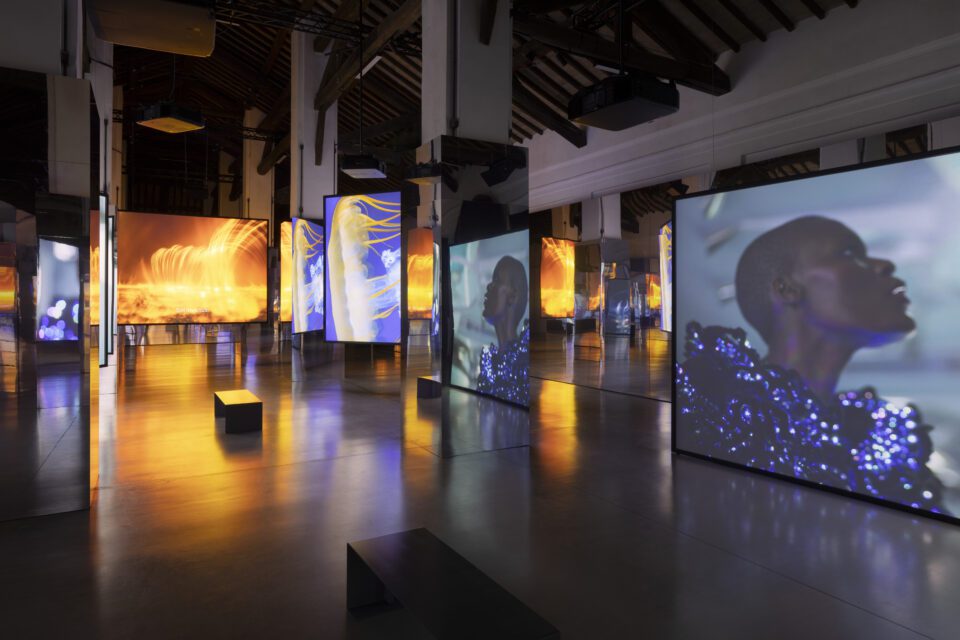
All That Changes You. Metamorphosis, presented at Victoria Miro, London, extends these investigations to a sweeping, immersive scale. The five-screen installation, accompanied by new photographic works, premiered in 2025 at Palazzo Te to celebrate the 500th anniversary of the Mantuan palace. Science fiction, ecological thought and philosophical enquiry converge in a meditation on identity, survival and life beyond the human. Transformation here is understood as an ontological condition, inseparable from the flux of the world itself. The installation invites reflection on impermanence, interconnection and co-existence.
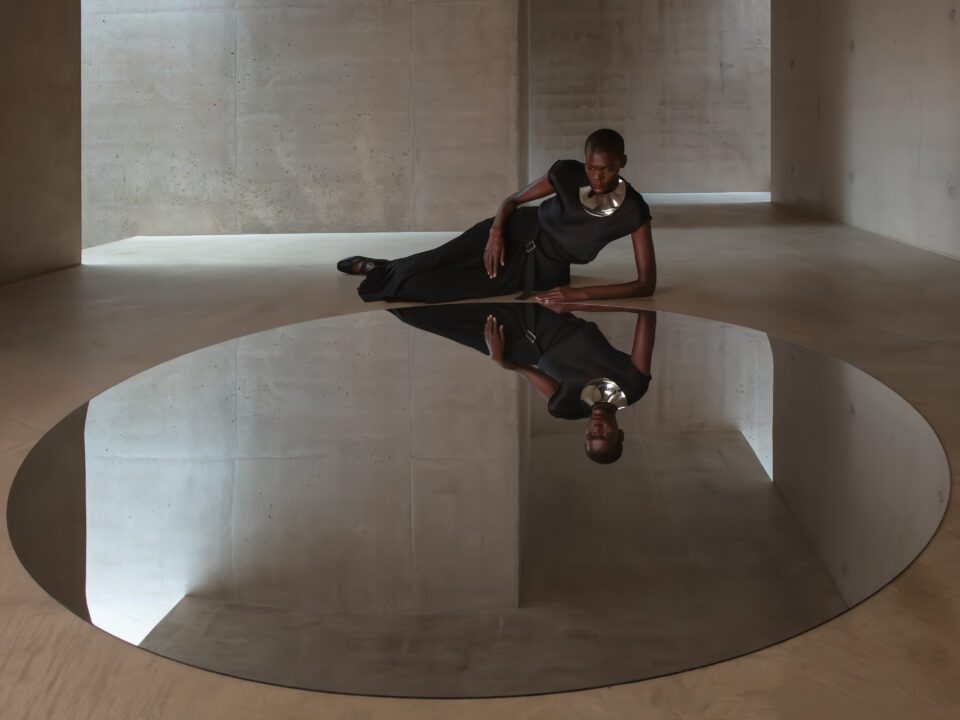
Two protagonists form the core of the work: Sheila Atim’s Lilith and Gwendoline Christie’s Naomi. Lilith, inspired by Octavia Butler’s heroines, embodies posthuman possibility, moving with mythic authority across time and space. Naomi, drawing on Naomi Mitchison’s Memoirs of a Spacewoman, remains rooted in human presence, attuned to empathy, listening and relationality. “We are not in control. Not even of ourselves. Everything is in flux,” Naomi observes, framing the installation’s exploration of adaptation and ethical engagement. The tension between Lilith and Naomi highlights difference as the source of connection and intimacy rather than conflict. Transformation becomes both emotional and philosophical.
Conceptual underpinnings are articulated through some of contemporary thought’s most incisive voices. Donna Haraway opens the work with a reading from Staying with the Trouble (2016), elaborating her theory of ‘becoming-with’, the necessity of living alongside other species rather than asserting dominance. Haraway’s reminder that ‘trouble’ once meant ‘disturbance’ underlines the ethical dimension of uncertainty, which pervades the film. Anna Tsing’s studies of ecological resilience and Carlo Rovelli’s relational understanding of time resonate alongside her reflections. These ideas are realised in gesture, rhythm and environment rather than expository dialogue. Lilith and Naomi embody these theories through movement and encounter, demonstrating how transformation is enacted in relation.
Architecture and landscape are integral to the installation’s affective and conceptual impact. The frescoed halls of Palazzo Te, including Giulio Romano’s Room of the Giants, stage Titans in collapse, evoking cycles of destruction and rebirth. From Renaissance halls, the narrative flows to Charles Jencks’s Cosmic House, Herzog & de Meuron’s Napa Valley glass pavilion, and Richard Found’s Cotswolds home. Human structures intersect with natural forms: redwoods sway, jellyfish pulse, fire and solar flares punctuate the world. Transformation is always relational, occurring at the intersection of environment, history and human intervention. Each space responds to the characters, shaping their journey as much as they shape it.
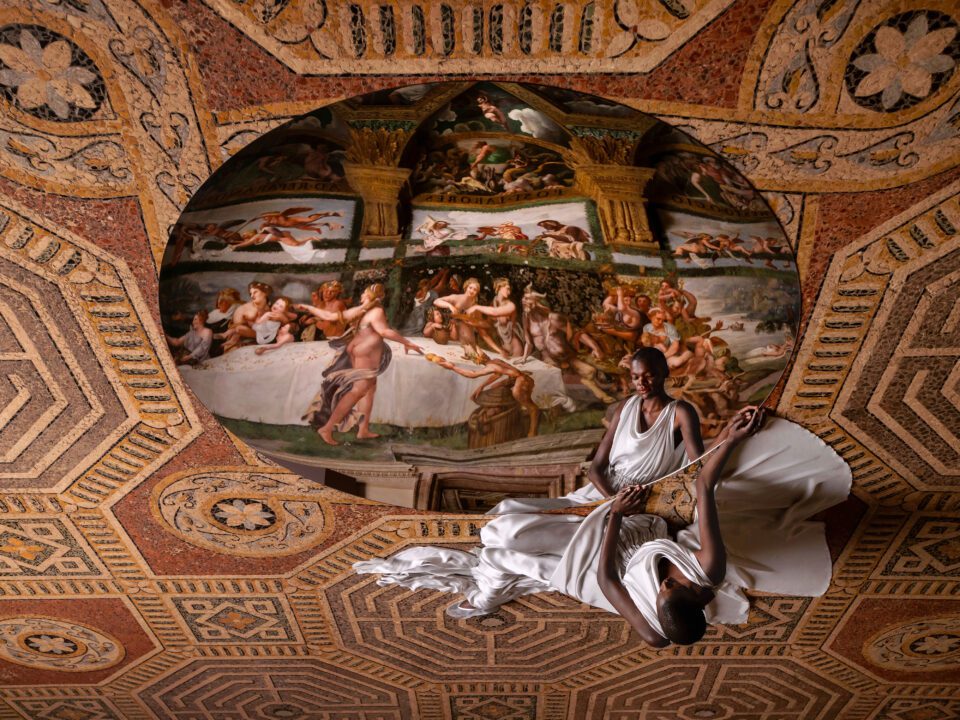
The mirrored, five-screen installation amplifies these explorations, dissolving linear temporality and narrative certainty. Images overlap, reflect and reappear while dialogue shifts into poetry. Naomi remarks, “Every moment carries with it a metamorphosis,” articulating the rhythms that govern the work. Viewers are drawn into a participatory engagement, where perception itself becomes a site of change. The environment refracts identity, narrative and temporality, making the audience both witness and participant in the unfolding flux. In this immersive structure, form mirrors theme.
Contemporary parallels deepen the installation’s resonance. Hito Steyerl’s How Not to Be Seen (2013) interrogates digital visibility and the instability of perception. Camille Henrot’s Grosse Fatigue (2013) explores encyclopaedic knowledge, ecological interconnection and myth, weaving complex narratives across disciplines. Trevor Paglen’s Orbital Reflector (2018) considers technology, planetary perspective and human ambition, situating the individual within vast systems. Julien’s work converses with these practices through its interrogation of human and posthuman entanglements, demonstrating how art can render perception, time and ecological interconnection simultaneously legible and felt.
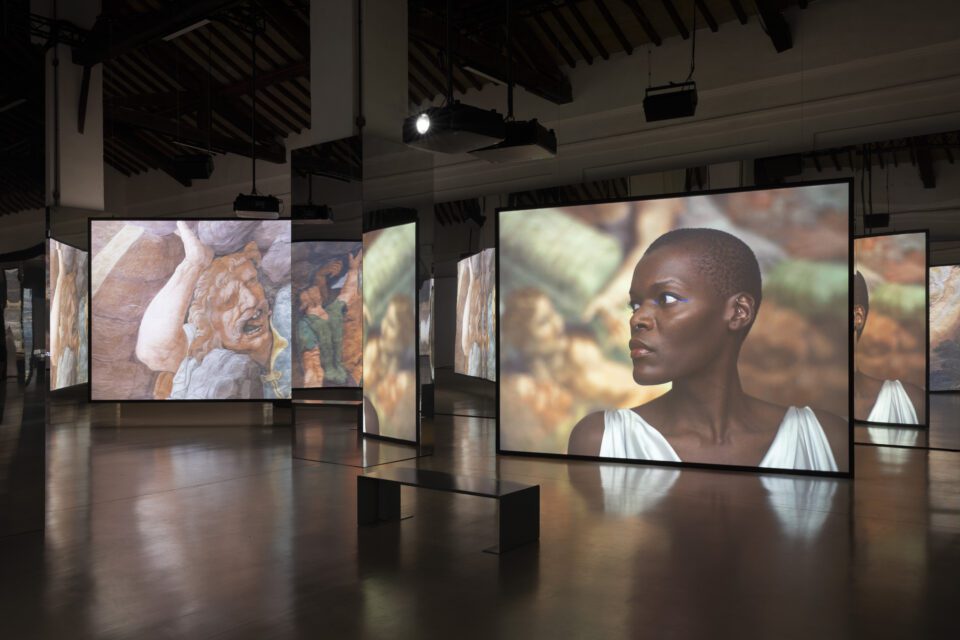
At its heart, Metamorphosis frames intimacy through difference. Lilith observes, “It was from the difference between us […] that love came,” suggesting that posthumanism is not an erasure of humanity but a recalibration of relational ethics. Transformation becomes a practice rather than a spectacle, an ongoing negotiation of connection, empathy and environmental attunement. The installation offers no tidy resolutions, instead insisting that inhabitation of change is essential to being alive. Viewers are drawn into cycles of reflection, renewal and relationality. Difference itself emerges as generative, creative and ethical.
The installation closes with Naomi’s echo of Butler’s meditation: “Whether you’re a human being, an insect, a microbe or a stone, all that you touch, you change, and all that you change, changes you.” The work affirms relationality, interdependence and the ethical weight of engagement with the world. Time is measured through environmental and cosmic rhythms, and transformation is inevitable, participatory and luminous. Audiences are invited to witness flux, to feel themselves entwined in the rhythms of life. All That Changes You. Metamorphosis embodies the interweaving of art, philosophy and ecological thought.
All That Changes You. Metamorphosis is at Victoria Miro, London until from 13 February – 21 March: victoria-miro.com
Words: Shirley Stevenson
Image Credits:
1. Isaac Julien, Satellite (All That Changes You. Metamorphosis), 2025. Inkjet Print on Ilford Gold Fibre Gloss mounted on aluminium 110 x 147 cm 43 1/4 x 57 7/8 in © Isaac Julien. Courtesy the artist and Victoria Miro.
2. Isaac Julien, Cosmic Narcissus (All That Changes You. Metamorphosis), 2025. Inkjet print on Ilford Gold Fibre Gloss mounted on aluminium 157 x 207 cm 61 3/4 x 81 1/2 in © Isaac Julien. Courtesy the artist and Victoria Miro.
3. Installation view, Isaac Julien, All That Changes You. Metamorphosis,2025. Palazzo Te, Mantua © Isaac Julien. Courtesy the artist and Victoria Miro Photo: Andrea Rossetti / Palazzo Te.
4. Isaac Julien, Metamorphosis I (All That Changes You. Metamorphosis), 2025. Inkjet Print on Ilford Gold Fibre Gloss mounted on aluminium 150 x 200 cm 59 x 78 3/4 in © Isaac Julien. Courtesy the artist and Victoria Miro.
5. Installation view, Isaac Julien, All That Changes You. Metamorphosis, 2025. Palazzo Te, Mantua © Isaac Julien. Courtesy the artist and Victoria Miro. Photo: Andrea Rossetti / Palazzo Te.