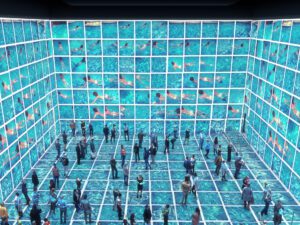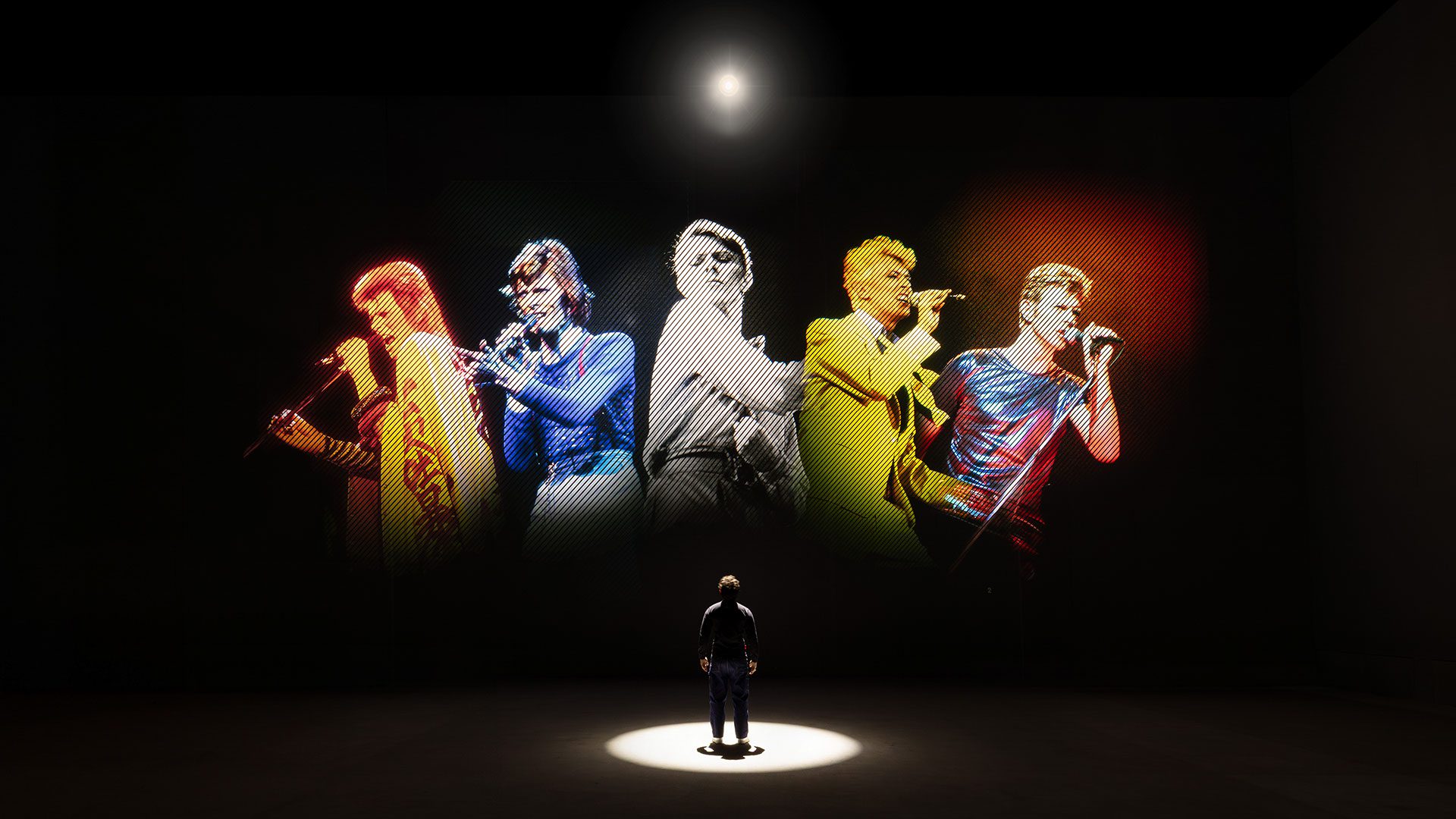
David Bowie (1947-2016) is widely regarded as one of the most influential musicians of the 20th century. This spring, a major new immersive experience dedicated to him is opening at London’s Lightroom, in close collaboration with the Bowie Estate. The 360° show – titled You’re Not Alone – promises to transport visitors inside the artist’s “iconic performances and creative mind”. From Space Oddity through Diamond Dogs, Heroes and ★, You’re Not Alone offers audiences the opportunity “to feel they have travelled through time to experience Bowie up close and first-hand.” But this is not about perpetuating the myths or characters often associated with Bowie, like Aladdin Sane, Halloween Jack, The Thin White Duke or Ziggy Stardust. Instead, the aim is to focus on “the man behind the masks.” The Kings Cross venue specialises in multimedia exhibitions, and is known for previous projects such as David Hockney: Bigger and Closer and The Moonwalkers: A Journey with Tom Hanks. This latest 360° experience is produced by Lightroom and designed by 59 Studio’s Mark Grimmer and Tom Wexler, with audio by multi-Olivier and Tony award-winning sound designer Gareth Fry. We sat down with Wexler, who is Co-Director and Designer, to discuss the immense technicality of the project, and how it felt to handle thousands of hours of archival materials.
A: Can you tell us the story behind your involvement in the show, and how this collaboration came about? Do you have a personal connection to David Bowie’s work?
TW: 59 Studio has a longstanding connection with Bowie’s work, having designed the David Bowie Is exhibition at the V&A in 2013. That exhibition broke the mould for how an artist’s work can be framed in a museum context, and as we co-founded Lightroom in 2023 with London Theatre Company, the idea of revisiting Bowie’s work in a new environment felt like something we had to explore. We knew from our experience at the V&A that breaking out of an object-based experience into something more experiential added another level of depth to the storytelling, and it felt natural to explore that thread. Lightroom approached Bowie’s estate in 2024 with the idea for a show that would be more focussed on video and audio drawn from his huge body of work, and they very generously opened up access to his archives. Once we were in there and digging around, it became clear that there was huge potential for telling another kind of story about Bowie’s life and work that offered something new to audiences.
From a personal perspective, I’ve always been a huge music fan and as such it’s almost impossible not to be an admirer of Bowie’s work – but I wouldn’t have classed myself as a fan until Blackstar came out in 2016. I was – and remain – profoundly moved by that record, partly for it’s lyrical content but also by the way in which it was clearly made by somebody that was still excited by new ideas and following their enthusiasms late in their career. It made me work my way backwards through his catalogue and, as such, I probably discovered Bowie in the reverse order to those who remembered seeing Starman on Top of the Pops. That’s one of the things you notice when you spend time around Bowie fans – everyone has a different route in. For some it’s Ziggy, others it’s Labyrinth, and for lots of people it’s Let’s Dance or Under Pressure. And yet everyone feels that he’s speaking directly to them, which is an extraordinary phenomenon.
A: You’re Not Alone draws on thousands of hours of material from the David Bowie Archive in New York. The selection includes more than just film, but photography, drawings, lyrics and personal notes. How did you decide what to include, and what was the process of transforming them for a 360° environment?
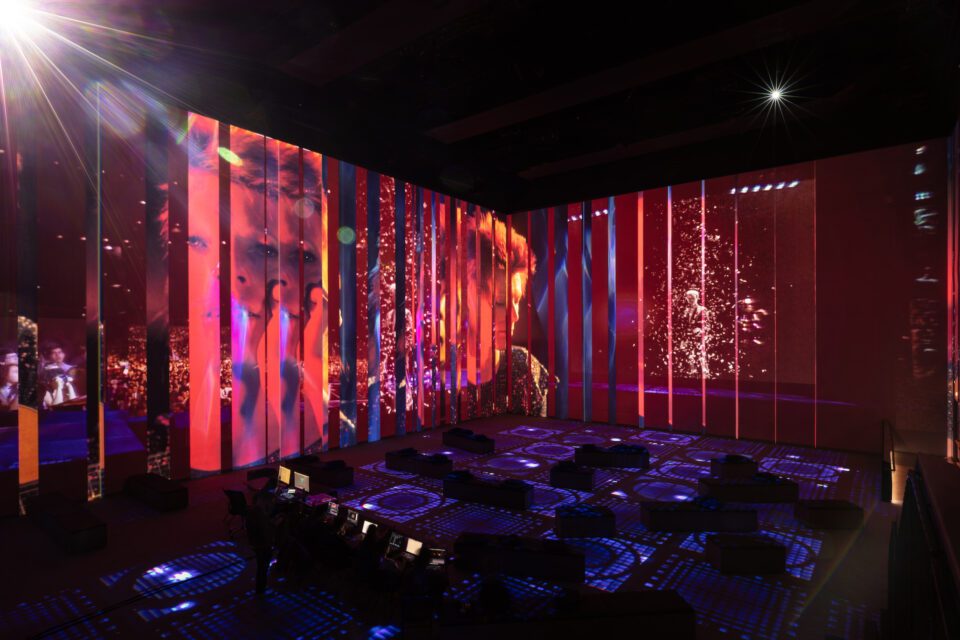
TW: From the start of the process, we knew this show wasn’t going to be a documentary. There are over 100 books about Bowie currently in print, as well as dozens of podcasts, TV retrospectives and of course the films – there can’t be many modern lives that have been pored over in such detail. Given the opportunity to approach Bowie’s work using an entirely different medium – as we have in Lightroom – we wanted to create something that made the most of the possibilities of the space. To us, that meant leaning into the material that would benefit from being experienced at scale, at high volume and in the company of your friends and strangers – which led us towards the live performances. But we didn’t want this to be simply a concert film either, as Bowie in performance was only one angle on his work – so we began looking for material that would help us weave a narrative thread between these moments. It was as we began digging deeper into the hundreds of interviews that Bowie gave across his career that we began to notice the themes that he returned to again and again, and they seemed to offer a new approach to considering his work through his own eyes, and – in particular – his own words. In turn, these themes led us toward material we might have overlooked, and the show began to take shape.
One of the other aspects to experiencing a show in Lightroom is that you have agency over how you engage – it’s not a passive experience like cinema. We can offer multiple angles into any subject – using all the walls and the floor to create a collage-like environment that the audience can explore by moving through the room. This multifaceted approach feels particularly appropriate when framing the work of an artist who was so plural in their approach and diverse in their influences. It felt important to retain some of the restlessness and unpredictability of Bowie’s work into the way we’ve treated the material – so we’ve not tried to impose a single aesthetic across the show, and we’ve deliberately not kept to a linear chronology.
Early in the process, when trying to work out how to weave this all together, we talked a lot about the joy of the best rambling conversations that you have in the pub with a good friend – touching on everything from the profound to the ridiculous in no particular order, yet in a way that feels completely natural. I think we’d all like to have one of those conversations with David Bowie, and there’s something of that feeling permeating the final piece. He describes himself as someone both in love with the richness of life and simultaneously isolated, and his interviews can move from terrible dad-jokes to wrestling with the biggest questions in a heartbeat. There’s an exhilaration in just being exposed to his energetic, inquisitive and charming presence and we’ve tried to tap into that in the narrative formed entirely from his own words.
A: How do you approach reworking archival material when the subject – like Bowie – carries such a powerful cultural legacy and means so much to so many people?
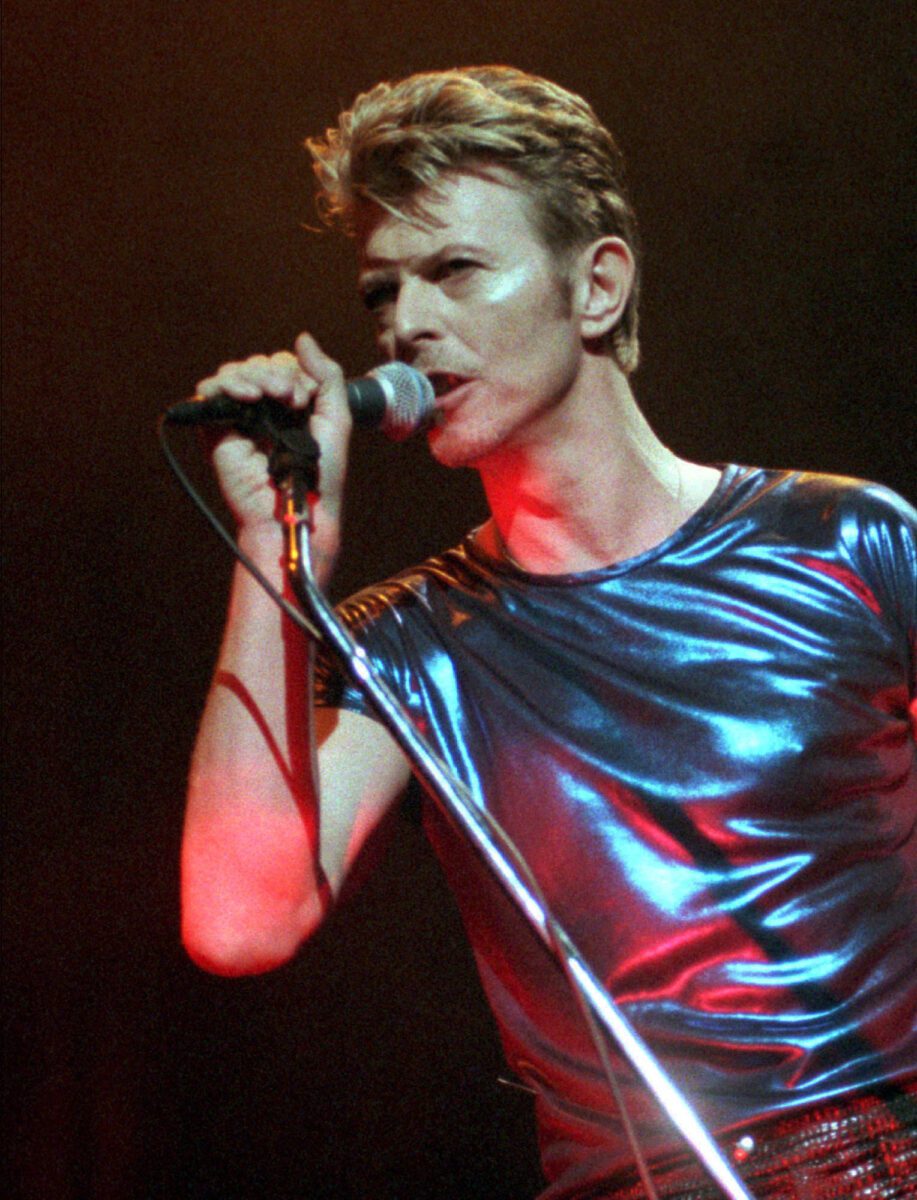
TW: There’s a tremendous feeling of responsibility when working with this material that means so much to people – and we made a decision early on in the process that we weren’t going to try to extrapolate material or use technology to fill in gaps. There’s such a wealth of output to explore within the archives that there was really no need either: some of the video or audio might be a bit scrappy or incomplete, or recorded on a low quality medium, but there’s enough character in all of it that we can allow the audience to use their own imagination to complete the picture. Many people are drawn to Bowie and his work by his enigmatic quality, and it felt appropriate to leave areas open to interpretation, rather than to try to use technology to present a polished, pixel-perfect simulation.
Bowie was a serial collaborator too, and within the archives there’s an amazing wealth of work from great musicians, photographers, filmmakers, costume designers and other creatives who are responsible for much of the way in which he appeared to the public. The show features D.A. Pennebaker, David Hemmings, Mick Rock, Duffy, Sukita, David Mallet, Floria Sigismondi, Mark Romanek and dozens of others, and it felt important to allow that work some space. Bowie said he was “not an original thinker” but more of a “synthesiser” – and to some extent we’ve tried to tap into that, bringing together diverse bodies of work and formulating them into something that feels new. Sometimes that’s creating unexpected juxtapositions, and sometimes it means getting out of the way and letting the performances speak for themselves.
A: The exhibition focuses on Bowie “the human” rather than mythic characters like Ziggy Stardust, Aladdin Sane, or The Thin White Duke. How did that idea influence the show’s design and storytelling?
TW: From listening to all the interviews and speaking to his friends and collaborators, it’s clear Bowie had a very keen sense of humour and a wonderful, self-deprecating charm, and yet that human side has sometimes been overshadowed by the image of the mysterious, extra-terrestrial rock god. What’s really striking about listening to him speak is that he was as human as the rest of us: excitable, uncertain, fallible, mortal. Of course he led a completely extraordinary life, and possessed a unique talent, but there’s plenty in him that we can see in ourselves, and that felt like an interesting avenue to explore. A guiding principle was not so much “what can we learn about David Bowie”, but more “what can we learn from David Bowie.”
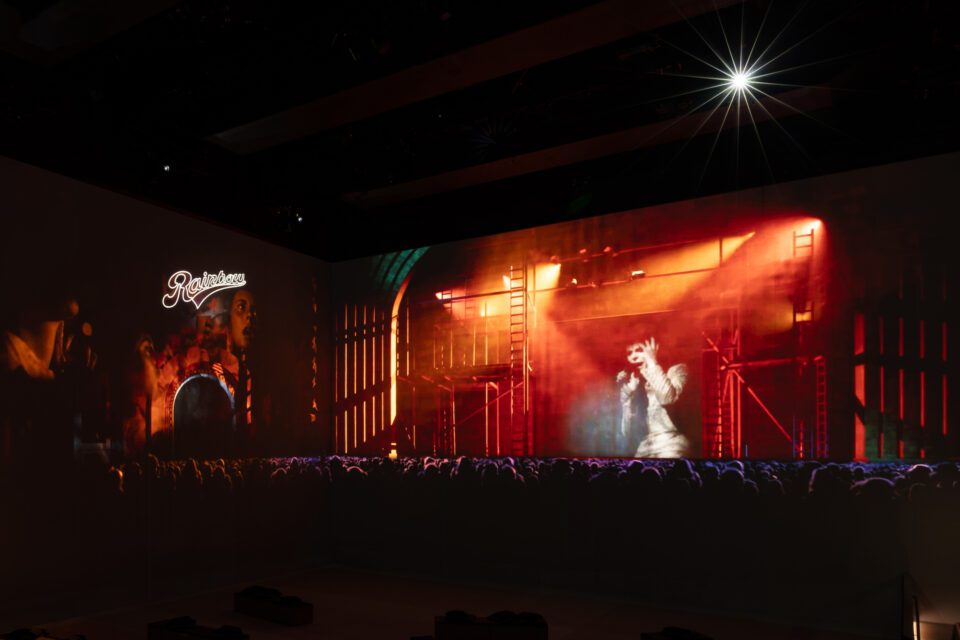
A: You’re Not Alone is described as “an intimate and revealing self-portrait.” What might audiences discover about Bowie that they didn’t know before? And how might experiencing the show in 360° change the way audiences understand or connect with him, compared with traditional displays?
TW: A traditional exhibition foregrounds venerated physical objects – evidence of a moment that has passed, and is now represented by a token. There can be something wonderful about that which draws on the same emotions that inspires pilgrimage, but in this environment we wanted to create something that felt alive and present, not trapped in a glass box. We’ve got this incredible footage, a huge space and a powerful sound system, but most importantly we’ve got a room filled with people who are experiencing something together. It isn’t maudlin, it should feel exhilarating and inspiring, and full of life.
A: The show includes reconstructed elements, such as the Diamond Dogs tour set. What were the technical challenges of bringing these moments back to life?
TW: With something like the set from the Diamond Dogs tour, it’s possible to piece together the set from the documentation in the archives – but there’s very little footage of the show itself. It was a fiendishly complicated piece of engineering, and notoriously problematic to construct, but represented a leap forward in the complexity of rock’n’roll shows inspired by the coming together of Bowie’s theatrical sensibilities with his ability to draw a big audience. The danger of trying to reproduce the stage show is that one can end up in the famous “uncanny valley” where things look almost real, but disturbingly imperfect. We’ve avoided this by taking a more fragmented, collage-like approach and using the actual set drawings and models as our source material. We’re not trying to create a pixel-perfect simulacrum of a show, but rather evoke the visual and sonic feeling of being there. A big part of that has been to use extensive footage of the audience, B-roll and photography to build an atmosphere rather than a virtual reproduction.
A: How do you adapt footage originally created for television or films so that it works in an immersive, large-scale space like Lightroom? How did the architecture of the space influence the show?
TW: When editing for a single screen, the director or editor has to make a decision on behalf of the viewer: should we see the guitarist here… maybe a cutaway to the crowd now… now a wide shot. In Lightroom, the process is different. We’ve had access to multiple cameras, and we can present as many of these simultaneously as we choose. This allows the audience some agency in the way they take it in. In that way it’s more similar to a live show, where you might find yourself focusing on the guitarist for a verse, or taking in the atmosphere of the room at another moment. We’re still constrained by the rectangular frame of each individual shot, but we can be more playful and generous in how we choose to use that footage.
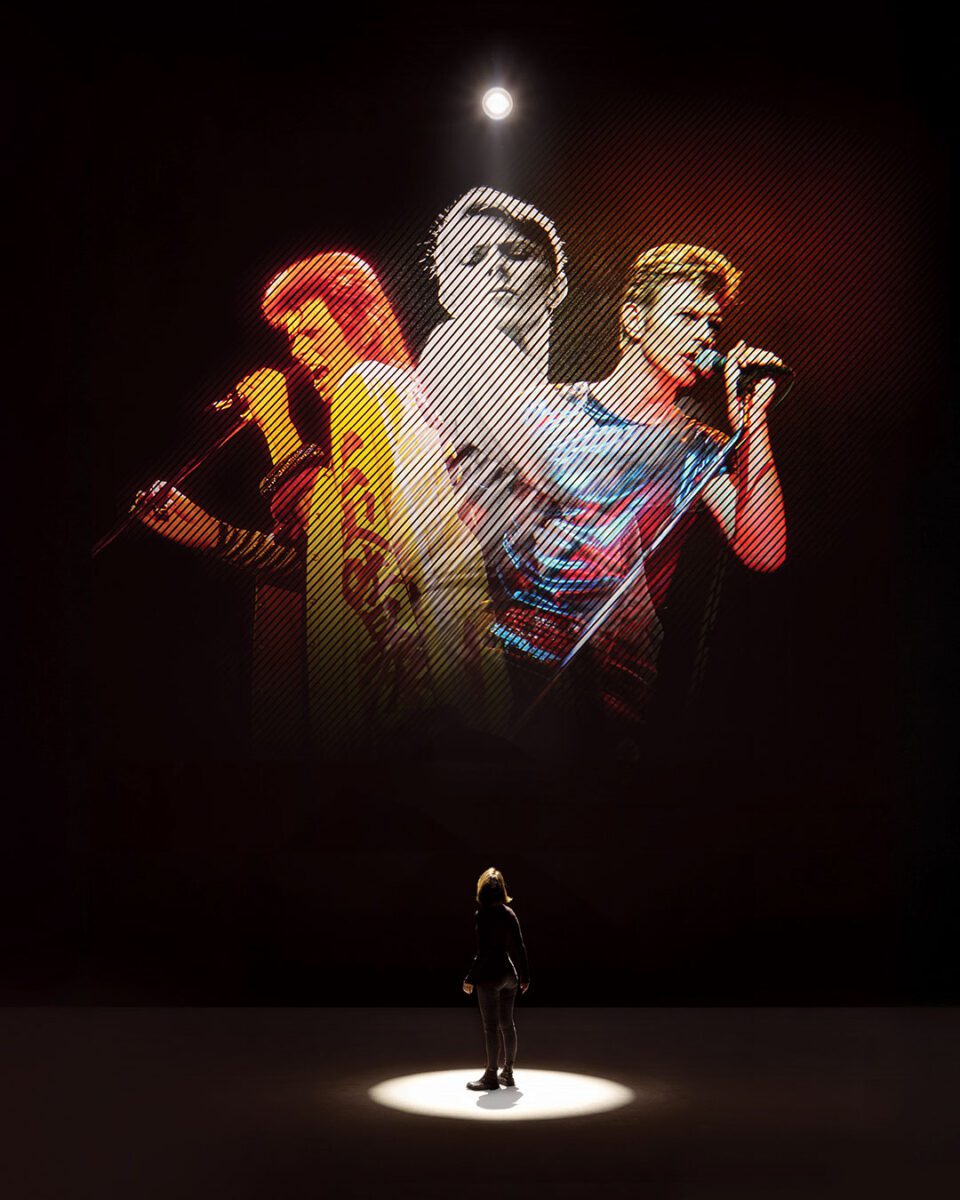
A: How does Gareth Fry’s spatial audio design shape the experience of Bowie’s performances in 360°?
TW: Most of the music in the show is drawn from live performances, rather than studio recordings. We’ve been lucky enough to have access to the original multitrack tapes of the shows, and Gareth’s been able to create mixes for the spatial audio system that sound quite unlike a stereo recording. Our aim has been to create a real sense of liveness, and a soundscape that feels different from different areas of the room. David’s voice really feels like it’s coming from one direction, with the band surrounding him. By returning to the original tapes we’re also able to include all the nuances ironed out in live albums – a wrong note here and there, a bumped microphone, interjections from the crowd – and it feels immediate and raw as a result. We’re also able to give a real sense of being surrounded by a crowd with feeds from original audience microphones being directed around the space – it’s quite unlike anything else.
A: What was the most rewarding part of directing this experience? Did anything shock or move you?
TW: I suppose the biggest surprise for me is that even after being immersed in Bowie’s music for so long, I’m still not remotely tired of listening to it. There’s always something new to dive into – an album I’d overlooked, a project that never came to fruition, some insight that emerges from an interview – a lifetime’s worth of tangents to follow. It’s been an incredible privilege to have access to all the material that’s gone into the show, and so much that we don’t have room to include.
A: Is there a particular moment in You’re Not Alone that you think will stay with audiences? What do you hope visitors take away, including those less familiar with Bowie’s life and work?
TW: At one point in the show we see Bowie performing two tracks in succession – The Loneliest Guy and Rock’n’Roll Suicide – written and performed 30 years apart, one famous, the other less so. There’s a lifetime of experience between those two moments, and it can be hard to believe that these are the product of the same person. That idea of remaining plural, changeable, unpredictable – that’s something I’d love visitors to take away. Maybe when people leave, they might choose to head off in a direction they’ve not been before.
David Bowie: You’re Not Alone is at Lightroom, London, from 22 April – 10 October.
Words: Eleanor Sutherland
Image Credits:
1. David Bowie: You’re Not Alone at Lightroom.
2. David Bowie: You’re Not Alone at Lightroom. Installation shot by Justin Sutcliffe.
3. David Bowie, Outside, 1995. Image by Bob Child.
4. David Bowie: You’re Not Alone at Lightroom. Installation shot by Justin Sutcliffe.
5. David Bowie: You’re Not Alone at Lightroom.