Britain’s historic landscapes are increasingly being redefined through contemporary artistic intervention, where heritage sites function less as static archives and more as evolving fields of cultural production. Within this shift, sculpture and installation are no longer positioned as temporary overlays upon history, but as agents that actively reshape how landscape, architecture and memory are perceived. The stately home, once a site of preservation and fixed narrative, is being reimagined as a space of encounter in which contemporary practice can test the boundaries of time, material and ecology. Anya Gallaccio’s forthcoming exhibition at Gunton Park, Norfolk, sits firmly within this trajectory, extending her long-standing engagement with decay, transformation and the instability of natural systems. Here, landscape is not simply a setting for sculpture, but the condition through which the work comes into being. The result is an exhibition that resists permanence at every level, insisting instead on continual change.
This broader institutional recalibration can be seen across major heritage and landscape sites in the UK, where contemporary art has become integral to programming rather than supplementary to it. At Castle Howard, large-scale artistic interventions such as those by Es Devlin have reconfigured the relationship between narrative, architecture and environment through immersive spatial design. Meanwhile, at Harewood House, exhibitions drawing on archival figures such as Cecil Beaton have continued their exploration towards the intersections of photography, performance and aristocratic representation within a historic setting. More recently, at Kew Gardens, Henry Moore’s monumental outdoor sculptures have been installed across the landscape in one of the most extensive presentations of his work to date, reinforcing the idea that sculpture is fundamentally altered by exposure to weather, planting and seasonal change. Across these sites, the emphasis is increasingly on duration and encounter rather than display, with works activated through movement and time rather than fixed viewpoints.
It is within this context that Thomas Dane Gallery presents Anya Gallaccio’s new off-site project at Gunton Park. The exhibition unfolds within a 1,000-acre deer park near Cromer in North Norfolk, an environment defined by its layered planting, shifting light and proximity to the Gunton Arms, which functions as both social space and informal threshold to the estate. Works are distributed across woodland and interior locations, requiring visitors to move through terrain rather than encounter objects in a single field of vision. This sequencing of experience is essential to Gallaccio’s practice, where perception is shaped gradually through proximity, duration and environmental change. Nothing is presented as fixed; instead, each work is activated by its surroundings, which continually alter how it is read.
Gallaccio, born in Paisley in 1963, has developed a practice rooted in the instability of organic matter and the temporal conditions of perception. Working between London and San Diego, she has consistently explored how materials such as fruit, flowers, trees and edible substances behave outside the stabilising logic of the gallery. Her work has been presented at institutions including Turner Contemporary, Tate Britain, Camden Arts Centre and the Museum of Contemporary Art San Diego, alongside major outdoor commissions at sites such as Yorkshire Sculpture Park, The Whitworth, Jupiter Artland and The Contemporary Austin. Across this body of work, sculpture is not understood as an object with a stable identity, but as a process unfolding in real time, shaped by decay, weather and biological transformation.
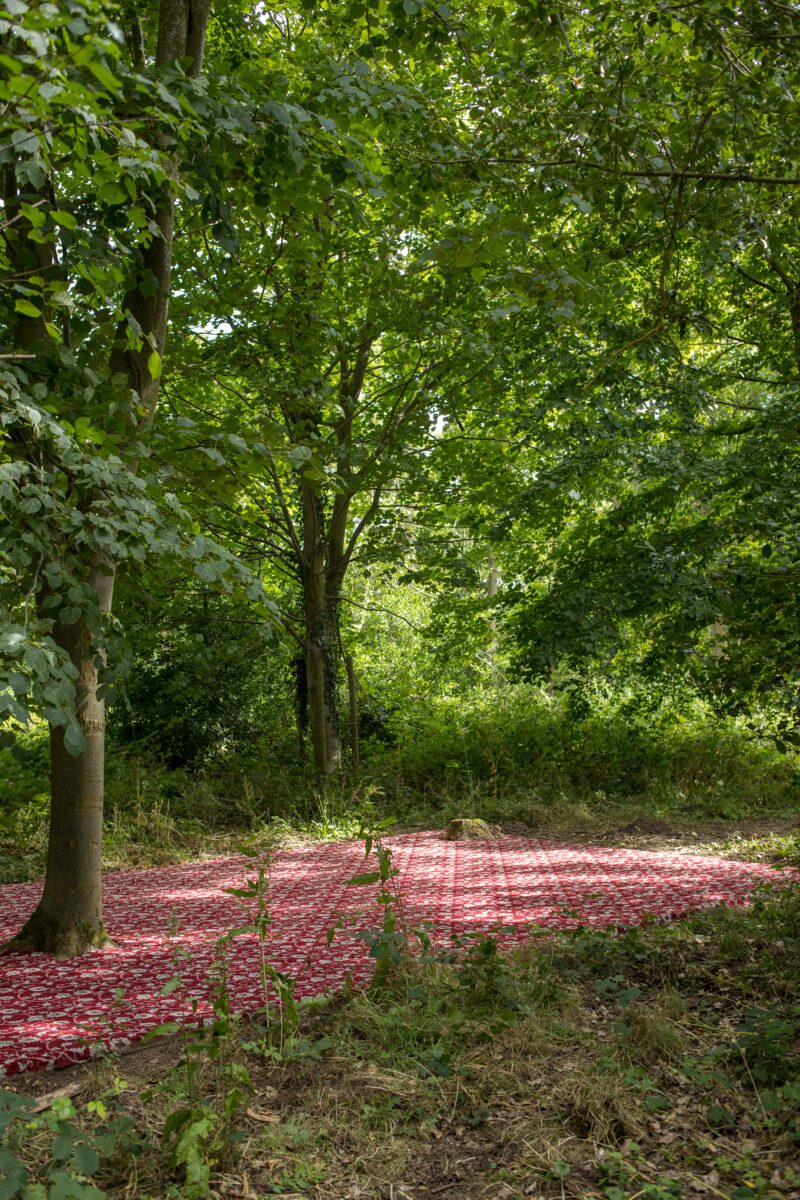
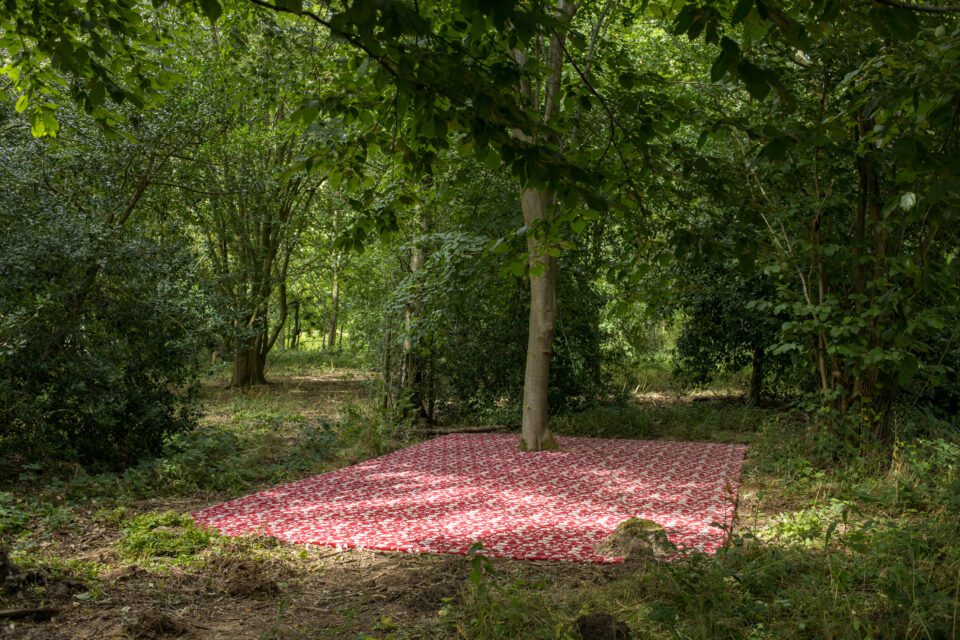
The Gunton Park exhibition brings together three significant historical works that articulate this relationship between material, time and landscape. forest floor (1995) consists of a rectangular expanse of floral patterned carpet laid directly onto woodland ground. The work produces a visual and conceptual inversion: decorative systems derived from botanical imagery are returned to the environment that originally informed them. The patterned surface sits uneasily against soil, moss and leaf litter, creating a tension between manufactured ornament and living ecology. Rather than blending into the landscape, it asserts its artificiality while simultaneously being absorbed by it over time.
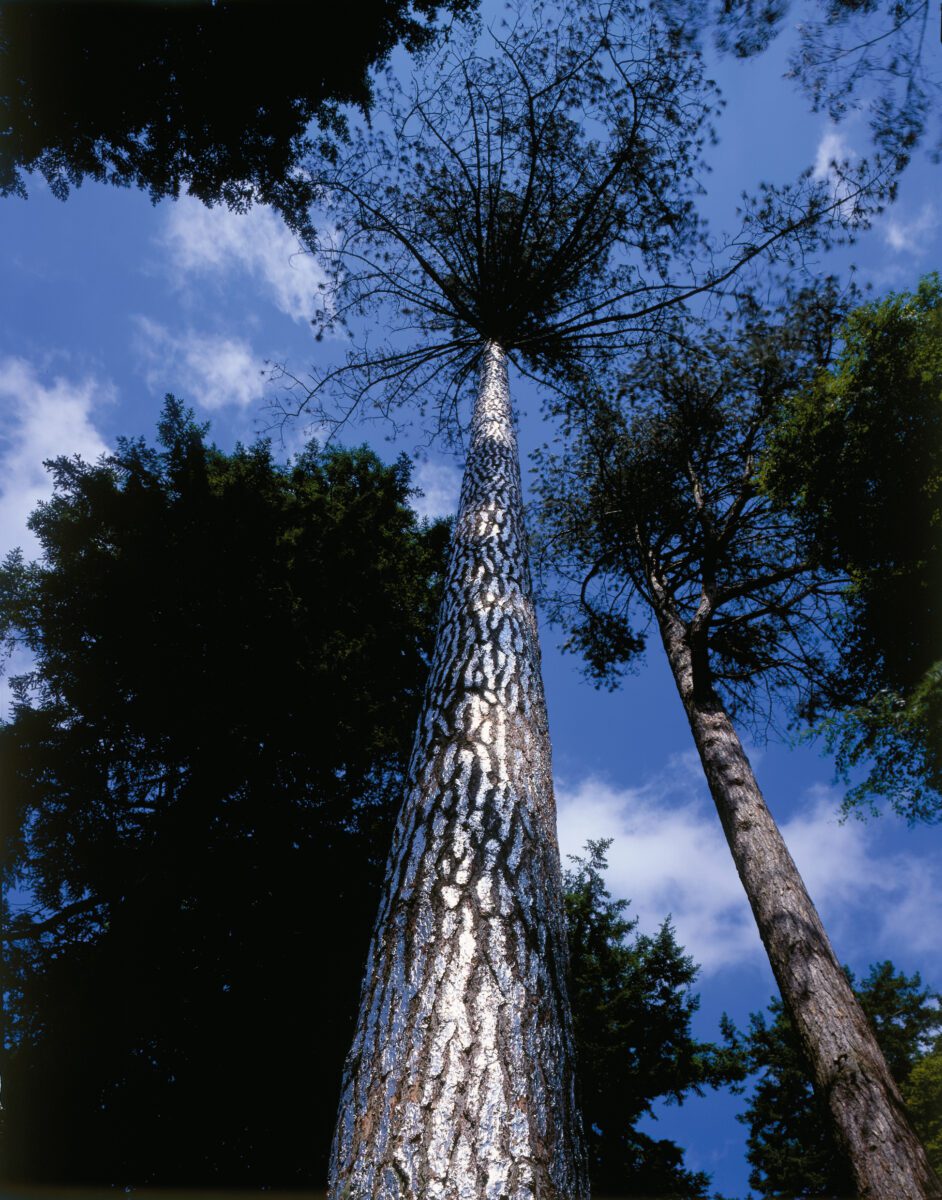
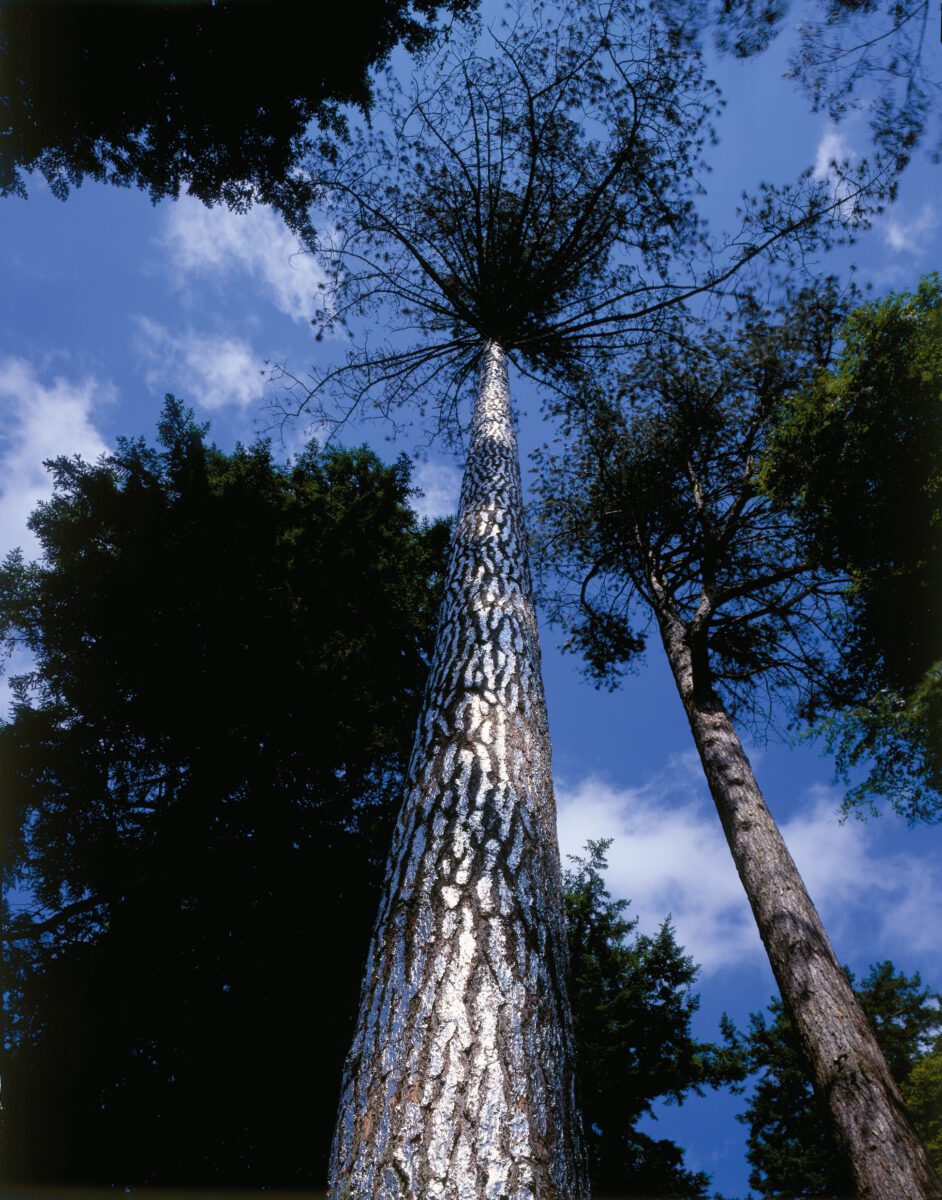
In begin again to the summoning birds (2005), a mature conifer is covered in silver leaf, transforming its surface into a reflective skin that shifts with changing light. As daylight moves across the park, the tree alternates between opacity and luminosity, its material surface unable to settle into a single visual state. The intervention does not stabilise the tree as an image; instead, it intensifies awareness of atmospheric conditions that are usually peripheral to perception. The work exists only in relation to time passing through it. Installed outdoors, it becomes a register of weather rather than a fixed sculptural form.
The third work, as long as there were any roads to amnesia and anaesthesia still to be explored (2002), a group of oak trunks stripped of branches and foliage. Arranged vertically, resembling architectural columns or fragments of a ruined structure, yet remaining unmistakably organic in scale and material. First shown in the Duveen Galleries at Tate Britain, the work is reinstalled using the original tree trunks, carrying with them the memory of previous contexts. At Gunton Park, the absence of canopy heightens their exposure by letting light fall directly across bark surfaces emphasizing texture, age and volume. The surrounding woodland reframes them not as remnants, but as suspended presences between life and construction.
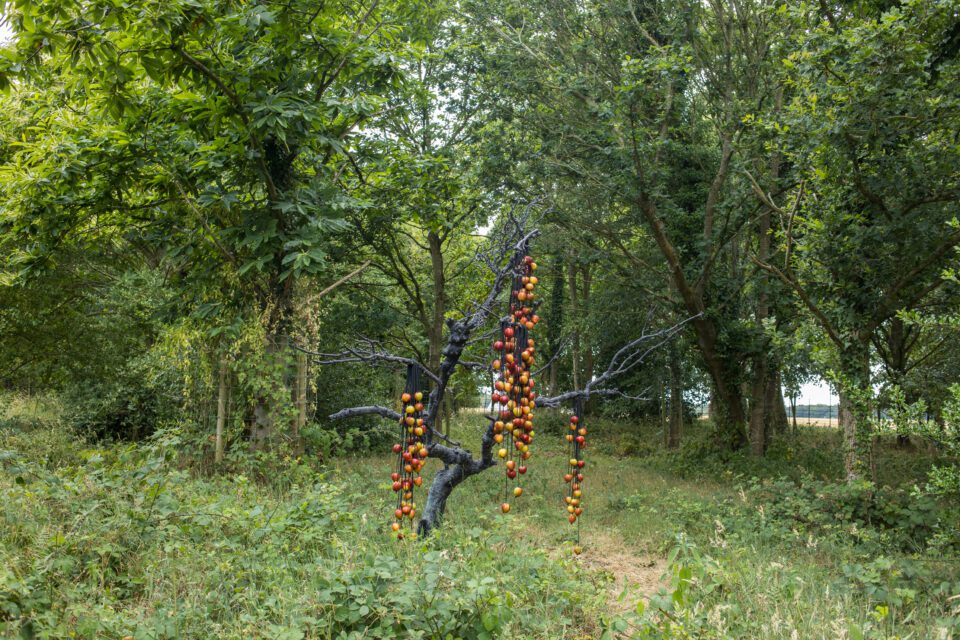
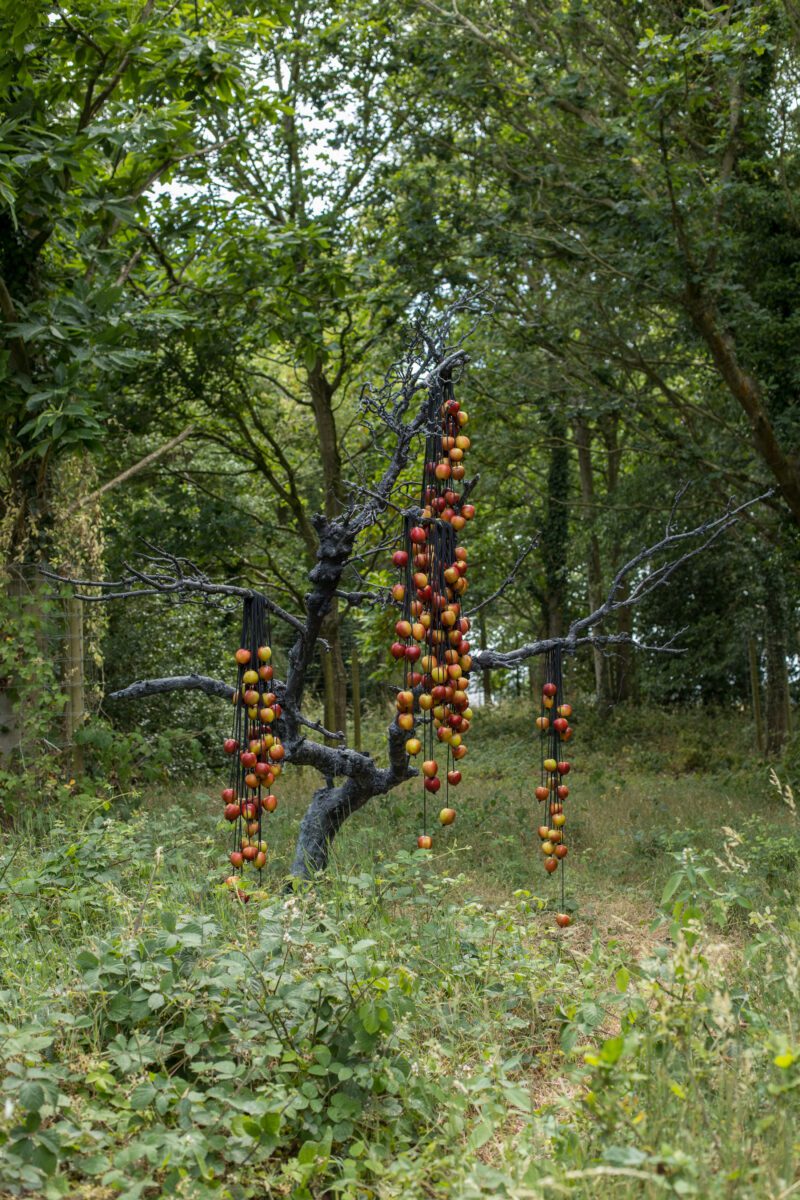
Alongside these works, new commissions extend Gallaccio’s investigation into the entanglement of preservation and decay. A life-size bronze apple tree supports real fruit that gradually deteriorates, producing a continuous tension between cast permanence and organic collapse. The sculpture resists resolution: its meaning shifts as the fruit changes state, moving from fullness to softness to disappearance. Nearby, glass flower press works frame botanical material at different stages of compression and drying, suggesting both archival impulse and inevitable loss. These works do not preserve nature so much as expose the impossibility of full preservation, where every act of fixing is also an act of transformation.
Gallaccio’s practice sits among artists concerned with ecological systems, material change and temporal experience. There are affinities with Andy Goldsworthy in the use of natural materials and site responsiveness, though Gallaccio’s emphasis is less on gesture than on duration. Connections can also be drawn to Giuseppe Penone, whose work reveals the internal structures of growth within trees, and Agnes Denes, whose large-scale ecological projects foreground long-term environmental thought. Yet, Gallaccio’s work remains distinct in its refusal to stabilise ecological meaning into statement or symbol. Instead, it holds attention within the instability of processes themselves, where transformation is never complete.
Gunton Park becomes an active component in this system of change. The estate’s combination of woodland, open parkland and historic architecture produces a shifting field of perception in which artworks are constantly recontextualised by movement, weather and seasonal variation. The proximity of the Gunton Arms introduces a social dimension, where hospitality and landscape intersect, extending the exhibition beyond the frame of the traditional gallery visit. As visitors move through the park, the distinction between artwork and environment becomes increasingly difficult to maintain. Each work is apart of a broader ecology of surfaces, sounds and durations rather than as an isolated object.
Within Gunton Park, Gallaccio’s works resist resolution into fixed forms, instead remaining open to the processes that continually reshape them. Meaning is not imposed through curatorial control but emerges through exposure, where time operates less as backdrop than as an active material. Rather than presenting a sequence of discrete objects, the exhibition unfolds as shifting states of matter and perception, each contingent on the conditions that surround it. Sculpture here is understood as fundamentally unstable, held in suspension between presence and disappearance. What persists is not permanence, but instead sustained attention to change itself — gradual, continuous and irreversible.
Anya Gallaccio is at Gunton Park, Norfolk until 13 September: thomasdanegallery.com
Words: Shirley Stevenson
Image Credits:
1&6. Anya Gallaccio, begin again to the summoning birds, 2005. silver leaf. Mount Stuart Trust, Isle of Bute, Scotland © Anya Gallaccio. Courtesy the artist and Thomas Dane Gallery.
2. Anya Gallaccio, forest floor, 1995/2026. Domestic floral patterned carpet 700 x 400 cm. 275 1/2 x 157 1/2 in. Installation view, Gunton Park, Norfolk, 2026.© Anya Gallaccio. Courtesy the artist and Thomas Dane Gallery. Photo: Katherine Mager.
3. Anya Gallaccio, Everything starts in doubt, 2026. bronze tree, apples 360 x 260 x 200 cm. 141 3/4 x 102 1/4 x 78 3/4 in. Installation view, Gunton Park, Norfolk, 2026. © Anya Gallaccio. Courtesy the artist and Thomas Dane Gallery. Photo: Katherine Mager.
4. Anya Gallaccio, forest floor, 1995/2026. Domestic floral patterned carpet 700 x 400 cm. 275 1/2 x 157 1/2 in. Installation view, Gunton Park, Norfolk, 2026.© Anya Gallaccio. Courtesy the artist and Thomas Dane Gallery. Photo: Katherine Mager.
5. Anya Gallaccio, Everything starts in doubt, 2026. bronze tree, apples 360 x 260 x 200 cm. 141 3/4 x 102 1/4 x 78 3/4 in. Installation view, Gunton Park, Norfolk, 2026. © Anya Gallaccio. Courtesy the artist and Thomas Dane Gallery. Photo: Katherine Mager.