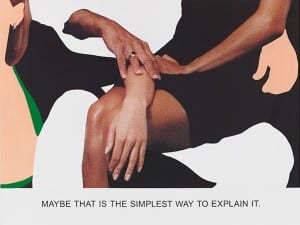
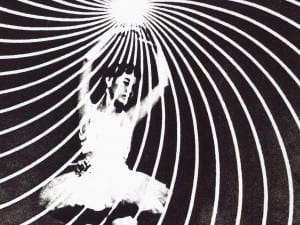
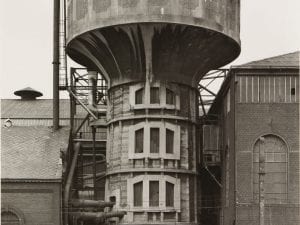
Humour is often dismissed as trivial, a fleeting moment of pleasure, a pause between more serious encounters with life. Yet, within the realm of contemporary art, it functions as much more than amusement; it is a lens, a critical instrument through which we examine the absurd, the illogical, and the unexpected dimensions of human experience. Seriously., the latest exhibition at Sprüth Magers, London, situates humour at the centre of its enquiry, inviting audiences not merely to laugh, but to interrogate the cultural and political frameworks that humour illuminates. It is an exhibition that asks us to consider what it means to be funny, and why some things resonate while others remain opaque.
Humour is inherently subjective. What provokes laughter in one viewer may fall flat in another; context matters, as does personal experience, taste, and cultural reference. This exhibition acknowledges that complexity, including works that span the historically humorous, the subtly ironic, and the deceptively serious. The curatorial decision to foreground humour challenges conventional hierarchies in art, highlighting wit, pun, and playful disruption as serious strategies of engagement. Not all pieces were necessarily intended to provoke laughter, yet when framed within this thematic lens, their cleverness, absurdity, and unexpected juxtapositions emerge with a fresh clarity.
The roster of artists represented in Seriously. is remarkable in its breadth, encompassing figures traditionally associated with wit alongside those whose humour is more hidden, conceptual, or nuanced. John Baldessari, a pioneer of linguistic play and visual punning, exemplifies the intersection of humour and intellect. His text-based works and appropriations of found imagery manipulate expectations, revealing the structures of meaning in ways that are both clever and disarmingly funny. In a similar vein, William Wegman’s iconic photographs of Weimaraner dogs in human-like poses bring absurdity and charm into the gallery space, bridging high art and popular culture. However, Baldessari and Wegman sit alongside artists whose humour is subtler challenging viewers to discover the laugh beneath layers of conceptual rigor.
Consider Bas Jan Ader, whose poetic gestures and explorations of failure and loss contain an element of the absurd, even when the underlying intent is tragic or melancholic. Keith Arnatt’s conceptual humour, often found in the quiet absurdities of everyday life, invites reflection on presence, identity, and art itself. Similarly, the works of Bernd and Hilla Becher, with their methodical typologies of industrial architecture, evoke a dry, observational humour: repetition and seriality generate a visual pun of structure versus expectation. Across these examples, humour is never gratuitous; it is embedded in technique, form, and concept, and operates as a subtle counterpoint to seriousness.
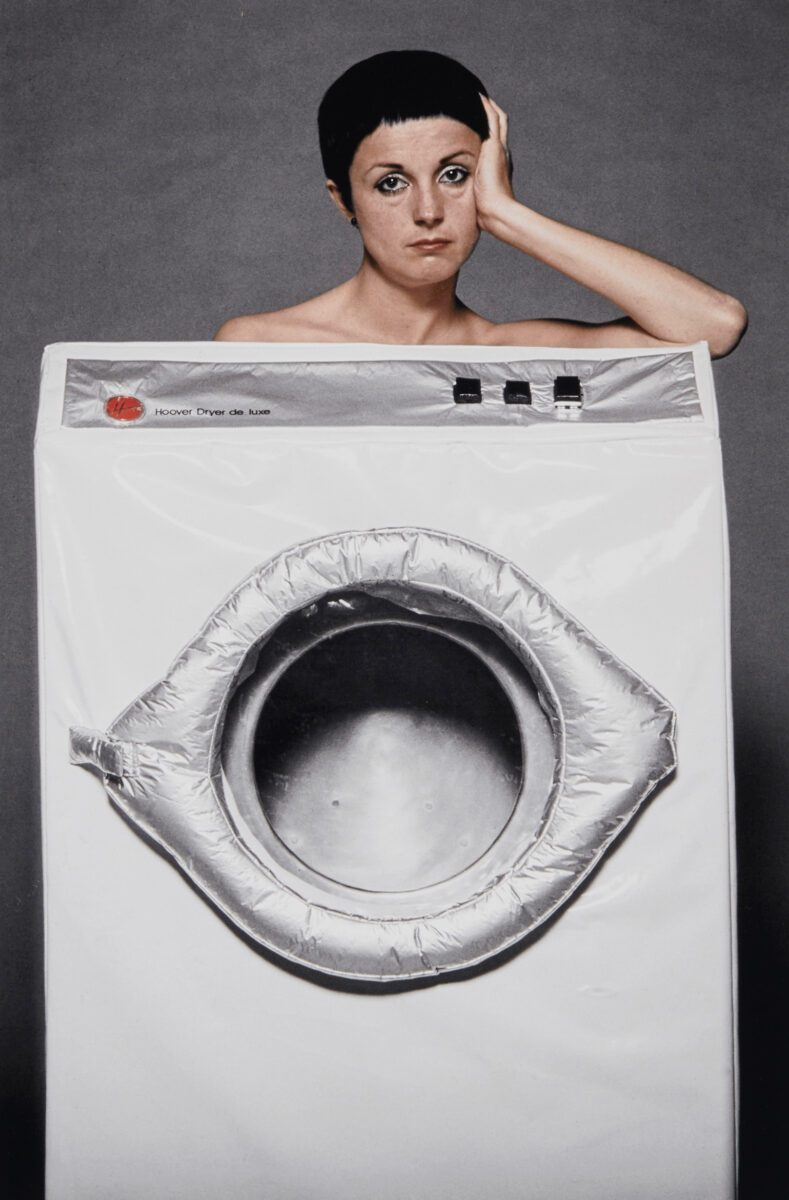
Artists such as Lynda Benglis, Helen Chadwick, Robert Cumming, and Thomas Demand further expand the exhibition’s exploration of humour, blending performance, photography, and installation. Chadwick’s transformative use of materials in her sculptural photographs, for instance, subverts conventional readings of the body and domestic objects, often with playful or unsettling results. Demand’s meticulously staged photographs of constructed environments operate like visual jokes: what appears natural is fabricated, what seems familiar is rendered strange. Through these strategies, humour becomes a tool for critical observation, revealing the quirks, contradictions, and absurdities of social norms.
In other instances, humour intersects with socio-political commentary. Philip-Lorca diCorcia, Cao Fei, and Hans-Peter Feldmann deploy irony and narrative disjunction to question systems of representation, consumer culture, and social hierarchy. Similarly, artists such as Barbara Hammer, Nancy Holt, Robert Smithson, and Rebecca Horn navigate the interplay of humour and ecological or political critique. In these works, laughter and reflection coexist: humour is a mechanism of empathy, a vehicle for critique, and a method of engagement that not only works alongside, but that transcends the purely aesthetic.
The exhibition also foregrounds practices that interrogate identity, gender, and power through wit. Sarah Lucas, Urs Lüthi, Louise Lawler, Cindy Sherman, and Gillian Wearing, among others, use performance, photography, and installation to expose societal contradictions with sardonic humour. In these works, absurdity illuminates serious concerns: the tension between expectation and reality, the construction of self, and the performativity of social roles. Laughter becomes a means of resistance, it reveals structures of authority, privilege, and convention, while inviting audience participation in the act of recognition.
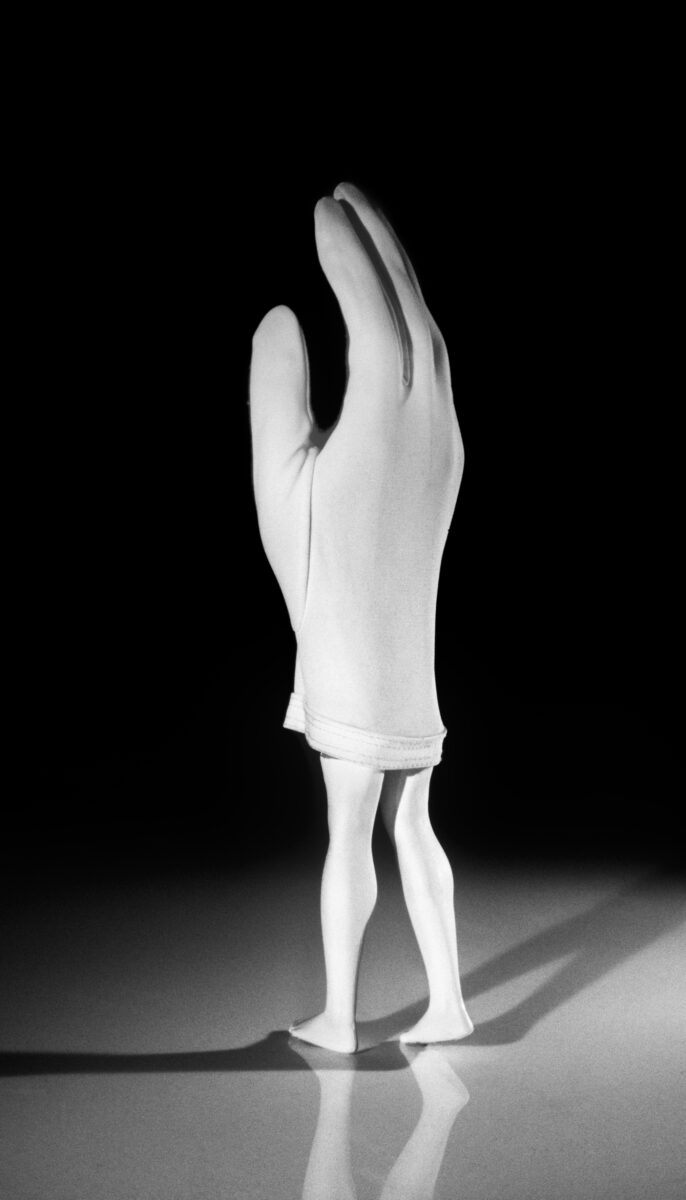
In addition to individual artists, the exhibition highlights relationships and dialogues between historical and contemporary practices. Rodneys Graham’s time-based works, Sigmar Polke’s painterly wit, Charles Ray’s sculptural exaggerations, and Laurie Simmons’ staged photographic narratives form a continuum in which humour evolves across medium and context. By juxtaposing diverse approaches, Seriously. demonstrates that humour in art is not monolithic; it is plural, multifaceted, and often operates in tension with itself, oscillating between clarity and ambiguity, pleasure and unease, insight and irreverence.
At its core, Seriously. celebrates the potency of humour as a mode of critical engagement. It reframes the seemingly trivial as significant, revealing the subtle strategies through which artists provoke thought and dialogue. Humour functions here as a lens through which the strange or illogical aspects of contemporary life are made visible. Whether through absurd visual puns, linguistic play, performative gestures, or ironic interventions, the works on display challenge audiences to confront contradictions, question assumptions, and experience the unexpected delight of intellectual engagement. Moreover, the exhibition foregrounds humour as a relational experience. The act of laughter, of recognition, or even of puzzlement, is inherently social. In this way, humour becomes a conduit for connection: between artist and viewer, between historical moments and contemporary interpretation, and between disparate bodies of work that collectively illuminate the human condition. It is not simply entertainment, nor a mere diversion, but a tool that cultivates empathy, critical awareness, and intellectual curiosity.
The thematic richness of Seriously. is matched by the diversity of media and approaches. Photography, sculpture, installation, video, performance, and conceptual work converge in a single dialogue that is at once playful, profound, and provocative. The exhibition’s breadth, featuring over 60 artists including Anthony McCall, Jonathan Monk, Peter Moore, Bruce Nauman, Dennis Oppenheim, Ed Ruscha, Santiago Sierra, and Carrie Mae Weems, underscores the enduring relevance of humour in contemporary practice. Each work contributes to an overarching exploration of wit, absurdity, and reflection.
In framing humour as a serious lens through which to view contemporary life, the exhibition challenges viewers to reconsider preconceived notions of taste, value and artistic intention. It affirms that humour is not antithetical to depth, insight, or critique; rather, it amplifies these qualities, offering a pathway into complex social, political, and philosophical terrains. Seriously. provokes thought and rewards careful observation, demonstrating that wit and intellectual engagement are inseparable.
Ultimately, Seriously. is a celebration of artistic intelligence, inventive play, and the subversive power of humour. It reminds us that to laugh is not to trivialise, but to engage; to see the absurd is to perceive the structures that shape our lives. In a cultural landscape often dominated by solemnity and urgency, this exhibition offers a space to pause, reflect, and experience the pleasure of insight through humour. It is both a showcase and a manifesto: laughter, with precision and thoughtfulness, is serious business indeed.
Seriously. is at Sprüth Magers, London, until 31 January 2026.
Words: Anna Muller
Image Credits:
1. Thomas Ruff, L’Empereur, 1982. C-Print 10.1 x 14.7 cm | 4 x 5 7/8 inches 31 x 41 cm | 12 1/8 x 16 1/8 inches (framed) Thomas Ruff / VG Bild-Kunst, Bonn 2025. Courtesy Sprüth Magers.
2. Laurie Simmons, Walking Glove, 1991. Pigment Print 213.4 x 121.9 cm | 84 x 48 in Courtesy of the artist.
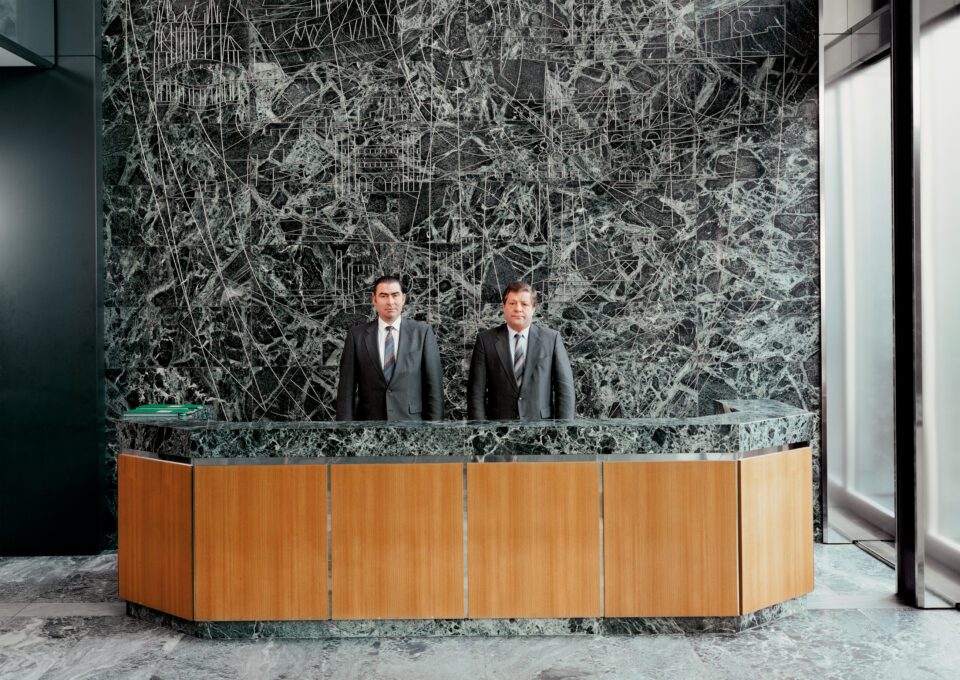
3. Andreas Gursky, Desk Attendants, Provinzial, Düsseldorf, 1982. 43.2 x 53.3 cm | 17 x 21 inches (framed) © Andreas Gursky / DACS, 2025 Courtesy Sprüth Magers.
4. Helen Chadwick, In the Kitchen (Washing Machine), 1977. Colour Archival Pigment Print Image size: 41.9 x 27.7 cm Sheet size: 50.8 x 40.6 cm Approximate framed size: 53.3 x 43.1 cm Copyright Helen Chadwick. Courtesy Richard Saltoun Gallery, London, Rome & New York.
5. Laurie Simmons, Walking Glove, 1991. Pigment Print 213.4 x 121.9 cm | 84 x 48 in Courtesy of the artist.
6. Thomas Ruff, L’Empereur, 1982. C-Print 10.1 x 14.7 cm | 4 x 5 7/8 inches 31 x 41 cm | 12 1/8 x 16 1/8 inches (framed) Thomas Ruff / VG Bild-Kunst, Bonn 2025. Courtesy Sprüth Magers.