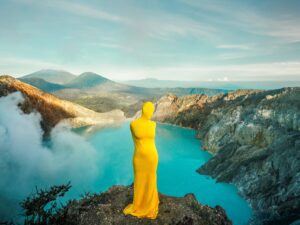
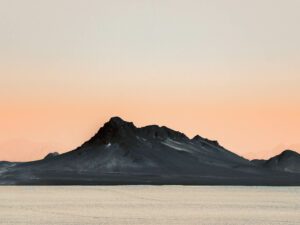
Sarah Maple has spent almost two decades making images out of contradiction. Religion meets feminism; Britishness meets Punjabi inheritance; motherhood sits alongside questions of labour, language and autonomy. Her subjects may begin with the personal, but they rarely stay there. Sarah Maple – Double Life, opening at Museum Arnhem on 3 October, brings together work from across her career, tracing these tensions through photography, painting, video and installation. As the first solo exhibition of Maple’s work at a Dutch museum, it provides a chance to see how questions that first appeared in provocative early photographs have developed into a broader enquiry into family, history and belonging.
Maple was born in the UK in 1985 to a British father and a mother with an Islamic Punjabi background and family roots in India and Kenya. That history sits close to the work, although it would be too simple to treat biography as an explanation for it. Maple has instead made her own image a recurring testing ground, placing herself inside the expectations she is examining and sometimes turning those expectations against themselves. Humour is crucial here. It allows a serious question to arrive sideways, while moments of confrontation stop the work from becoming something that is merely playful.
Her early photographs make that approach particularly clear. Fighting Fire with Fire No. 2 (2007) and God Is A Feminist (2009) bring religion, gender and representation into uneasy proximity, with Maple herself occupying the centre of the image. There is no neutral viewpoint from which to observe the work: the artist is both the person being looked at and the person controlling what can be seen. That tension connects the photographs to a longer history of feminist self-representation, but Maple complicates the familiar language of liberation by bringing religious identity into the picture. Rather than choosing between opposing positions, she allows them to exist together – awkwardly, provocatively and without resolution.
A similar directness runs through Menstruate with Pride (2010–2011). Something ordinarily pushed towards privacy becomes the subject of an unapologetically public image, turning embarrassment into the material of the work itself. Maple is interested in the rules that decide which parts of the body can be discussed openly and which must remain hidden behind euphemism. Feminist artists have long used the body to question that division between public and private; Maple adds a particular mixture of humour and bluntness, making the viewer aware of how quickly discomfort can become a form of social control.
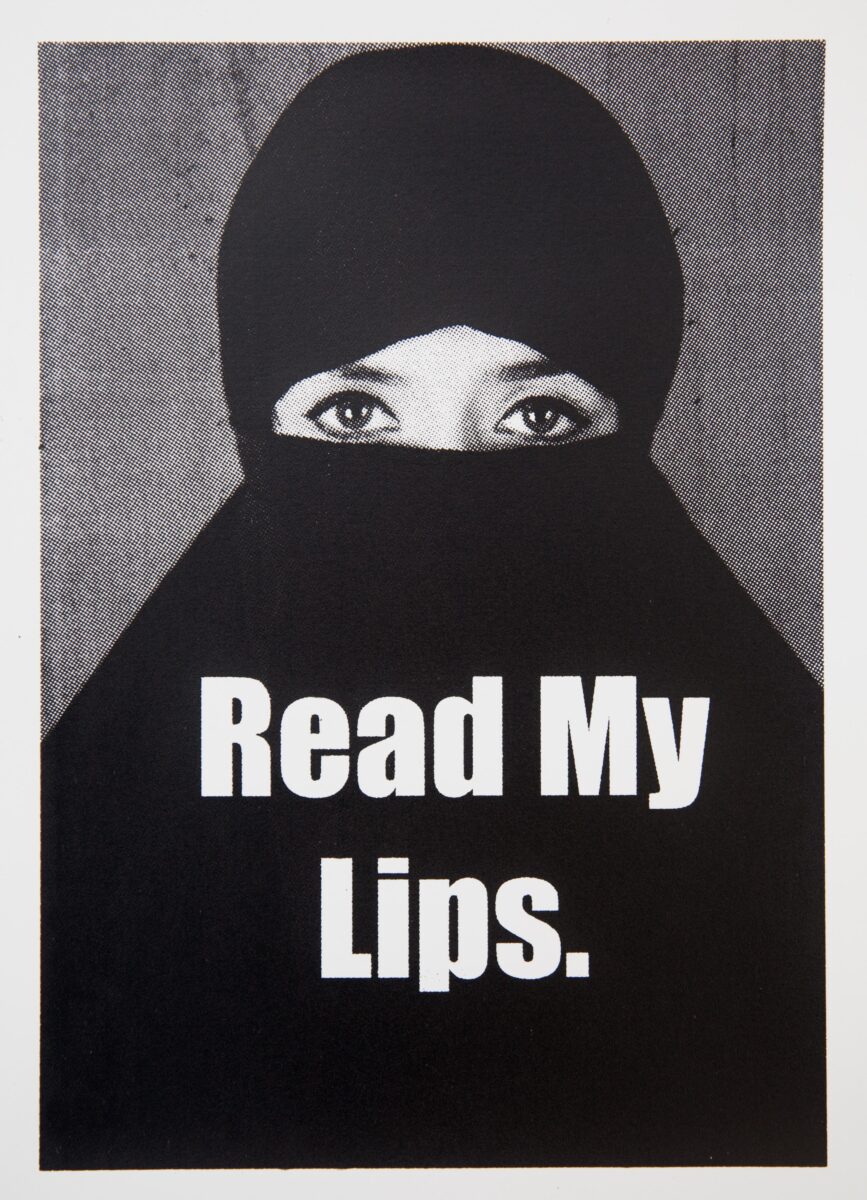
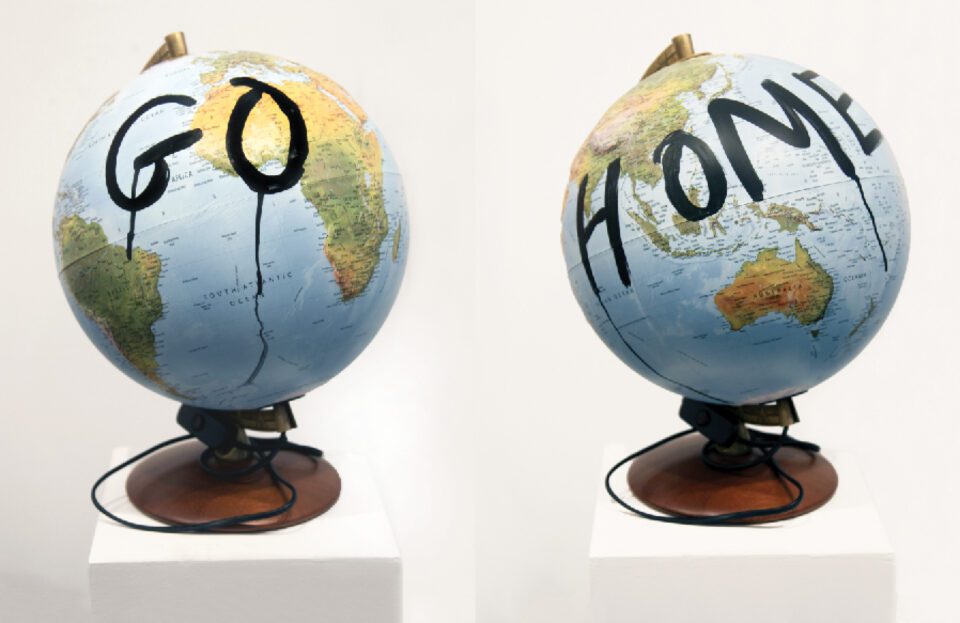
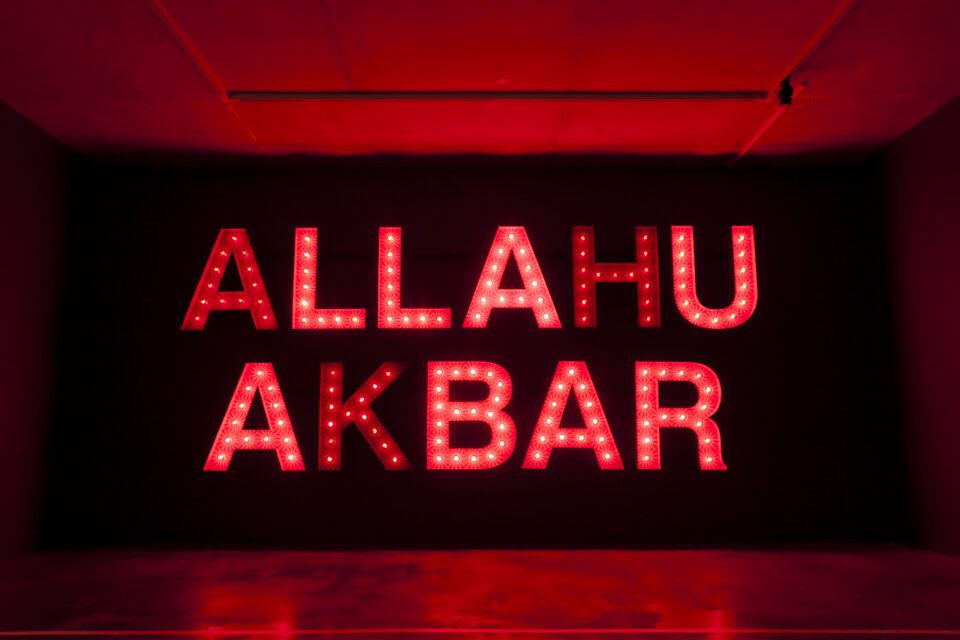
Words carry a similar charge in works such as GO HOME (2016), Read my lips (2016) and Allahu Akbar(2016). Their titles arrive already loaded, carrying histories and assumptions that can precede the images themselves. Maple is interested in that moment when language stops being descriptive and becomes a judgement about who belongs, who is threatening and who is entitled to speak. The Past Is Now (2018) pushes the question into national history, bringing colonialism and British identity into the same frame. Its title refuses the reassuring idea that history sits safely behind us; what happened before continues to shape the present, including the stories nations tell about themselves.
Museum Arnhem’s decision to organise Double Life through thematic chapters rather than simply following the dates of Maple’s career makes these connections easier to see. Works made years apart are brought together around cultural identity, feminism and motherhood, allowing a concern that first appears in one context to return somewhere quite unexpected. A chronological survey might have produced a tidy story of development; this arrangement is more interested in recurrence. The museum has been programming art concerned with identity since the 1980s, and Maple’s work sits within that history while also extending it through her combination of autobiography, humour and confrontation. The exhibition feels less like a catalogue of subjects than a series of conversations between different moments in the artist’s practice.
Motherhood shifts those conversations into a more intimate register. Labour of Love (2022) looks at the work surrounding care – the repetitive, physical and often unseen labour that can disappear behind the cultural ideal of motherhood. The subject is familiar within feminist discourse, but Maple approaches it through the accumulated details of lived experience rather than through an abstract argument about equality. Mother Tongue moves further into questions of inheritance. Punjabi was her mother’s first language, yet Maple only began learning it after becoming a mother herself, creating a strange reversal in which becoming a parent sends her back towards her own maternal history.
Not speaking a language can be as revealing as speaking it, particularly when that language belongs to a parent, a family and a history that has not been entirely passed down. Mother Tongue makes that absence tangible. Cultural identity here is not something automatically secured by ancestry; it must be approached, learnt and sometimes recovered. The work also changes the meaning of motherhood within Maple’s practice. Earlier pieces often ask what society expects women to be, whereas this one considers what a woman might discover about herself through becoming a mother. That movement backwards – towards language, family and memory – gives the work an emotional register that is quieter than some of Maple’s earlier provocations, without making it any less political.
That development can also be traced through Maple’s relationship with the Aesthetica Art Prize. She was shortlisted in 2022 for The Sarah Maple Show, a video art sitcom that turns its attention towards the art world itself and returned to the shortlist in 2025 with Mother Tongue. The two works could hardly appear more different in tone, yet both ask questions about the identities people construct and the structures that surround them. Her practice is also represented in Aesthetica Art Prize 20: Defining the Future of Contemporary Art, the 2026 anniversary exhibition at Scarborough Art Gallery. Across these appearances, satire, autobiography and questions of cultural identity remain connected.
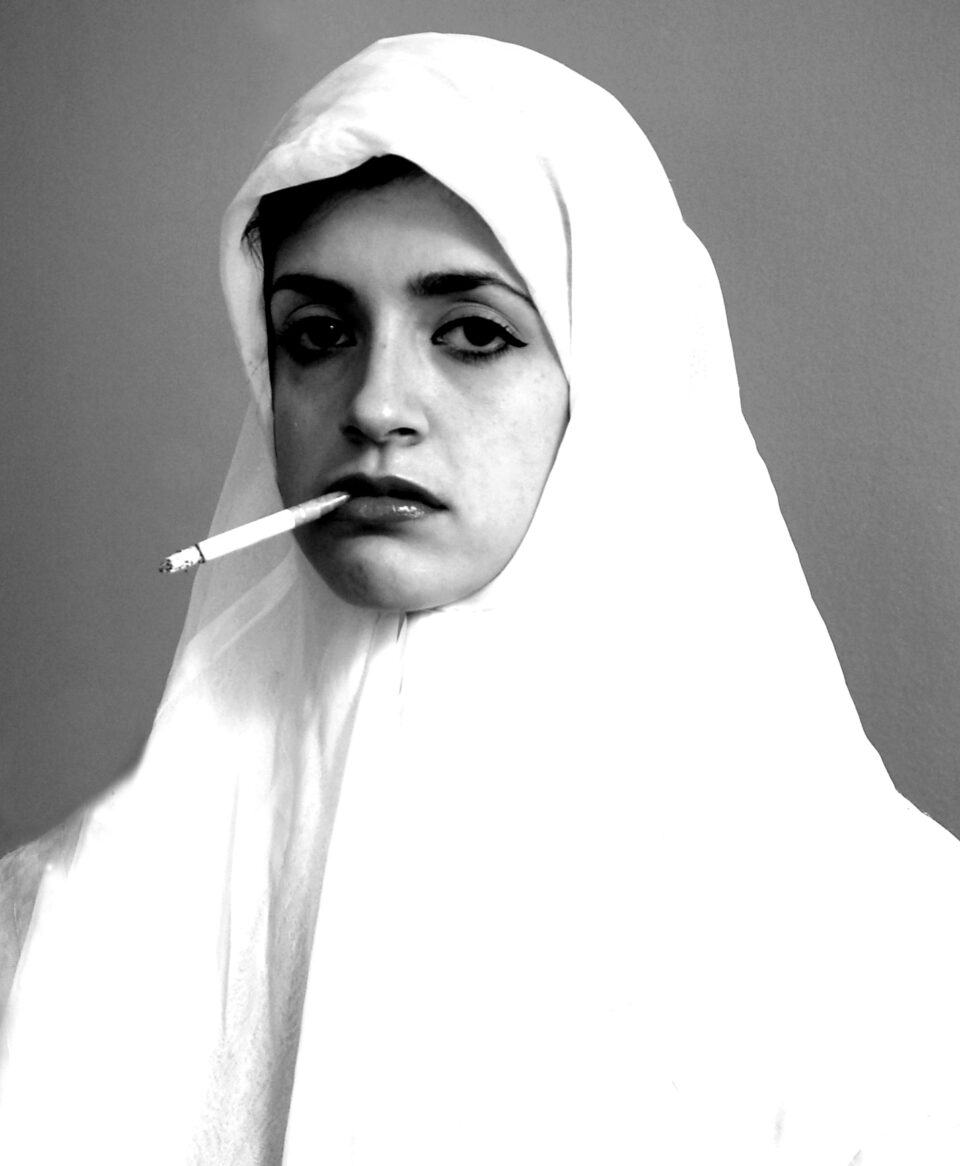
Humour can sometimes make political art look lighter than it is. In Maple’s work, however, comedy is a way of putting pressure on an idea before the viewer has decided how to respond to it. A joke can expose an assumption more quickly than an explanation, particularly when the subject is something as heavily coded as religion, gender or national identity. That is part of what makes her use of herself so effective: she is not presenting identity as a fixed position from which to lecture the viewer, but as something to be performed, questioned and reassembled. The work’s provocations depend on uncertainty as much as certainty – on the possibility that a viewer might laugh, feel uncomfortable and then have to work out why.
That quality becomes important when considering Maple’s place within contemporary art discourse. Artists working with autobiography have increasingly challenged the expectation that personal experience should provide a straightforward account of identity, particularly when that identity has historically been represented by other people. Maple’s work pushes against that expectation. Her biography matters, but she does not turn herself into a spokesperson for a single community or experience. Instead, she uses particular details – a religious symbol, a phrase, a bodily experience, a family language – to open questions that remain deliberately unresolved. The result is work that can be personal without becoming confessional, and political without becoming didactic.
Curation plays an important role in preserving that openness. Museum Arnhem is presenting a broad overview, from the controversial early photographs on Islam and representation to later feminist paintings and recent installations addressing motherhood and cultural connection. A new painting, made for the exhibition, will join the museum’s collection after the show closes. A publication on Maple’s practice, published by KochxBos Gallery and including contributions from curator Manon Braat, accompanies the exhibition, while lectures, talks and participatory events extend its questions into a wider public setting.
What makes Double Life compelling is the way these subjects keep folding back into one another. Religion becomes inseparable from questions of gender; national history surfaces in a discussion of belonging; motherhood leads to language and cultural inheritance. Nothing is finally settled, and that seems important. Maple’s work does not ask the viewer to choose between identities or to arrive at a single interpretation of them. Instead, it keeps returning to the uncomfortable space where different parts of a life overlap – where the personal becomes political, where the past remains present, and where something as intimate as a mother tongue can reveal the larger histories carried inside it.
Sarah Maple – Double Life is at Museum Arnhem from 3 October – 11 April: museumarnhem.nl
Words: Shirley Stevenson
Image Credits:
1&4. Sarah Maple, Fighting Fire with Fire No. 2, 2007.
2. Sarah Maple, Read my lips, 2016.
3. Sarah Maple, GO HOME, 2016.
5. Sarah Maple, Allahu Akbar, 2016.