

Tate Modern’s programme is a global cultural barometer – less a sequence of shows than a continuous reconfiguration of how contemporary art is experienced, narrated and absorbed. The recent Tracey Emin: A Second Life survey sharpened this direction, folding autobiography into institutional scale with an intensity that blurred confession and spectacle. It sat in productive tension with earlier landmark presentations such as Yayoi Kusama’s Infinity Rooms and Olafur Eliasson’s The Weather Project, both of which recalibrated perception itself as curatorial material. More recently, El Anatsui’s expansive material assemblages and A World in Common: Contemporary African Photography have extended this trajectory, shifting attention toward global image systems and transformed matter. Across these moments, Tate Modern operates less as a container than a generator of cultural meaning, constantly rewriting its own grammar of modernity.
Within that evolving framework, Frida: The Making of an Icon arrives as both culmination and counterpoint. Rather than functioning as a conventional retrospective, it operates as an enquiry into visibility itself – how an artist becomes an image, and how that image mutates across time, geography and ideology. Kahlo’s work is positioned not as fixed heritage but as active infrastructure, shaping and being reshaped by successive artistic generations. The result is less a linear narrative than a distributed field of references, where biography, politics and aesthetics overlap without resolution. What emerges is a portrait of cultural persistence, one that aligns with the institution’s broader shift toward networked histories.
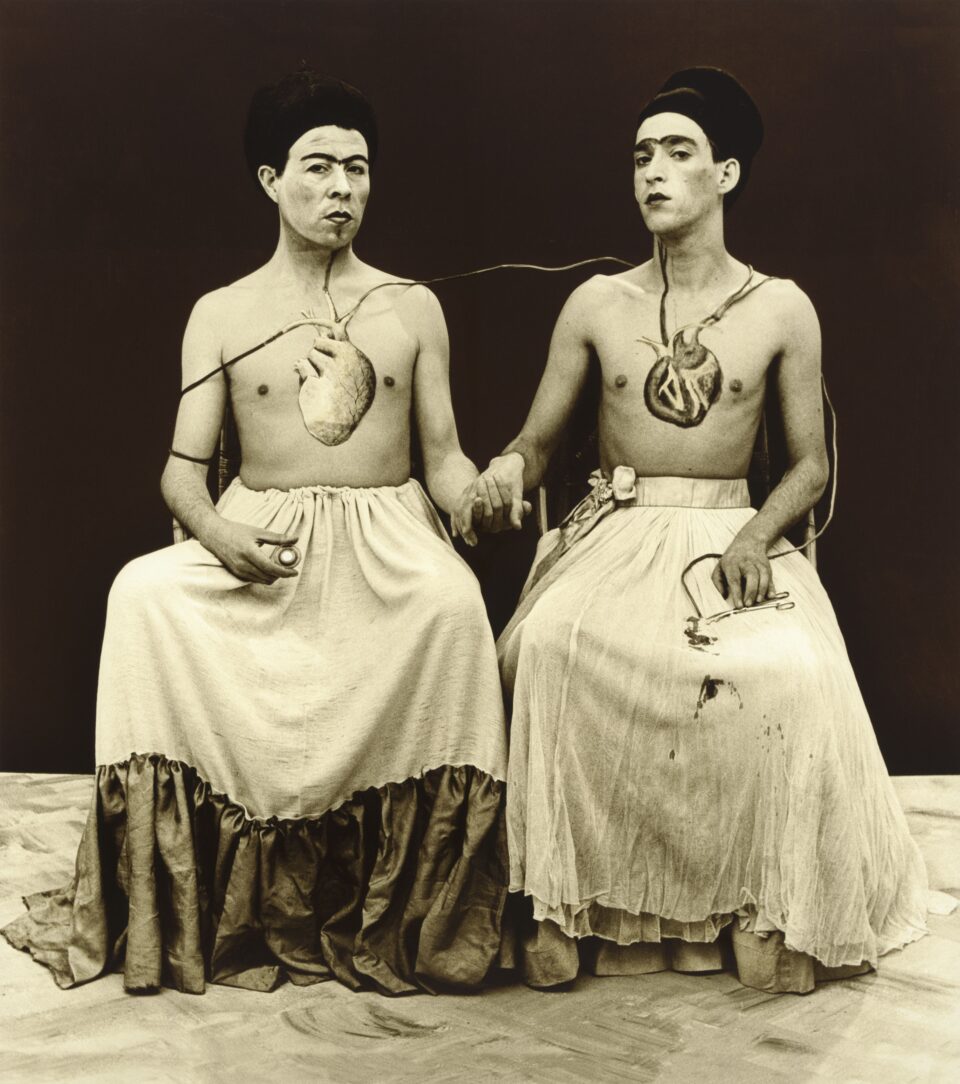
The encounter with Kahlo’s practice is structured around identity as construction rather than essence. Self-portraits are reframed as performative systems, in which gender, disability, nationality and desire are continuously negotiated. Works such as Self-Portrait (With Velvet Dress) and Self-Portrait with Loose Hairare embedded within a wider visual ecosystem that includes photography, dress and archival material. Diego Rivera and María Izquierdo appear as part of a shared intellectual terrain, dissolving the idea of isolated authorship. Identity becomes a layered process of assembly, rupture and reinvention, a logic that echoes throughout Tate Modern’s recent curatorial turn toward relational thinking.
This logic extends through a dense constellation of artists whose practices enter into sustained dialogue with Kahlo’s visual language. Judy Chicago, Ana Mendieta and Kiki Smith form a particularly resonant triad. Chicago’s monumental feminist structures amplify Kahlo’s insistence on the body as site of knowledge, pain and political articulation, translating intimate experience into collective address. Mendieta’s earth-body interventions reconfigure embodiment through disappearance and trace, echoing Kahlo’s oscillation between corporeal vulnerability and mythic transformation. Smith’s sculptural works, often fragmented and anatomical, offer a quieter but persistent reflection on the body as residue, memory and ecological form. Together, these practices extend Kahlo’s concerns beyond representation into material, spatial and temporal instability, forming a triangulated conversation that refuses hierarchy.
Across these exchanges, the body becomes less a subject than a field of negotiation. Kahlo’s depictions of childbirth, fracture and self-mythologising resonate differently when placed alongside Mendieta’s ephemeral imprints or Chicago’s declarative iconographies. Smith’s restrained materiality reframes bodily fragmentation as continuity rather than rupture, suggesting endurance within fragility. What binds these practices is not influence in a linear sense but a shared refusal of stable categories. The body is neither contained nor resolved – it persists as process, tension and transformation, a condition rather than a form.
Surrealist lineages are reactivated not as historical chapter but as methodological undercurrent. Kahlo’s uneasy relationship with André Breton’s framing of Surrealism is acknowledged, yet her work sits productively alongside Leonor Fini and Kati Horna, where masks, skeletons and dream logics function as tools of perception rather than aesthetic motifs. These connections reposition Surrealism as a dispersed global sensibility rather than a European orthodoxy. Within this expanded field, Kahlo works at the threshold where inner states and external realities collapse into one another, a space of instability.
Political readings of Kahlo’s image are equally central, particularly through Chicana/o cultural movements and feminist reinterpretations from the 1970s onward. Works such as My Dress Hangs There are reframed through histories of migration, displacement and ambivalent modernity, where identity is shaped through tension rather than belonging. Within this context, Kahlo becomes a visual anchor for resistance and self-definition across diasporic communities. Later generations of Mexican artists, including Nahúm B. Zenil and Georgina Quintana, extend this legacy by reworking nationalist imagery into critiques of gender and authority. The result is a shifting political iconography that refuses fixed interpretation.
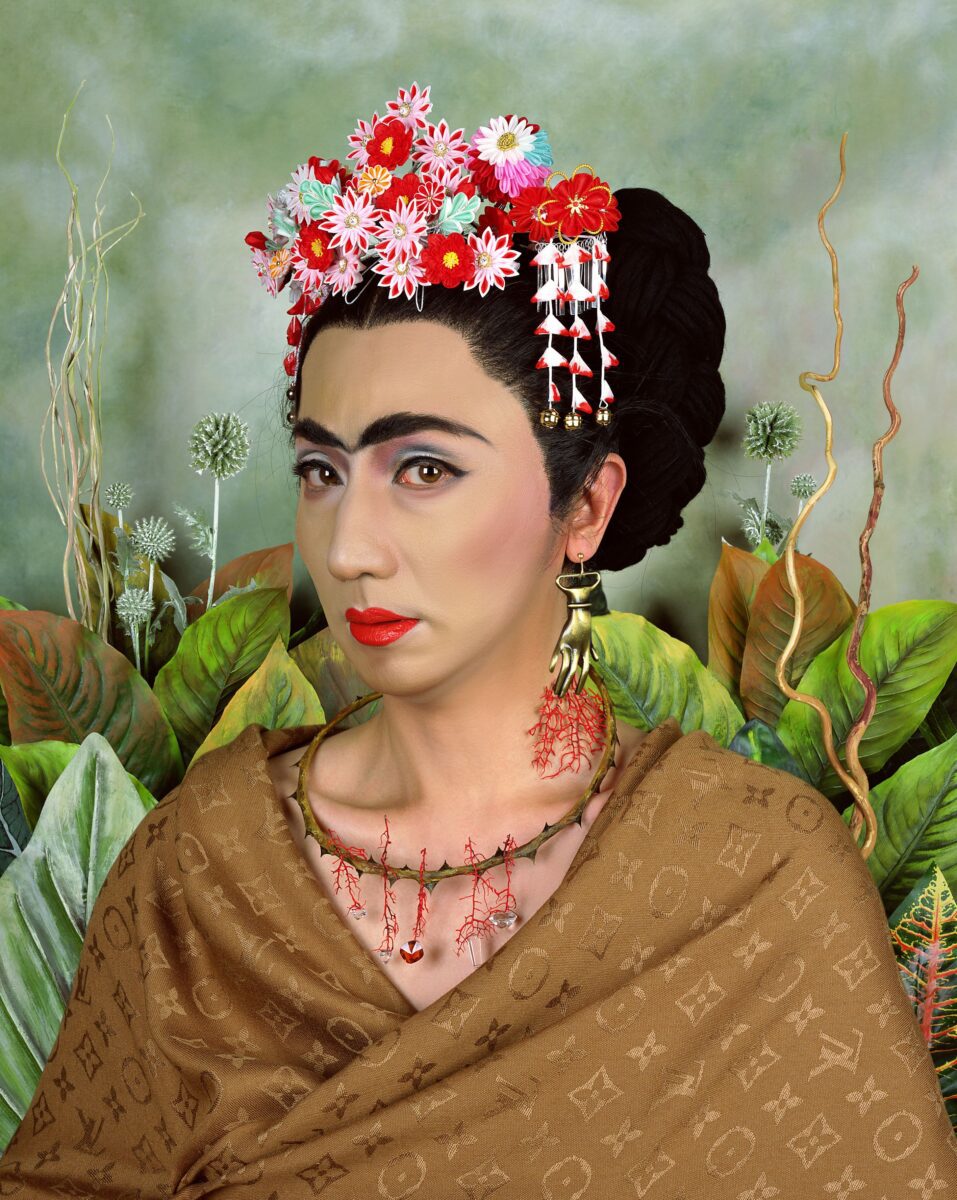
The inclusion of contemporary practitioners such as Martine Gutierrez and Yasumasa Morimura further destabilises authorship through appropriation, embodiment and performative self-staging. Their works complicate Kahlo’s image by multiplying its surfaces, turning identity into a site of repetition and distortion. Rather than reinforcing a singular icon, these gestures fracture it, exposing the mechanisms through which cultural figures are constructed and consumed. What remains is not stability but circulation – an image perpetually in motion, reshaped each time it is seen or restaged.
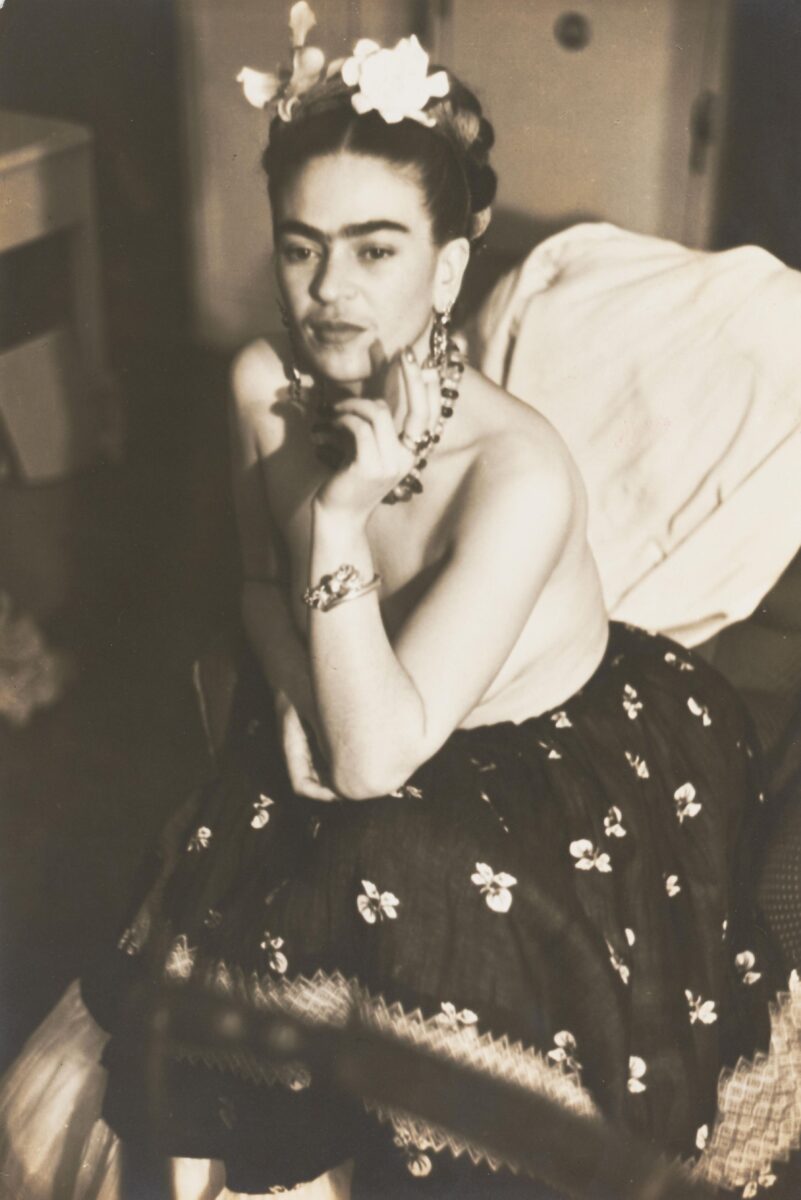
A final curatorial turn confronts this circulation directly through the phenomenon of “Fridamania”. More than a display of merchandise, this section maps the transformation of Kahlo into global commodity, where her image migrates across fashion, design and digital culture. Far from being a peripheral appendix, it becomes integral to the argument, revealing how aesthetic value and market logic intertwine. The artist’s face, once anchored in specific biographical and political contexts, now functions as an open signifier, endlessly reproducible and reinterpreted. Iconography here is not diminished by repetition – it is intensified by it, gaining new velocity through mass circulation and cultural repetition.
Taken together, these strands situate Kahlo within a broader curatorial ecology shaped by recent Tate Modern shows – from Tracey Emin’s intimate monumentalism to Yayoi Kusama’s immersive spatial logic and Olafur Eliasson’s perceptual environments. Alongside El Anatsui’s material transformations and A World in Common’s reframing of photographic authorship, Kahlo is placed within a curatorial present defined by circulation, hybridity and instability. Art is no longer contained by medium or geography but shaped through relational structures that are constantly in flux. Kahlo becomes a lens through which these conditions are made visible – not as exception, but as exemplar. This constant and progressive identity feels particularly pointed. The institution no longer merely stages retrospectives but constructs frameworks in which historical and contemporary practices continually refract one another. Frida Kahlo is therefore not isolated within history but dispersed across it, reactivated through every new interpretative encounter. The exhibition ultimately suggests that icons are not endpoints but processes that are produced through looking, repetition and reinvention. Meaning is never settled but always in formation.
Frida: The Making of an Icon is at Tate Modern, London 25 June – 3 January: tate.org
Words: Anna Müller
Image Credits:
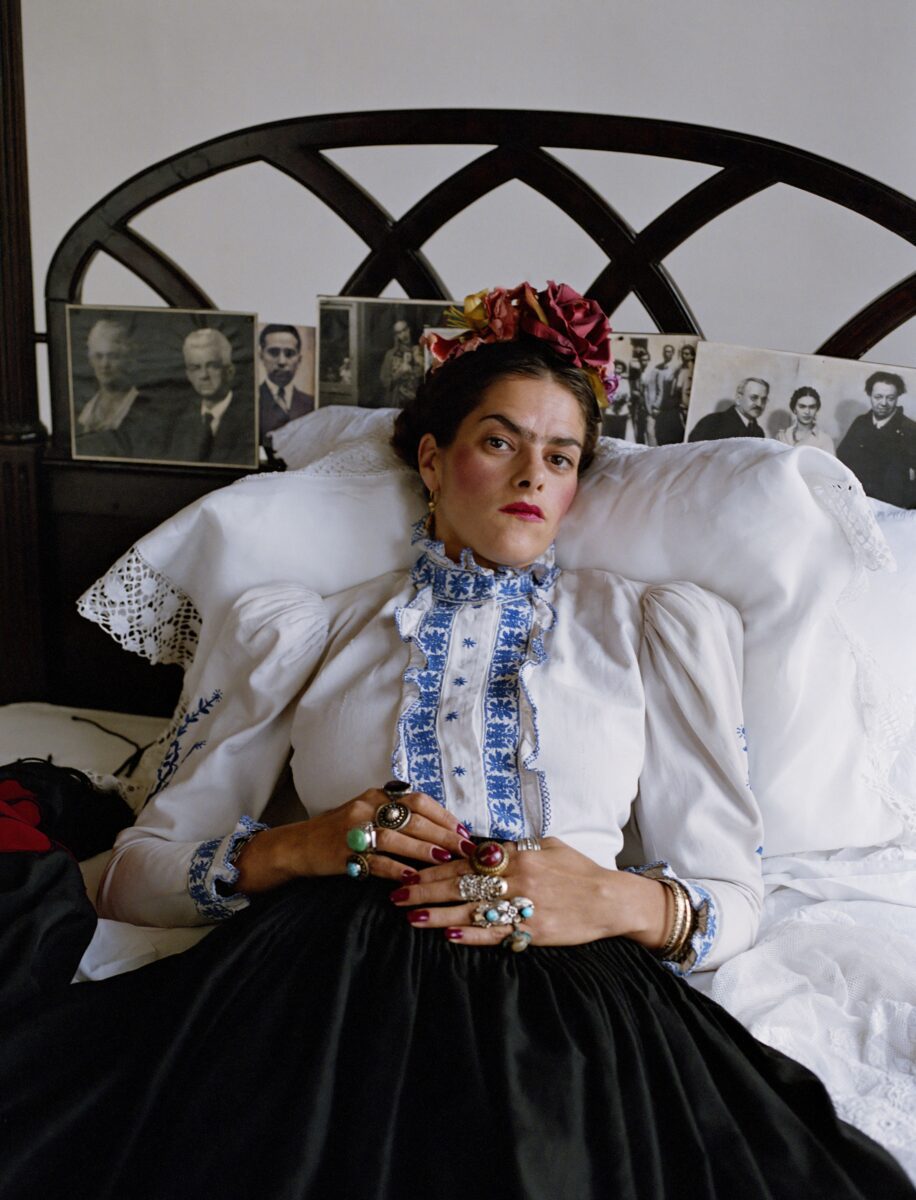
1&5. Mary McCartney, Being Frida, London 2000. © Mary McCartney. Courtesy the artist.
2. Las Yeguas del Apocalipsis, Las dos Fridas, 1989. © Yeguas del apocalipsis. Tate Collection. Image courtesy Malba Foundation, Museum of Latin American Art of Buenos Aires.
3. Yasumasa Morimura, An Inner Dialogue with Frida Kahlo (Hand Shaped Earring), 2001 © Yasumasa Morimura; Courtesy of the artist, Luhring Augustine, New York and Yoshiko Isshiki Office, Tokyo.
4. Julien Levy, Frida Kahlo 1938. © Courtesy Philadelphia Museum of Art.


