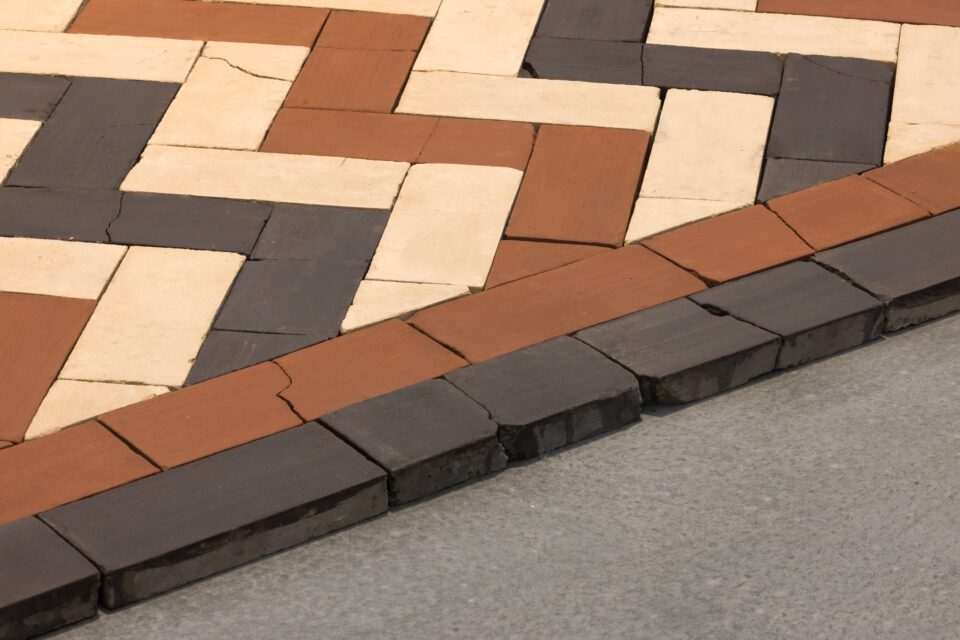
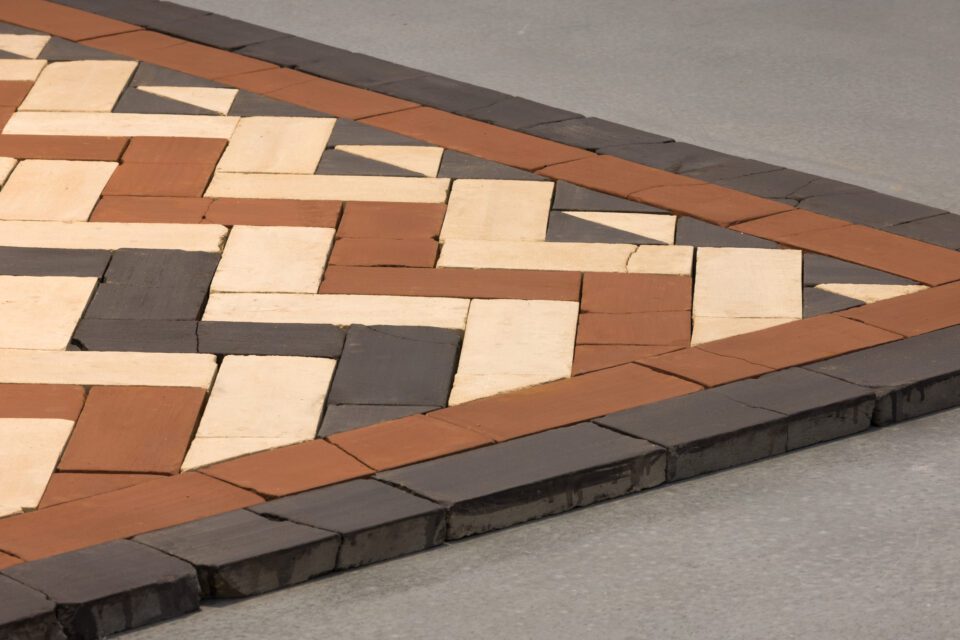
Palestinian-Saudi artist Dana Awartani’s practice centres around one primary contrast: the act of creation and the experience of loss. Her multidisciplinary practice addresses the destruction of cultural heritage, reflecting upon the ravages of conflict within the Middle East. The artist’s latest exhibition, held at Towner Eastbourne until the end of the month, takes its name from an ongoing series. Standing by the Ruins traces the act of remembrance, healing and forgetting. At its heart is a major floor installation constructed in collaboration with adobe restoration craftsmen from Riyadh. The piece draws directly from the historic Hamam al-Sammara, one of Gaza’s oldest bathhouses, now believed to be destroyed. Awartani recreated the architecture in intricate geometric detail, but the piece deliberately remains unfinished and without a binding agent, reminding audiences that our cultural institutions remain vulnerable to destruction or loss. Awartani’s work is also at Goodwood Art Foundation, with installation I Went Away And Forgot You. A While Ago I Remembered. I Remembered I’d Forgotten You. I Was Dreaming (2017), named after a poem by Palestinian poet Mahmoud Darwish. A geometric floor composition in coloured sand, recalling Islamic tilework and sacred geometries, is paired with a single-channel film of the artist sweeping away the work’s recreation in an abandoned house in Jeddah that was built in the European architectural style.
The artist spoke to Aesthetica about her work and how she hopes will prompt a greater awareness of rampant cultural loss in the Middle East and across the world.
A: Take us back to the start. How did this exhibition come about?
DA: The exhibition was first developed for Arnolfini, who invited me to present a solo exhibition. Towner Eastbourne later joined the project, allowing the exhibition to tour across the UK.
A: Your work draws from Islamic and Arab traditions. What first drew you to these historical practices?
DA: I encountered the writings of Edward Said when I was a student at Central Saint Martins, which gave me a new perspective on what it means to be a Middle Eastern artist working in an environment shaped largely by western viewpoints. I became interested in understanding how to engage with genuine expressions of my culture, finding a space for myself outside a lens that fetishises the East and relies on clichés that are often untrue. I grew up immersed in the western canon, so I felt compelled to educate myself in aesthetics and pattern-making rooted in Eastern historical contexts. I pushed myself to study the complex histories of Islamic art and traditional crafts of the region, and fell in love in the process.
A: You often work with skilled, traditional artisans. How do these collaborations shape your vision?
DA: My collaborations with master artisans continually shift my perspective. I am myself a trained craftswoman, and I prefer to work with crafts I know how to practice. Sometimes I begin with an idea and then seek out the process that best supports it. Other times, I am drawn to a specific technique, such as stone carving, which is prevalent in the region, and develop the work from there. At the core of my practice is artisanal rigor, rooted in the handmade. I am deeply invested in ethical modes of production and in what it means to create work that is communal in nature and that actively supports craft communities.
A: The show explores remembrance and healing. How do you translate memory into material form?
DA: Remembrance is deeply tied to craft forms. They are passed down through generations and are themselves imbued with memory. This memory is also rooted in place though materiality. In Standing by the Ruins, I use clay earth sourced from Saudi Arabia; in other works, I source stone historically used in the regional architecture of Jordan and Syria, or dyes locally foraged from the forests of Thiruvananthapuram in India. There is a poetic language embedded in these materials and their origins.
A: Your practice blends tradition with contemporary issues. How do you maintain that balance?
DA: Finding this balance is difficult. It involves taking craft out of its usual context and innovating with it, so that it does not remain stagnant, but continues to evolve. It is about pushing the limits of the artform.

A: The exhibition’s titular work reconstructs a destroyed bathhouse in Gaza. How do you approach reviving lost architecture through art?
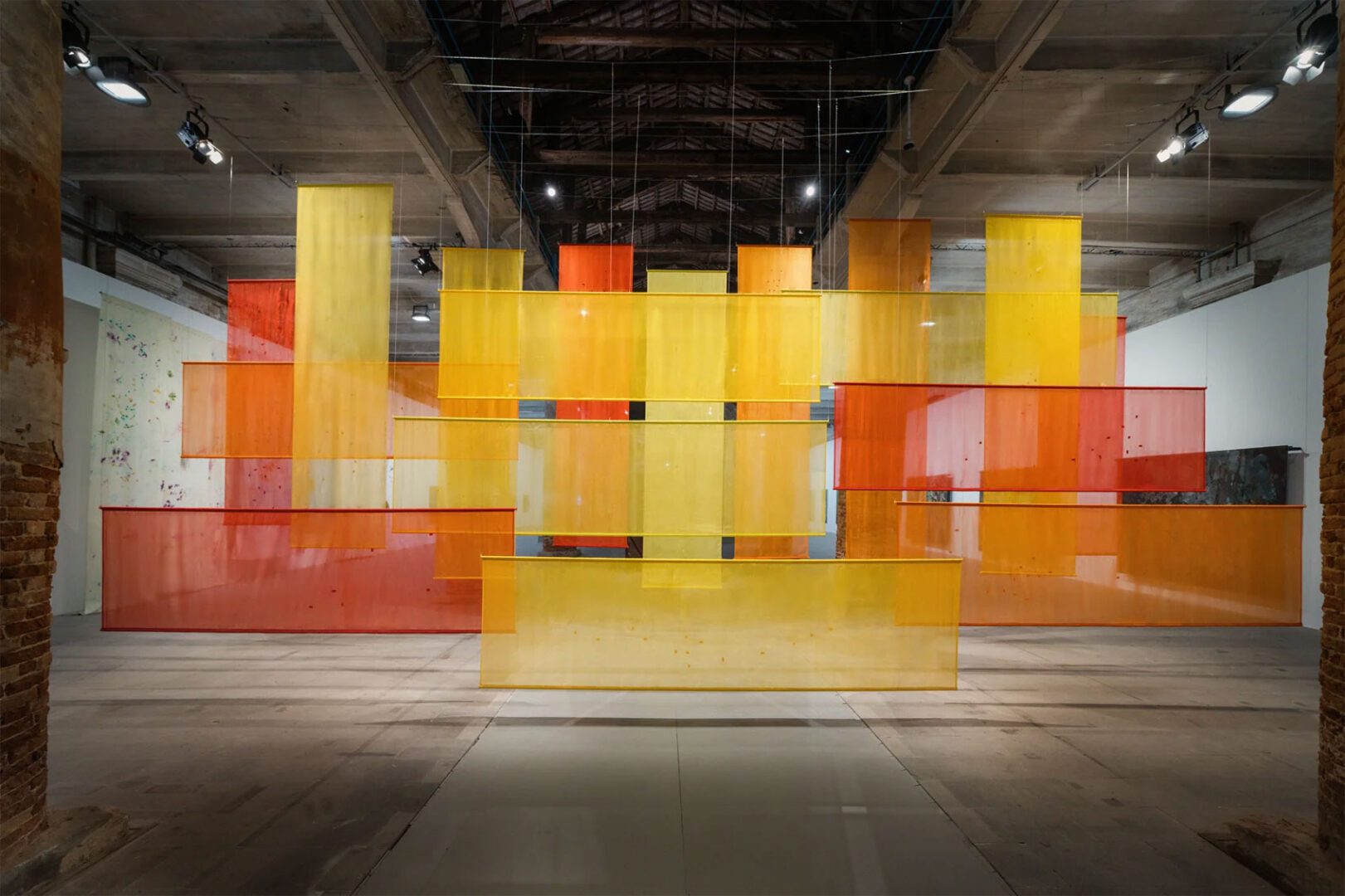
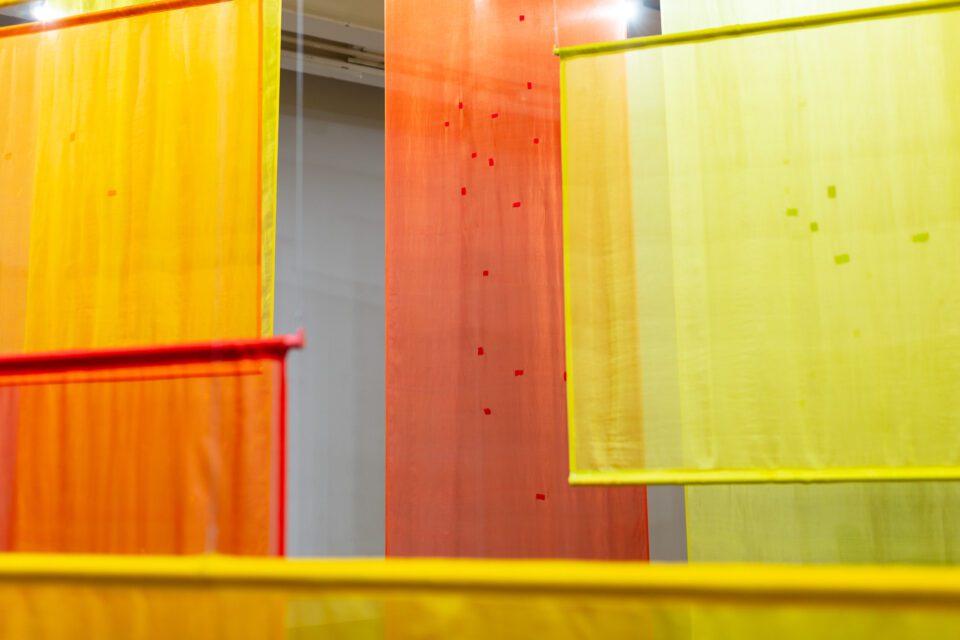
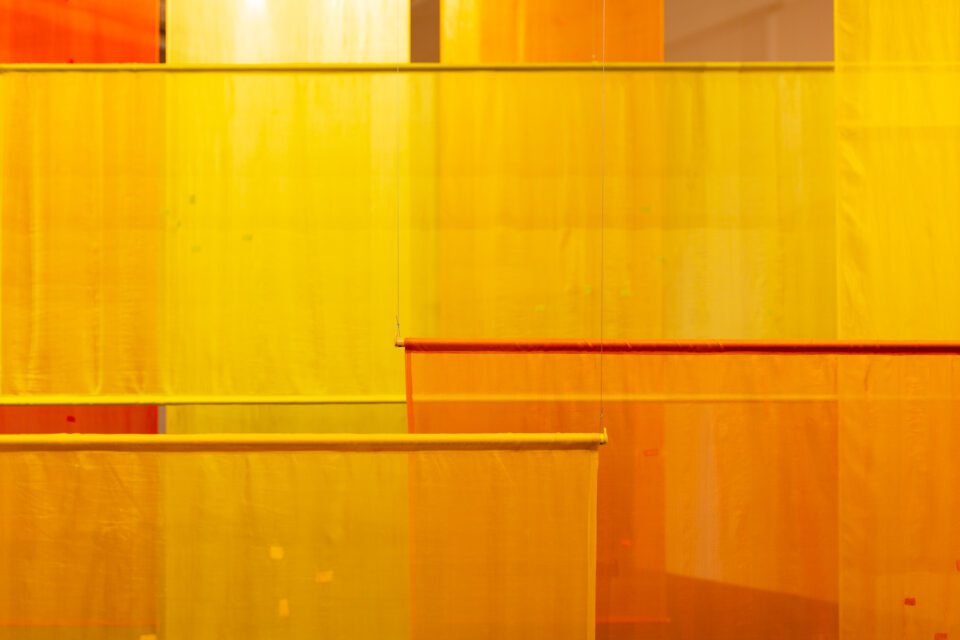
DA: It varies with each project. In some, I work by extracting architectural elements from buildings and transforming them into standalone artworks, such as replicating the patterns of a hammam’s floor tiles. In others, like the Let me Mend Your Broken Bones series, I reference architecture with textiles, a material that is not directly linked to it. There are many ways to approach this.
A: Your mended fabrics carry a sense of repair. Do you see art as a tool for collective healing?
DA: I don’t see my work being about collective healing or cultural repair. It is more of a personal, cathartic process for me. As someone from the Middle East witnessing the erasure of her cultural history and heritage, my darning works are a way to process that personally. I recognise that I cannot actually mend destroyed buildings or restore what has been lost, but through the darning I find a way to meditate and heal on an individual level. Art can contribute to cultural repair in other ways, but this happens when it moves beyond the art world and engages directly with people affected. The craftspeople I collaborate with are displaced by war and conflict and are bearers of intangible heritage. Supporting them is a far more effective way of healing. It is through the process itself, rather than positioning art as the hero.
A: Who, or what, are your biggest creative inspirations?
DA: I have many sources of inspiration that inform my work, and I don’t consider any one more important than the others. Ancient architecture, travel and reading poetry and literature from the Middle East are all significant influences. Traditional crafts also inspire me profoundly. Seeing objects created with such perfection, beauty and precision is truly remarkable. Mother-of-pearl inlay from Syria and marble inlay from India are examples, and it is the mastery behind these crafts that I find most inspiring. I also remember seeing Alhambra for the first time and being completely blown away.
A: What do you want visitors to feel or take away from Standing by the Ruins?
DA: The first thing is awareness. I don’t feel people fully know of the extent of destruction happening. The countries of the Levant are rich with multicultural histories, from Byzantine to Roman and Greek influences. These monuments are part of our shared experience, they live beyond us and carry our stories forward. I wish people felt the same outrage for what is being destroyed in the Middle East as they did when Notre Dame burned. Many of these sites predate the Parisian cathedral by centuries.
A: Where will your practice go next? Are there new traditions or sites you’re eager to explore?
DA: There are many crafts I’ve been eager to explore, as I don’t see myself sticking to just one. There are so many techniques I want to try. However, with the ongoing genocide and cultural erasure in Gaza, there is an urgent need to respond. Much of the work I am currently developing is focused on Gaza, addressing these pressing issues and the stories that need to be told.
Standing by the Ruins is at Towner Eastbourne until 25 January: townereastbourne.org.uk
Words: Emma Jacob & Dana Awartani
Image Credits:
1. Come, let me heal your wounds. Let me mend your broken bones, 2024 by Dana Awartani. © Dana Awartani, courtesy the artist and Lisson Gallery, photographer Samuele Cherubini.
2. Installation view of Dana Awartani: Standing by the Ruinsat TownerEastbourne, by Rob Harris.
3. Dana Awartani, Standing by the ruins, Arnolfini June 2025. Lisa Whiting Photography for Arnolfini. All rights reserved.
4. Installation view of Dana Awartani: Standing by the Ruinsat TownerEastbourne, by Rob Harris.
5. Dana Awartani, Standing by the ruins, Arnolfini June 2025. Lisa Whiting Photography for Arnolfini. All rights reserved.
6. Installation view of Dana Awartani: Standing by the Ruinsat TownerEastbourne, by Rob Harris.