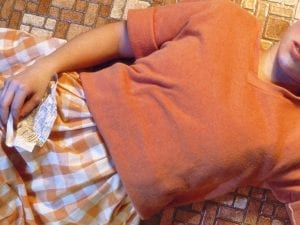
Cindy Sherman and Lorna Simpson have spent decades questioning what photographs ask us to believe. This autumn, their practices meet in London through concurrent exhibitions at Hauser & Wirth, where Sherman stages new images of women and Simpson reworks photographs from the historical archive. Their methods are markedly different, but both artists treat the image as something made rather than found – a structure that shapes how identity is seen and how history is remembered. That distinction feels especially relevant in a culture saturated with self-portraiture, advertising and digitally altered realities. As Frieze Week brings the international art world into the city, their exhibitions offer an opportunity to look beyond the spectacle of the fair and consider how images acquire their power in the first place.
Both artists have spent decades interrogating the image as a site where social identities are produced rather than simply recorded, yet they approach that problem from different directions. Sherman constructs fictional personas from the visual language of cinema, fashion, advertising and popular culture, whereas Simpson takes fragments of existing histories and subjects them to processes of cropping, layering, painting and recontextualisation. Their practices therefore meet around a shared suspicion of photographic authority – an understanding that images never simply show us the world, but organise how it can be seen. This makes their pairing particularly productive within a commercial gallery context, where the mechanisms of display themselves inevitably become part of the conversation.
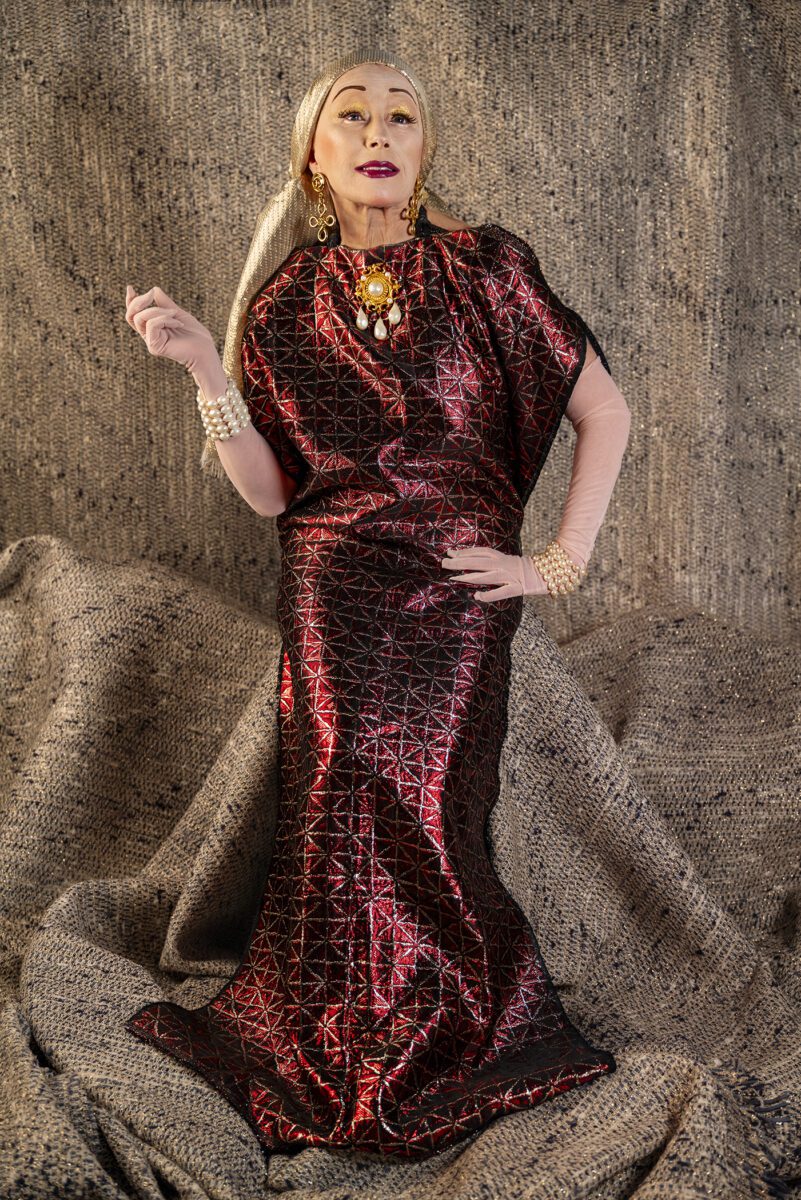
Sherman’s Fabric Matrons extends a practice that has made the instability of identity one of contemporary photography’s defining subjects. Born in New Jersey in 1954, she emerged alongside the Pictures Generation in the late 1970s, becoming known for photographs in which she transformed herself into an array of recognisable yet unsettling characters. Untitled Film Stills established this strategy through deliberately constructed scenes that borrowed from mid-century cinema, while later series pushed further into grotesque, glamour, ageing, celebrity and artifice. What remains consistent is an insistence the supposedly authentic self is itself entangled with inherited visual conventions.

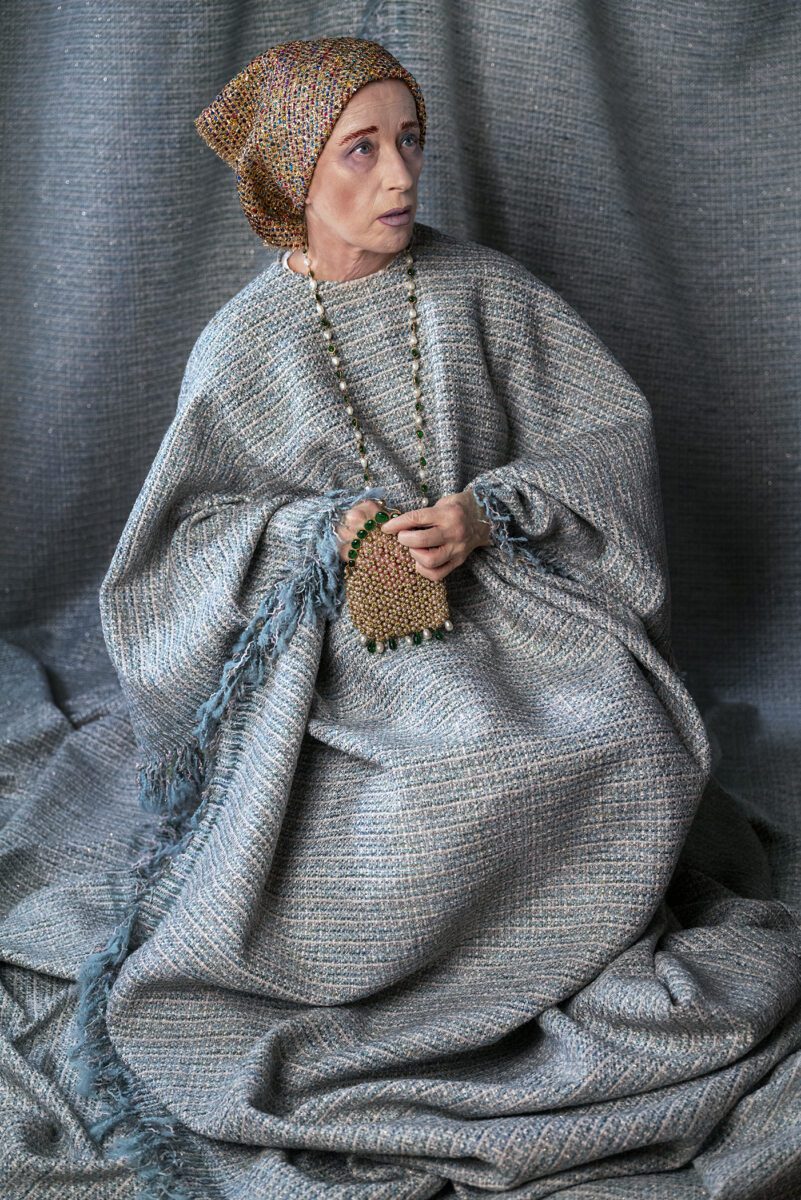
Fabric becomes a particularly fertile material for that enquiry. In the new photographs, elaborately patterned textiles envelop Sherman’s figures until body and backdrop appear almost indistinguishable, producing a tension between concealment and display. The works draw on fabrics and other elements from Chanel’s archives, extending a relationship with the fashion house that began with Ominous Landscapes (2010–12), while adopting the heightened theatricality of editorial photography. Fashion here is neither simply decorative nor merely a subject to critique; it becomes a system of signs through which femininity is continually fabricated, consumed and performed. Sherman’s figures seem caught inside that system, simultaneously controlling their appearance and disappearing beneath it.
Such strategies place Sherman within a longer feminist interrogation of the constructed female image. Barbara Kruger’s confrontational combinations of text and advertising aesthetics, for instance, exposed the ideological machinery behind seemingly familiar pictures, while Francesca Woodman turned the female body into an elusive, unstable presence that could seem to merge with architecture or disappear entirely. Sherman’s method differs from both, particularly in its sustained embrace of theatrical excess, but the conceptual territory overlaps. Each artist recognises that representation is never neutral, especially when the body has historically been presented as an object to be looked at, classified and desired. Fabric Matrons consequently feels less like a retreat into fashion than an examination of what happens when the codes of glamour become so elaborate that they begin to reveal their own construction.
Memory operates differently within Simpson’s practice, where the archive becomes both material and contested terrain. Born in Brooklyn in 1960, Simpson came to prominence through conceptual photographs that paired images of unidentified Black figures with fragments of text, challenging the stereotypes through which Black women had historically been represented. Her work has consistently resisted the idea that documentary imagery offers transparent access to the past, instead exposing the gaps, assumptions and exclusions embedded within visual culture. The artist’s shift towards painting from 2014 expanded into a more fluid relationship between photography, collage, abstraction and materiality.
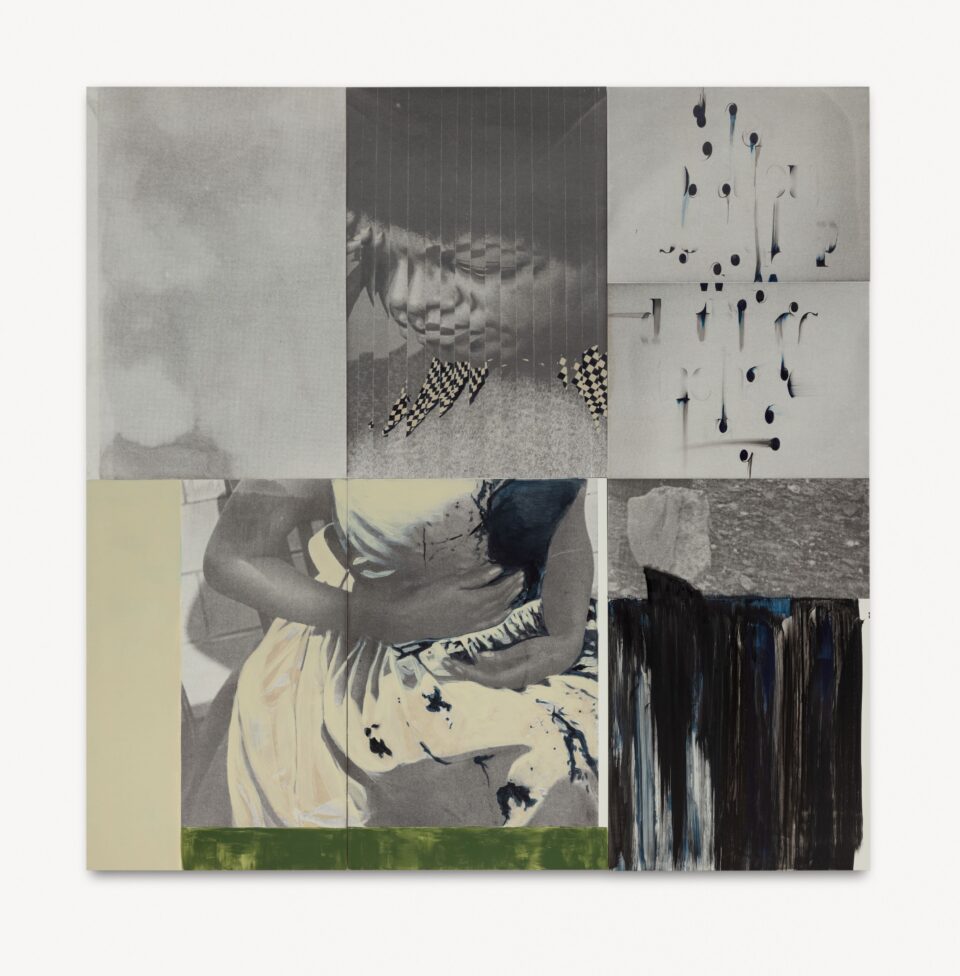
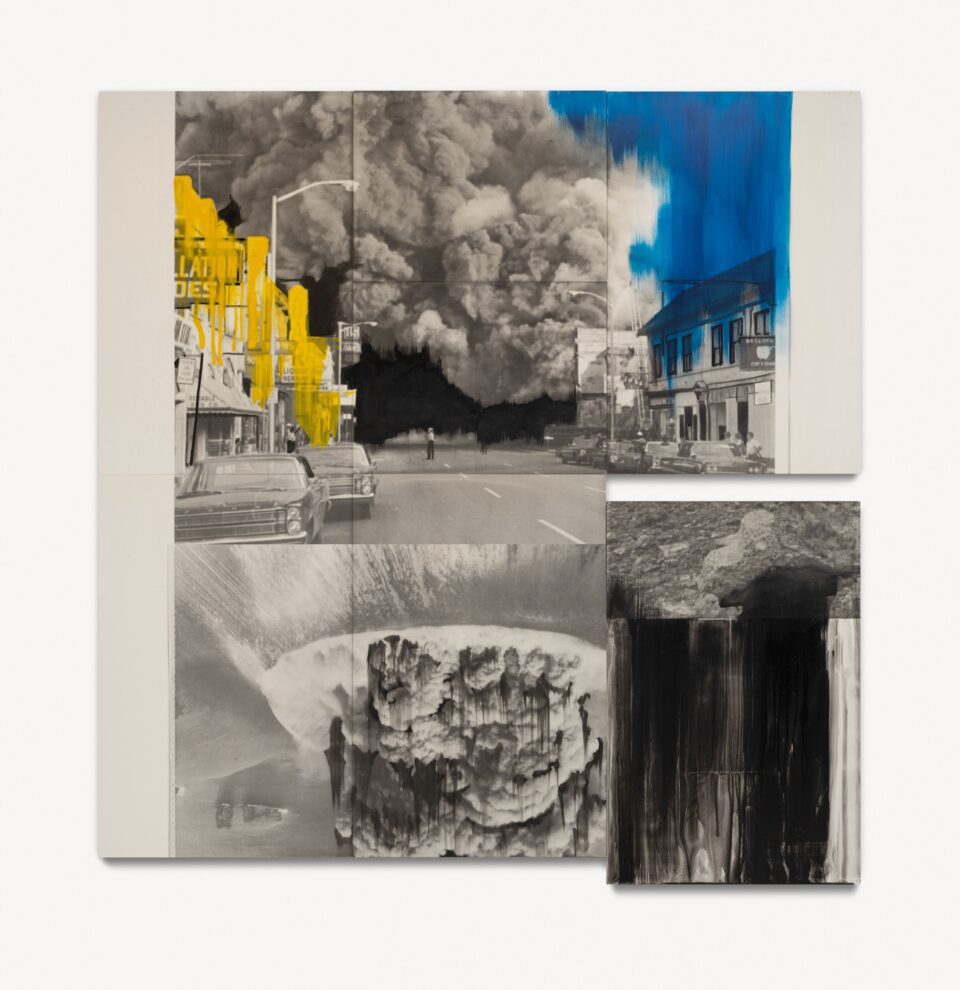
Archival photographs from publications including Ebony are central to the London exhibition, where Simpson reworks fragments of defunct news photography into multi-panel compositions, large-scale paintings and sculpture. Images become unstable objects in this process – cropped, spliced, obscured and painted over until their original contexts begin to fracture. The effect is not historical reconstruction but something closer to historical speculation, allowing the past to remain incomplete while revealing how its images continue to shape the present. Simpson’s approach recalls broader debates within contemporary art around appropriation and archival practice, particularly the argument that reusing an image can expose the structures through which cultural memory has been produced. Her archive is therefore not passive evidence; it is a living, contested field in which meaning accumulates and changes.
Colour provides another route into this interrogation. Simpson’s recent figurative paintings are marked by a deep blue that can evoke night, sky and the planetary scale of the Earth, while also carrying associations with indigo, labour and the histories embedded within pigment itself. That chromatic continuity gives the new work a visual coherence even as its source material remains fragmented. At Punta della Dogana in Venice, the breadth of her practice has similarly been framed through the relationship between painting, photography, collage and sculpture; the exhibition is curated by Emma Lavigne in close collaboration with the artist. London consequently offers another opportunity to consider Simpson not as a photographer who moved into painting, but as an artist whose central concerns have always exceeded medium.
The comparison with Sherman becomes increasingly revealing here. Where Sherman manufactures images to expose the performance of identity, Simpson dismantles existing images to expose the politics of memory. One begins with the constructed persona; the other begins with the inherited record, yet both ultimately question who controls the terms of visibility. Carrie Mae Weems offers a useful point of connection, particularly through her sustained examination of Black representation, domestic histories and the politics of the photographic gaze. Simpson’s work is more oblique, but like Weems, she understands photography as a technology whose intimacy can conceal powerful structures of looking.
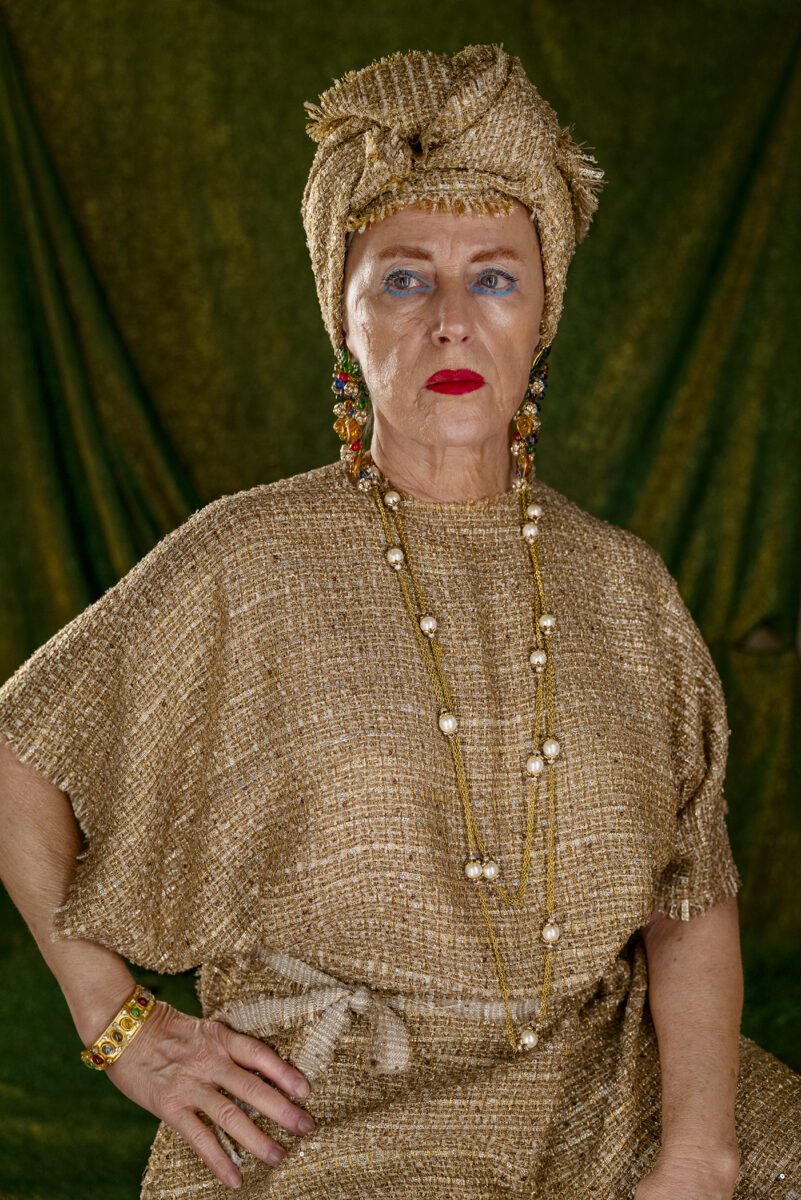
Curation will therefore matter as much as individual works when these exhibitions open. Hauser & Wirth is presenting the artists separately rather than forcing them into a formal joint exhibition, allowing each practice its own internal logic while the shared timing creates an unavoidable dialogue. That distinction is important: the pairing works precisely because the gallery does not need to manufacture thematic equivalence. Simpson’s return to the UK for the first time in eight years arrives after significant institutional attention, including her 2025 painting survey at the Metropolitan Museum of Art and the current Venice presentation. Sherman, meanwhile, enters London with a new body of photographs that extends practices in post-war photography into questions of ageing, fashion and visibility.
Their exhibitions will also sit within a particularly dense period for London’s cultural institutions and commercial galleries. Frieze London and Frieze Masters take place at Regent’s Park from 14 to 18 October, bringing almost 300 galleries from 48 countries and regions into the city, alongside a programme of curated sections, commissions, talks and non-profit initiatives. Frieze Week operates less as a single event than as a temporary intensification of London’s existing art infrastructure, with exhibitions and projects extending well beyond the fair itself. Hauser & Wirth’s decision to open Sherman and Simpson on 13 October places both shows directly within that heightened atmosphere, while giving visitors an opportunity to encounter substantial museum-calibre practices away from the temporality of the fair.
That wider context sharpens the political stakes of looking. Contemporary art has become increasingly attentive to archives, image circulation and the ways identities are mediated through mass culture, but Sherman and Simpson demonstrate that these concerns are not simply products of the digital present. Their practices belong to a longer critical history in which artists have questioned the supposedly objective status of photography and the cultural narratives it supports. Sherman’s self-staging and Simpson’s archival reconstruction both anticipate today’s anxieties around image-making, from algorithmic visibility to the pressure of self-branding. What distinguishes their work is not merely that they recognise images as constructed, but that they turn construction itself into an artistic method.
London’s autumn programme will inevitably generate the familiar acceleration of openings, fairs and overlapping exhibitions, yet these two presentations invite a slower form of attention. Sherman’s figures seem to ask what remains of a person when every surface has become costume, while Simpson’s fragments ask what remains of a history after the original image has been cut apart and remade. Neither artist offers a stable answer – instead, both make uncertainty productive. Across fashion, photography, painting and the archive, their work suggests that identity and memory are not fixed repositories but processes of continual editing. In a city temporarily saturated with images, that insistence on looking again may prove to be one of the most compelling reasons to step away from the fair and into the gallery.
Cindy Sherman and Lorna Simpson are at Hauser & Wirth London from 13 October – 23 December: hauserwirth.com
Words: Shirley Stevenson
Image Credits:
1&3. Cindy Sherman, Untitled #705, 2026. Chromogenic color print 141 x 94 cm / 55 1/2 x 37 in.
2. Cindy Sherman, Untitled #701, 2026. Chromogenic color print 76.2 x 50.8 cm / 30 x 20 in.
4. Lorna Simpson, Wounded, 2026. Acrylic and screenprint on claybord 7 panels, overall: 182.9 x 182.9 x 3.8 cm / 72 x 72 x 1 1/2 in.
5. Cindy Sherman, Untitled #704, 2026. Chromogenic color print 101.6 x 67.6 cm / 40 x 26 5/8 in.
6. Cindy Sherman, Untitled #706, 2026. Chromogenic color print 101.6 x 152.4 cm / 40 x 60 in.
7. Lorna Simpson, Yesterday/Today, 2026. Acrylic and screenprint on claybord 7 panels, overall: 182.9 x 182.9 x 3.8 cm / 72 x 72 x 1 1/2 in.