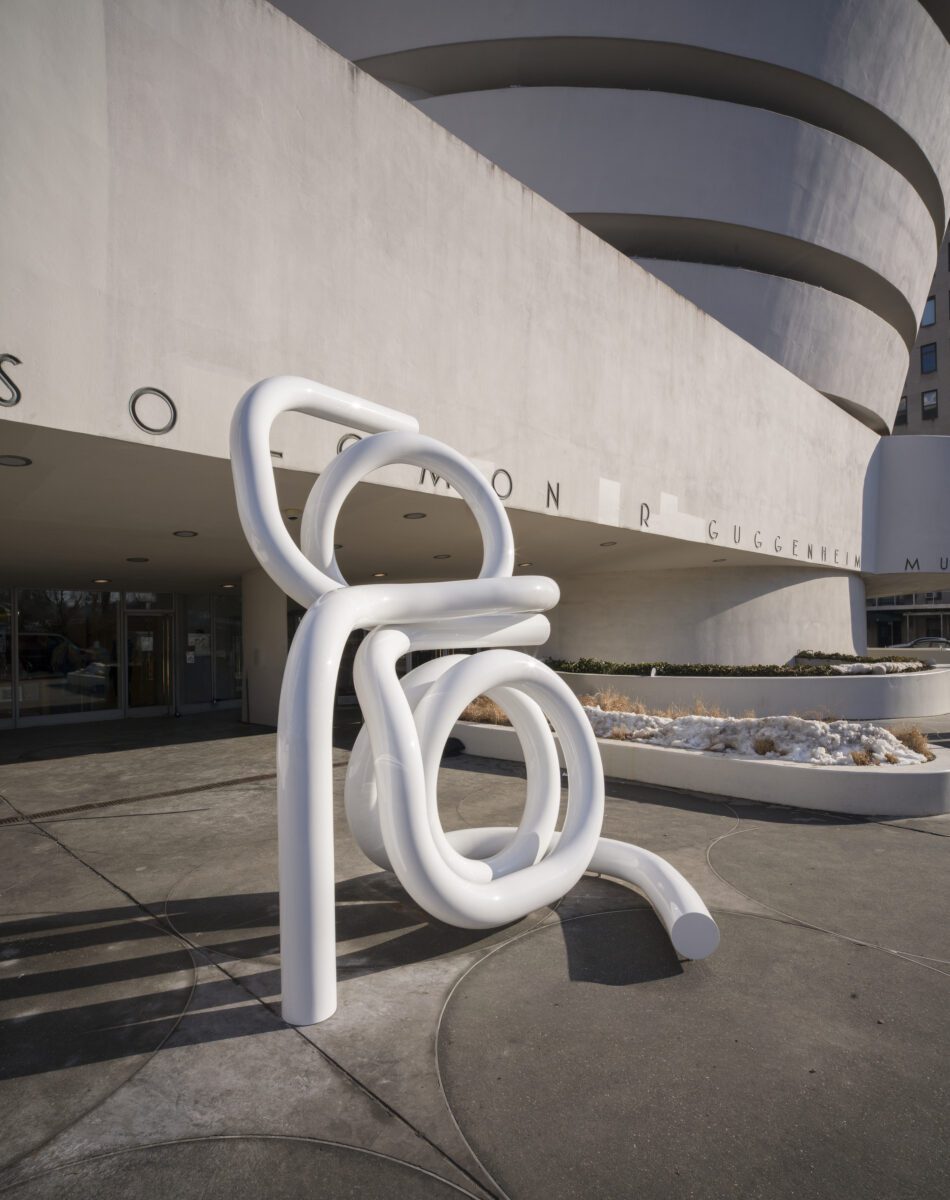
In 1943, Frank Lloyd Wright was commissioned to design a building for the Museum of Non-Objective Painting in New York. By this time, he was already considered one of the greatest architects of the 20th century, having designed the iconic Unity Temple (1908), Fallingwater House (1937) and Johnson Wax Headquarter (1939). Wright’s inverted-ziggurat design was not built until 1959, delayed by modifications to the design; the rising cost of building materials following WWII; and the death of the museum’s benefactor, Solomon R. Guggenheim. When it opened, the masterpiece was soon recognised as an architectural icon, and more than 60 years on, it welcomes 1.3 million visitors a year. In the words of critic Paul Goldberger: “Wright’s building made it socially and culturally acceptable for an architect to design a highly expressive, intensely personal museum. In this sense, almost every museum of our time is a child of the Guggenheim.”
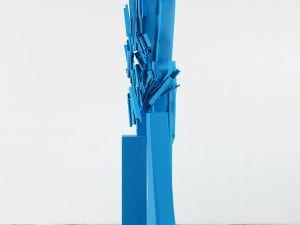
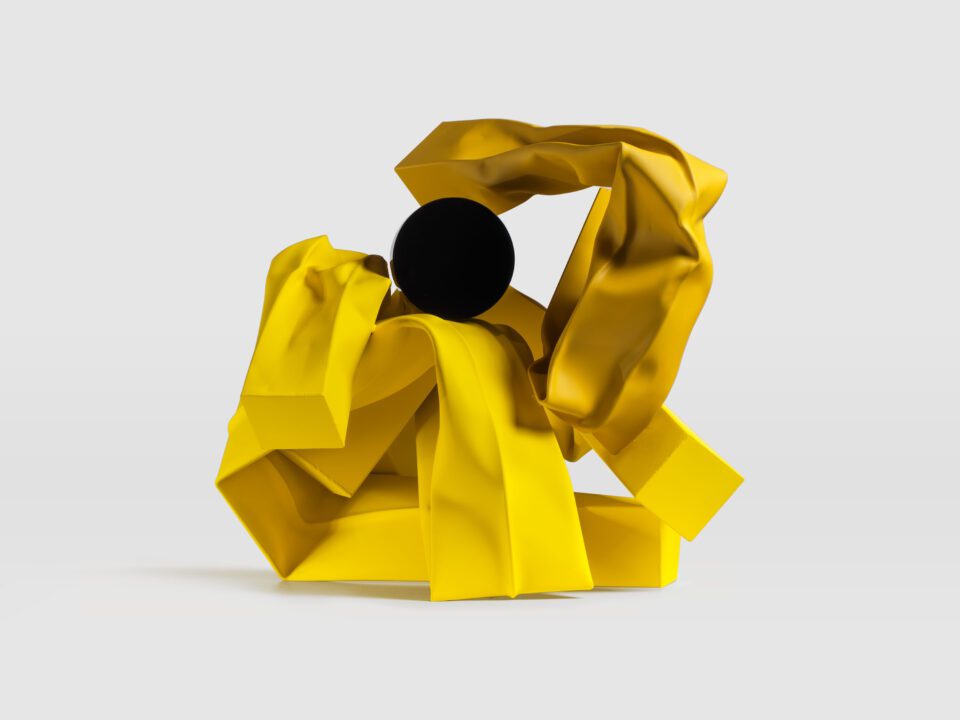
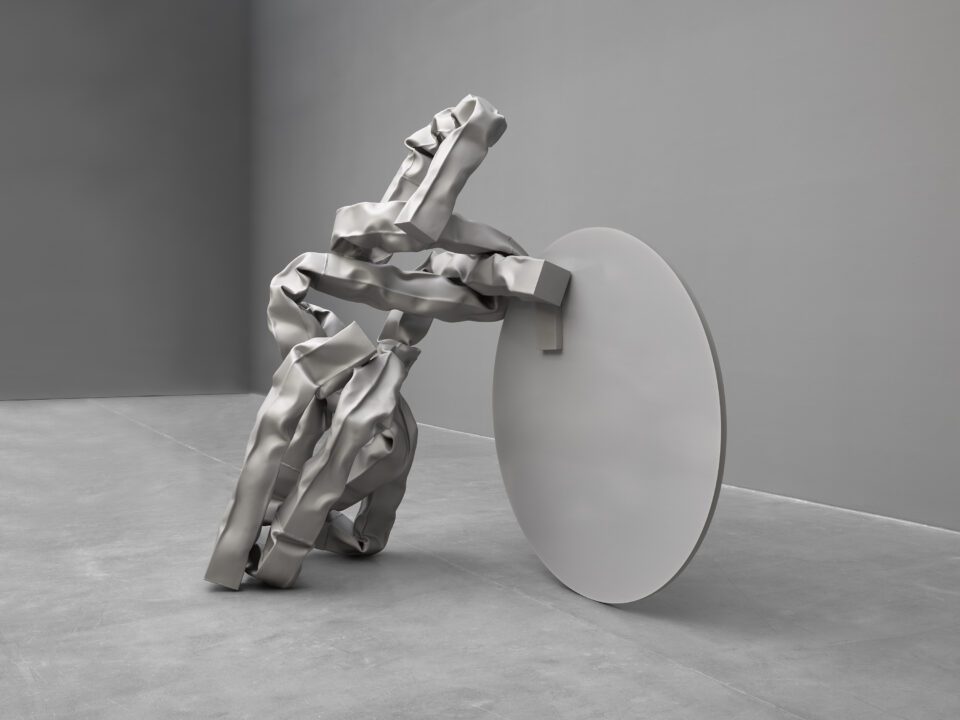
Now, Swiss artist Carol Bove reimagines that iconic rotunda in her largest exhibition to date. Her first museum survey invites visitors into a dynamic environment, presented in dialogue with Frank Lloyd Wright’s architecture. The show brings together installations, paintings, and works on paper that foreground the unique spatial dynamics of Wright’s architecture. It traces pivotal shifts in Bove’s career across more than 25 years and debuts two new bodies of work: a monumental group of her steel compositions conceived for the space, known as “collage sculptures” and a series of wall-mounted aluminum panel works. As Katherine Brinson, Daskalopoulos Senior Curator of Contemporary Art and Director of Global Initiatives, states; “This survey exhibition marks the first opportunity to see the full arc of Bove’s career, putting her early and more recent bodies of work in generative dialogue. At the same time, it coheres into a single artistic statement, animating the Frank Lloyd Wright spiral with colour and form while creating opportunities for rest and active play.”
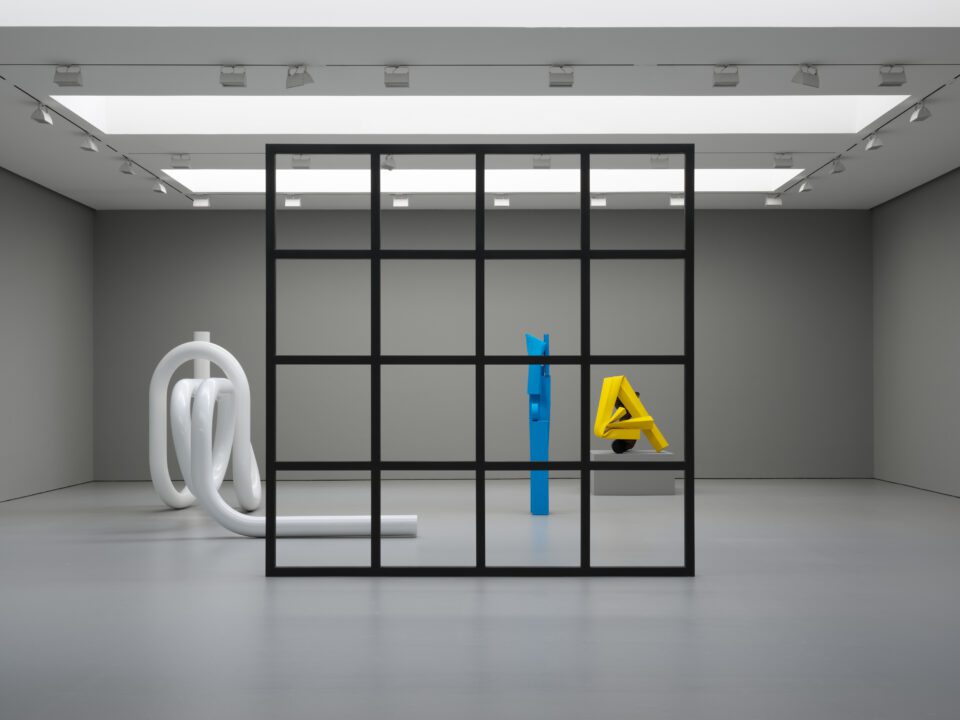
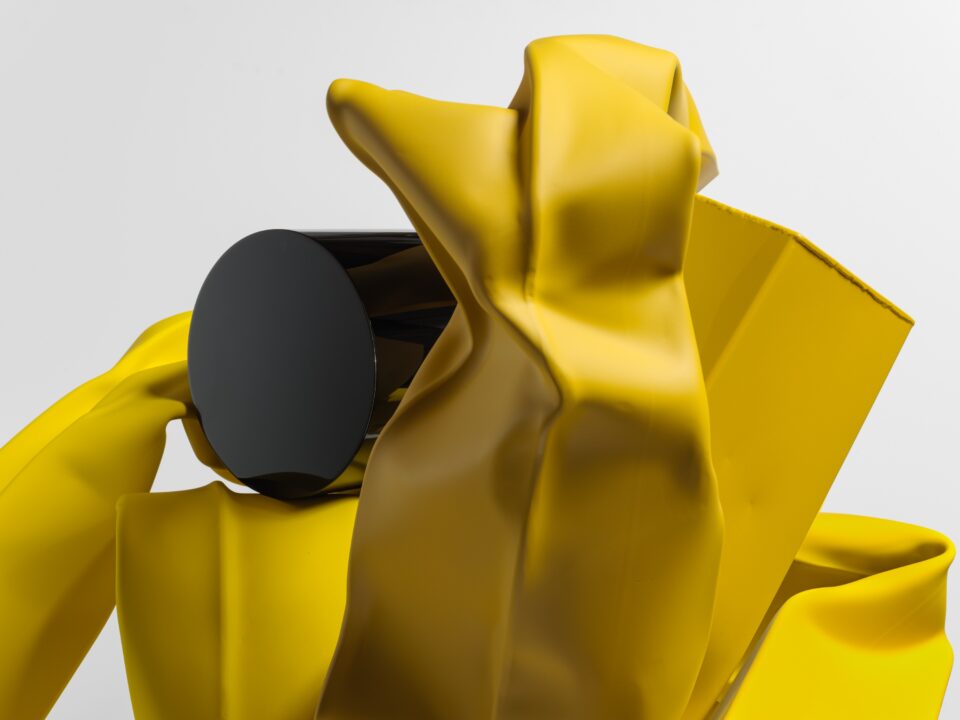
Born in Geneva, Switzerland, and raised in Berkeley, California, Bove is known for works that incorporate found and constructed elements with a unique formal, technical and conceptual inventiveness. Her work has been displayed at Nasher Sculpture Center, Dallas; the Metropolitan Museum of Art, New York; Museum of Modern Art, New York; San Francisco Museum of Modern Art; Tate Britain; and Palais de Tokyo, Paris. In 2017, Love was part of Women of Venice at the Swiss Pavilion at the 57th Venice Biennale, where she was invited to respond to the legacy of Alberto Giacometti. Her large-scale sculptures are often exhibited outdoors and in public spaces, a trend that continues at Guggenheim. The gallery’s spiral rotunda offers a resonant setting for Bove’s interest in the relationship between objects and their surroundings.
The exhibition is presented in a loose reverse chronology of Bove’s career, winding backwards in time from new sculptures on the museum’s lower ramps to drawings and installations made in the early 2000s at the top. As the viewer progresses upward, the physicality of the artworks gradually lightens, with large-scale steel abstractions giving way to compositions formed from fragile beads, feathers and thread. This feeling of ascension is echoed in the gradated grey paint that has been applied to the spiral ramp’s back wall, which progressively shifts from dark to light. At the heart of the experience, six polished aluminum disks rise through the rotunda in a vertical column. Originally created as elements of a group of sculptures commissioned for the nearby Met’s facade in 2021, the reflective disks activate the Guggenheim’s geometries, drawing the viewer’s eye upward to the museum’s skylight.
Historical research is central to Bove’s work, and she has regularly curated major presentations of the work of other artists. At the Guggenheim, the artist has incorporated a number of works by artists from earlier generations – including Bruce Conner, Agnes Martin and Édouard Vuillard – to appear alongside her own, foregrounding her engagement with cultural legacies and visual languages that are continually reshaped in the present. A particular highlight is a site-specific mural by Joan Miró and Josep Llorens Artigas from 1965–67 that was built into the first bay of the Guggenheim’s spiral ramps and has not been on view for more than 23 years. The mural was commissioned by Harry F. Guggenheim, then president of the Solomon R. Guggenheim Foundation, in memory of his wife, Alicia. Bove has created a diamond-shaped cutout in the wall that offers visitors a framed view of the mural.
Frank Lloyd Wright’s legendary building was famously pitched as a “temple of the spirit.” The Guggenheim’s latest show with Carol Bove reminds us why this description continues to ring true. There is a life to the building, as visitors move around its iconic spiral, they’re active participants in the experience. Audiences move through Bove’s career, where her experiments with colour, scale and space create moments of heightened imaginative awareness. By the time audiences reach the top, they are part of an experience that transcends the typical retrospective to become a dialogue between artist and architecture.
Carol Bove is at Guggenheim Museum, New York until 5 August: Guggenheim.org
Words: Emma Jacob
Image Credits:
1. Installation view, Carol Bove, March 5, 2026–August 2, 2026, Solomon R. Guggenheim Museum, NewYork. Photo: David Heald © Solomon R. Guggenheim Foundation, New York.
2. Carol Bove, Cutting Corners, 2018 (detail). Stainless steel andurethane paint, 35 7/8 × 38 7/8 × 38 5/8 in. (91.1 × 98.7 ×98.1 cm). Private collection. © Carol Bove Studio LLC. Photo: Maris Hutchinson/EPW Studio.
3. Installation view, Carol Bove: Polka Dots, David Zwirner, New York, Nov.5–Dec.17, 2016. © Carol Bove Studio LLC. Photo: Dan Bradica.
4. Carol Bove, Cutting Corners, 2018. Stainless steel andurethane paint, 35 7/8 × 38 7/8 × 38 5/8 in. (91.1 × 98.7 ×98.1 cm). Private collection. © Carol Bove Studio LLC. Photo: Maris Hutchinson/EPW Studio.
5. Carol Bove, Vase Face I / The Ascent to Heaven on a Dentist’s Chair, 2022. Stainless steel and laminated glass with heat-fused ink, 85 × 87 × 57 1/2 in. (215.9 × 221 × 146.1 cm). Collection of the artist. © Carol Bove Studio LLC. Photo: Maris Hutchinson.