

Ritual, myth and memory form Collective Gallery’s Time + Space 2026 Group Exhibition in Edinburgh, where four artists consider how the past persists within bodies, objects and places. Rather than treating memory as a stable archive, Huss Al-Chokhdar, Hetal Chudasama, Gianni Esporas and Abi Lewis approach it as something porous – reconstructed through touch, folklore, architecture and inherited stories. Their works move between the intimate and the cosmic, asking how personal histories become entangled with wider structures of belief, displacement, labour and cultural memory. Film, sculpture, painting and site-specific installation are brought together across Collective’s Dome and Hillside galleries, creating a dialogue between different ways of recording and transmitting experience.
Collective Gallery has long positioned itself as a space for experimentation, particularly through initiatives such as Satellites, which ran from 2014 to 2024, and New Work Scotland, established in 2000. Time + Space continues that commitment while placing greater emphasis on sustained development alongside exhibition-making, giving artists opportunities to research, produce and present new work. Sorcha Carey, Director of Collective, describes the programme as “an exciting new chapter” for the gallery, building on its history of supporting emerging artists in Scotland. That history matters because early-career practice is often framed through the language of discovery, as though artists simply arrive fully formed rather than developing with time, resources and critical exchange. Here, the programme’s title becomes more than a description of duration and location – it suggests that artistic development itself requires both.
Time + Space‘s curation creates productive proximity between distinct practices. This year’s group exhibition contributors were selected by Aqsa Arif and Adam Benmakhlouf, while Alberta Whittle and curator Seán Elder selected the artist for the programme’s solo presentation. Such an external selection process places the exhibition within a broader ecosystem of contemporary art in Scotland, where emerging practice is shaped through networks of artists, curators and institutions as much as through individual studio work. Collective’s decision to offer both solo and group exhibition routes also acknowledges that artists require different structures at different stages of their careers. Rather than flattening those differences, Time + Space makes space for plurality – a fitting curatorial premise for an exhibition concerned with the unstable ways that histories are held and transmitted.
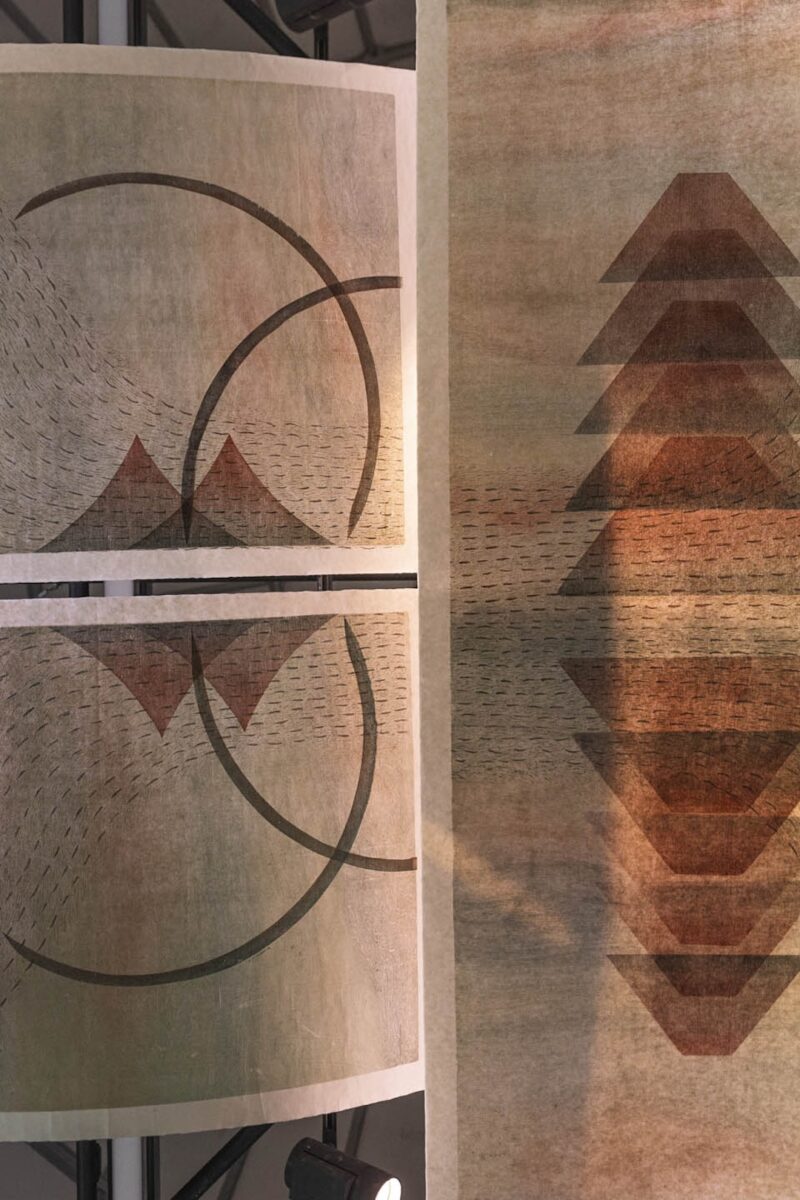
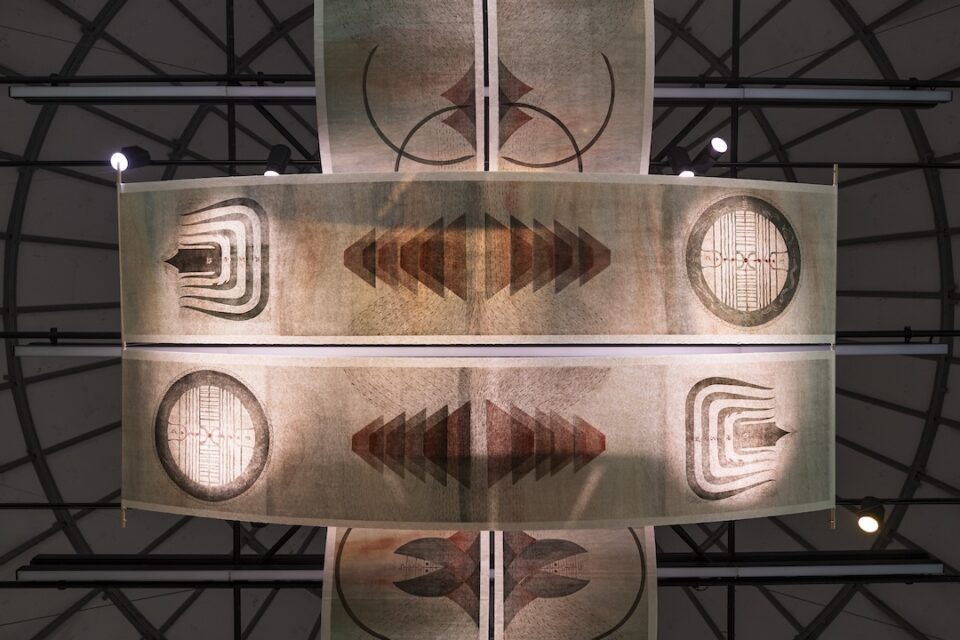
Architecture is an active participant in this process through Hetal Chudasama’s An Hour in Chrysalis. Situated within the Dome Gallery, whose history as an observatory remains embedded in its spatial character, the installation turns looking itself into a form of ritual. Large woodblock prints are suspended overhead, drawing upon tantric cosmological diagrams and their conception of the image as a passage between the earthly and the cosmic. Visitors are encouraged to look upwards, physically shifting their orientation and allowing the architecture to become part of the work’s conceptual field. Measurement, observation and the desire to extend human perception – impulses central to the building’s former astronomical function – are transformed into a meditation on scale, suggesting that contemporary art can reactivate architectural histories without simply reproducing them.
Chudasama’s intervention also recalls a longer history of artists questioning the supposedly objective authority of systems of observation. From astronomy to mapping, scientific instruments have traditionally promised a way of locating the human subject within a rationalised universe, yet cosmological traditions frequently complicate that distinction between knowledge and belief. Here, abstraction becomes a vehicle for precisely that ambiguity. The prints do not illustrate a fixed cosmology so much as create a visual and bodily proposition, asking visitors to move between the immediate scale of the gallery and the immense temporal dimensions implied by its observatory past. In this sense, An Hour in Chrysalis participates in a wider contemporary interest in ritual as a way of thinking beyond dominant structures of knowledge – not as a return to an imagined pre-modern world, but as a reconsideration of how perception is organised.
A more psychologically charged form of ritual emerges in Abi Lewis’ Night Tether, an immersive installation shaped by memories of night terrors and sleep paralysis. Taking Henry Fuseli’s 1781 painting The Nightmare as a point of departure, Lewis constructs a bedroom-like environment populated by paintings, found objects and sculptural “critters” drawn from their experiences of nocturnal fear. Biblical teachings and apocalyptic imagery mingle with a fascination for demonic creatures, producing an atmosphere that is playful without dissolving the unease at its centre. Second-hand materials are particularly important, allowing ordinary objects to acquire new identities and imagined biographies. A lamp dressed in fishnet tights and a rug sprouting seven beastly heads become more than props – they embody the uncertain boundary between object and subject, possession and personality.
Possession is a particularly fertile term within Lewis’ work because it carries two contradictory meanings: ownership of an object and the inhabitation of a body by an external force. That tension gives the installation a material dimension, asking what it means to own something when objects themselves appear to carry histories. Such thinking connects Lewis’ practice to wider strands of contemporary art concerned with animacy, material agency and the emotional lives attributed to things. Found objects are rarely neutral; they accumulate associations through use, abandonment and recollection, becoming repositories for stories that may be real, invented or somewhere between the two. Night Tether consequently transforms childhood fear into a broader investigation of how belief operates – particularly when the familiar becomes strange and the everyday begins to appear inhabited.
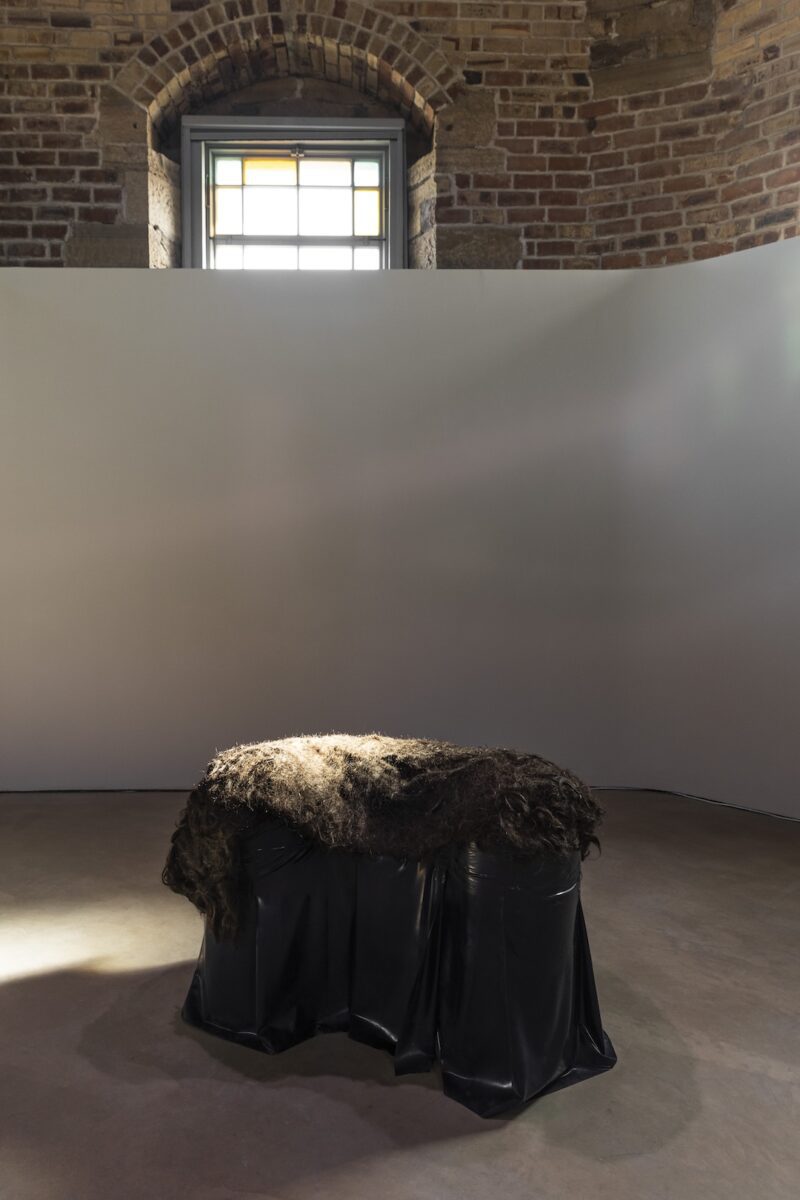
Memory takes a different form in Gianni Esporas’ exploration of hair, where the body becomes both material and archive. Drawing upon Filipino folklore surrounding Amamarang, or Gumon in some provinces, Esporas reworks the figure of the long-haired woman who becomes a vampiric being at night, using the myth to examine the contradictory cultural meanings attached to hair. Attached to the body, hair can signify vitality, health and femininity; once removed, it can become abject, uncanny or even repulsive. Her 2D animation extends this tension through folklore, while Monotonous Brunette gives it physical form as a breathing, felted animatronic sculpture made from real human hair. Lying on a bed of latex within the Dome, the sleeping figure occupies an uneasy space between the organic and artificial – alive enough to provoke recognition, but strange enough to resist it.
Esporas’ use of hair also opens onto questions of labour, race and femininity, demonstrating how a seemingly familiar material can contain complex social histories. Hair is intimate, but it is also culturally regulated, commodified and politicised, carrying expectations about presentation and identity that extend far beyond the individual body. Folklore provides Esporas with a means of unsettling those expectations, turning an everyday bodily material into something monstrous and vulnerable at once. Her approach reflects a wider contemporary engagement with myth not as an obsolete form of knowledge, but as a living structure through which societies negotiate anxieties that remain unresolved. Within Time + Space, folklore consequently operates as a critical technology – a way of accessing histories and embodied experiences that conventional archives can struggle to contain.
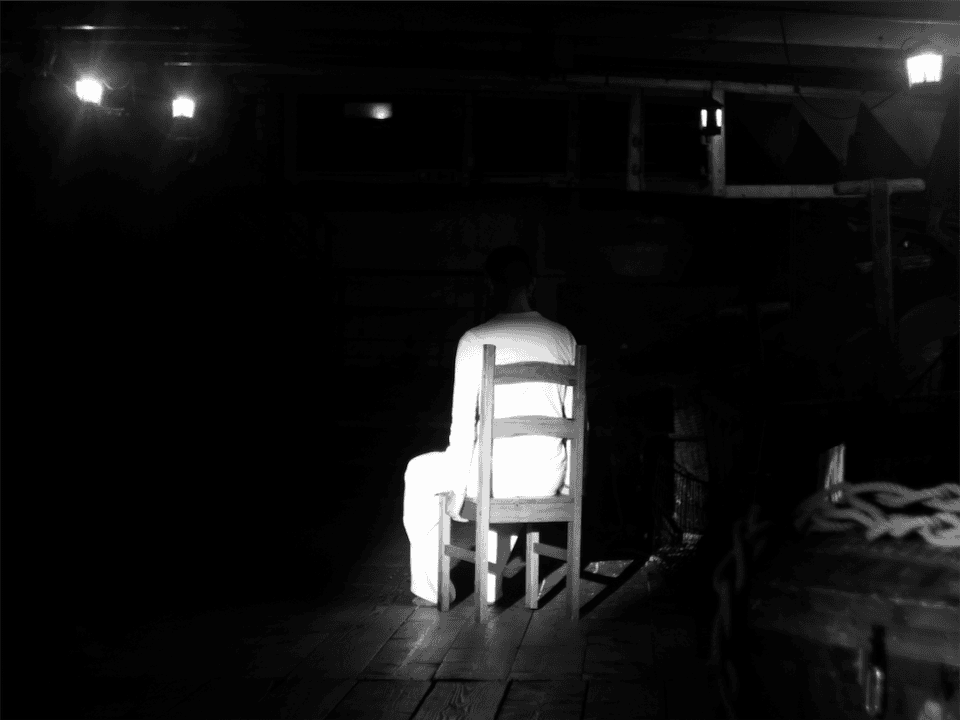
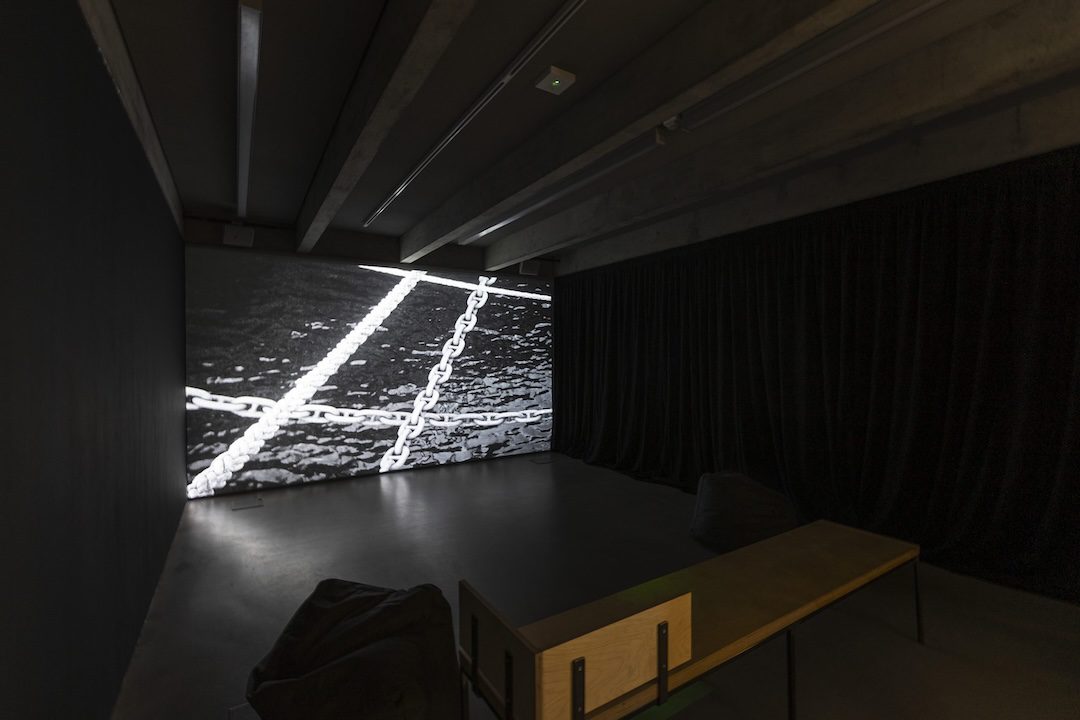
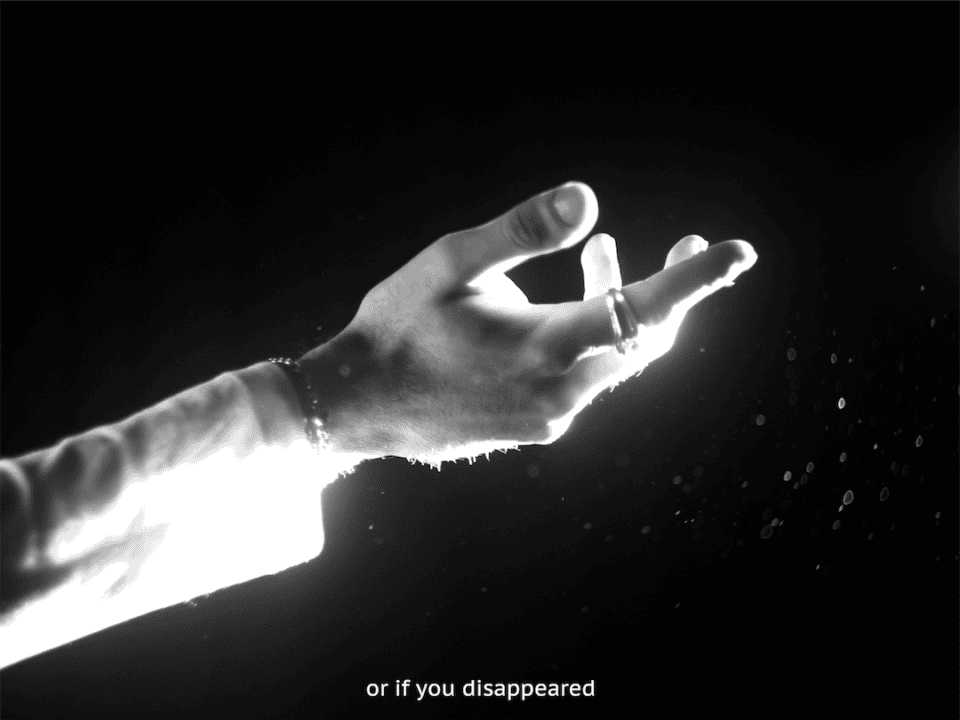
Questions of absence and inheritance reach their most explicitly political register in Huss Al-Chokhdar’s moving-image work The Ship That Left Without Us. Centring queer Arab memory, love and displacement, the film follows a man moving through Glasgow’s Tall Ship as traces of an absent lover begin to emerge through the vessel’s architecture. Its fragmented voices, water, machinery and flashes of touch collapse distinctions between remembered and imagined experience, making the ship feel less like a setting than a body carrying what cannot be left behind. The work is informed in part by histories of queer persecution in Cairo, including the 2001 Queen Boat arrests, placing private longing within the shadow of a specific history of state violence. Memory here is neither nostalgic nor complete – it becomes an embodied form of survival, carried when people, places and relationships have been forcibly separated.
Al-Chokhdar’s approach speaks to a broader shift in contemporary moving-image practice towards forms of storytelling that resist linear historical narration. Queer archives have frequently had to operate through fragments, omissions and unofficial records, particularly where institutional histories have excluded or endangered certain lives. Cinema can respond to this condition not by attempting to repair every absence, but by giving ambiguity a formal language. Within the enclosed spaces of the ship, architectural surfaces become repositories for voices that can no longer be physically present, while water suggests both passage and erasure. Such strategies place The Ship That Left Without Us within a wider discourse around queer memory, diaspora and the politics of whose histories become visible – while retaining the emotional specificity of an individual encounter with loss.
Taken together, these practices demonstrate how ritual and myth can become methods for negotiating contemporary conditions rather than escapes from them. Chudasama looks towards cosmological scale, Lewis towards the haunted domestic interior, Esporas towards folklore and the body, and Al-Chokhdar towards displacement and queer memory. Their works differ substantially in form and subject, yet each questions the assumption that history belongs only to the past. Instead, memory appears as active matter – suspended above the viewer, embedded in discarded objects, growing from the body or lingering within architecture. Time + Space consequently offers a model of early-career exhibition-making in which development is not separated from critical enquiry but becomes part of the work itself.
Collective’s new programme arrives at a moment when questions of access, institutional support and sustainability have become central to discussions of emerging practice. Supporting artists involves more than providing a platform; it requires time to develop ideas, space to take risks and critical structures capable of accommodating uncertainty. Time + Space foregrounds those conditions through its combination of professional development and exhibition opportunities, while the resulting works demonstrate what can emerge when artists are given room to pursue research across disciplines and histories. Richard Maguire’s preceding solo exhibition, There Is No Beginning, As There Is No End, initiated the programme during Edinburgh Art Festival 2026, establishing a framework now expanded through collective encounter. Across the four practices, time is not simply a subject but a resource – something stretched, revisited and made tangible through the act of looking.
What binds Time + Space 2026 is its refusal to treat memory as a sealed archive. Instead, its artists reveal how the past persists through bodies, buildings, myths, objects and acts of imagination, continually changing as it is remembered. Collective’s Dome and Hillside galleries become laboratories for these encounters, where astronomical histories, childhood fears, Filipino folklore and queer Arab memory can coexist without being reduced to a single curatorial thesis. The exhibition’s most compelling proposition is therefore also its most expansive: that making space for emerging artists means making space for forms of knowledge that are unfinished, embodied and difficult to categorise. In giving those practices time to unfold, Time + Space asks not simply what we remember, but what memory continues to make possible.
Time + Space: 2026 Group Exhibition is at Collective Gallery, Edinburgh, until 20 December.
Words: Simon Cartwright
Image Credits:
1. Huss Al-Chokhdar, The Ship That Left Without Us, 2026. Photo: Eoin Carey
2. Preview of work by Huss Al-Chokhdar from Time + Space exhibition. © Huss Al-Chokhdar.
3. Gianni Esporas, Monotonous Brunette, 2026. Photo: Eoin Carey
4. Hetal Chudasama, An Hour in Crysalis, 2026. Courtesy of the Artist and Collective Gallery. Photo: Eoin Carey
5. Preview of work by Huss Al-Chokhdar from Time + Space exhibition. © Huss Al-Chokhdar.
6. Hetal Chudasama, An Hour in Chrysalis, 2026. Courtesy of the Artist and Collective Gallery. Photo: Eoin Carey


