The story of art changed forever in 1961, whilst Dan Flavin (1933-1996) was working as a guard at the American Museum of Natural History in New York. Why? It was there he began to consider electric light as a medium. Two years later, he affixed a fluorescent tube to his studio wall and called it an artwork. This was the start of something new – both for his practice and the creative industries at large. He began to use commercially available light fixtures in 10 colours and four standard lengths, whose form he never altered, arranging them on walls and floors in simple configurations. By the mid-1960s, he had come up with a whole vocabulary to describe these sculptures – or, as he called them, “situations.” Amongst his repertoire were “corners”, “monuments”, “barriers” and “corridors”, which eventually evolved to fill entire rooms.
Flavin’s radical use of industrial materials – that anyone could buy – is the subject of Some Light at Guggenheim Bilbao, opening this November. The exhibition brings together more than 20 major works spanning from the 1960s to the 1980s, and kicks off with a selection of early experiments, made right after Flavin set aside paint and canvas in favour of fluorescent tubes. These installations, which glow with both cool and warm white light, treat electric illumination as, in Flavin’s words, “just another instrument.” Pieces such as the nominal three (to William of Ockham) (1963) are arranged across corners, floors and walls.
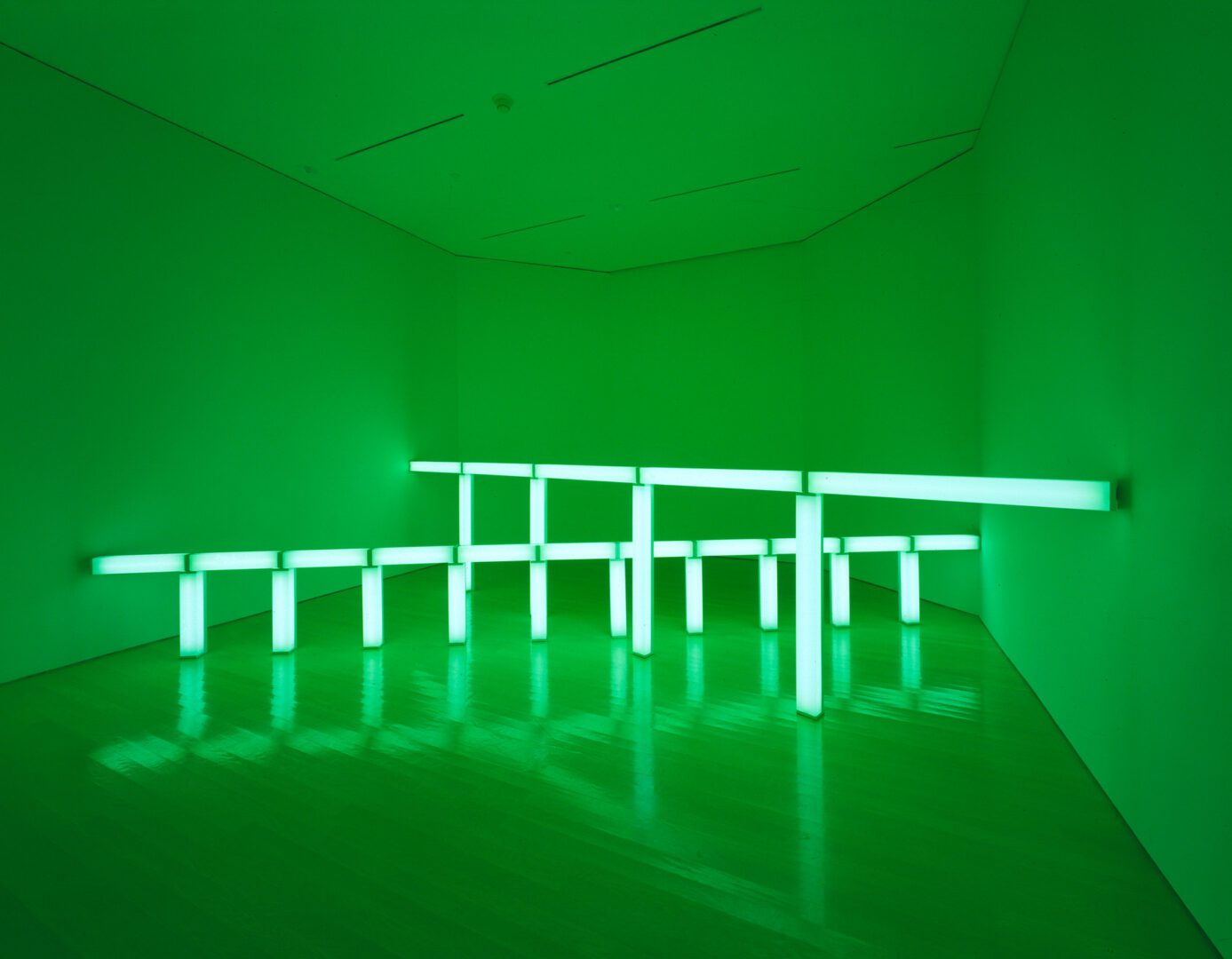
The next portion of the show focuses on Flavin’s engagement with the gallery itself. “I knew that the actual space of a room could be disrupted and played with by careful, thorough composition of the illuminating equipment,” he said. A highlight is his first barrier piece, greens crossing greens (to Piet Mondrian who lacked green) (1966), which assembles, unsurprisingly, green fluorescent tubes into a post-and-lintel, fencelike structure that physically blocks access to the gallery, inverting the conventional museum experience.
Visitors may notice a common theme in Flavin’s titles: many are dedicated to specific individuals. Some Light includes seven of the 39 “monuments” Flavin produced in tribute to the Russian avant-garde artist and architect Vladimir Tatlin, as well as several other works made for dealers Leo Castelli and Margo Leavin, as well as Flavin Starbuck Judd, the son of minimalist artist Donald Judd. The exhibition closes with works from the 1980s, when Flavin expanded his practice in response to the various new types of lamps reaching the market. It’s fitting that Flavin pays tribute to so many creative minds, given his influence on today’s practitioners. The popularity of light festivals is booming, and in many ways it all started here.
From grids to single beams, crosses and curves, Flavin never grew bored of his material. “He found in the familiar fluorescent tube the perfect means of transforming spaces and how we experience them,” says Ignacio S. Galán, Executive Chairman of Iberdrola, the electric utility company sponsoring the show. Some Light is set to be a mesmerising experience, where hues of blue, pink, red and yellow fill the air.
Dan Flavin: Some Light is at Guggenheim Bilbao from 11 November – 4 April.
Words: Eleanor Sutherland
Image Credits:
1. Dan Flavin, greens crossing greens (to Piet Mondrian who lacked green), 1966. Green fluorescent light Solomon R. Guggenheim Museum, New York Panza Collection 91.3705 © Dan Flavin, VEGAP, Bilbao 2026
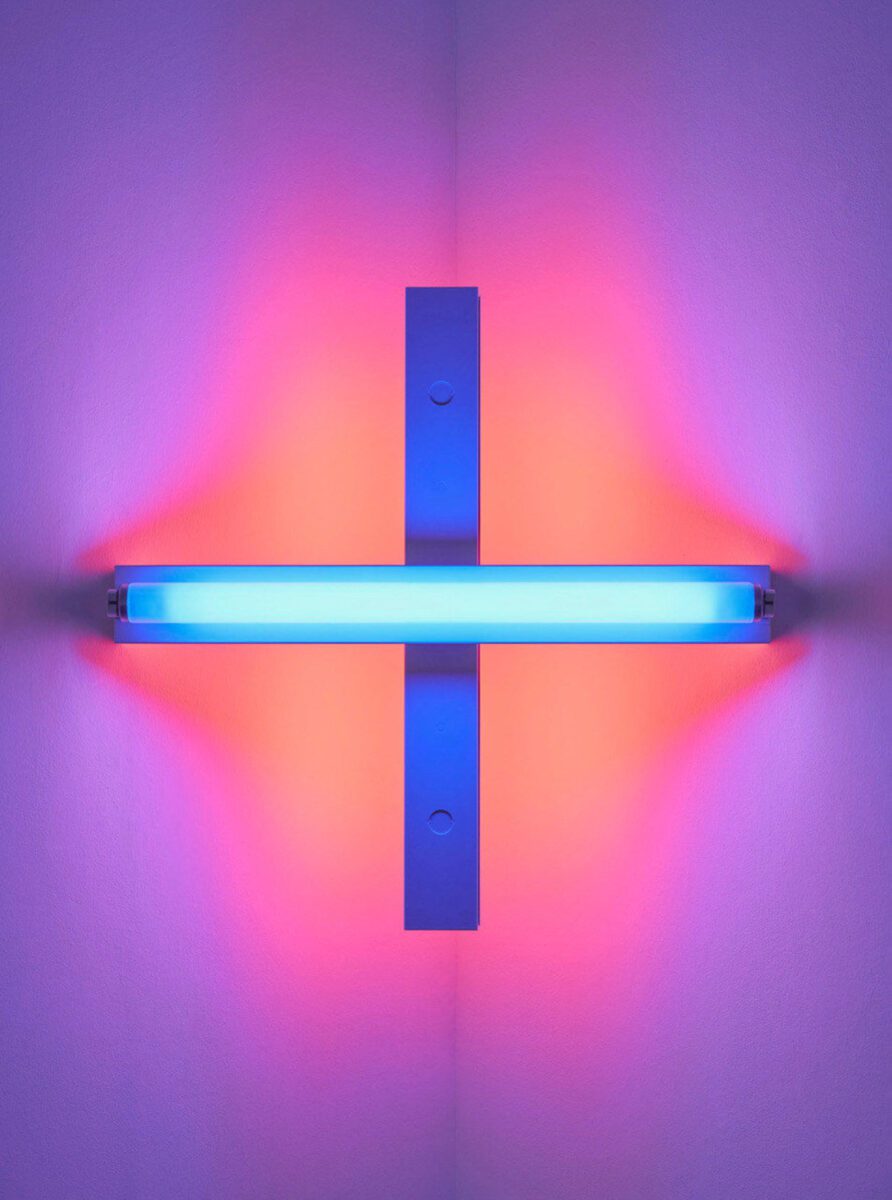
2. Dan Flavin, untitled (to Barbara Nüsse), 1971. Blue and pink fluorescent light Edition 8/50 Solomon R. Guggenheim Museum, New York Panza Collection, Gift 92.4118 © Dan Flavin, VEGAP, Bilbao 2026
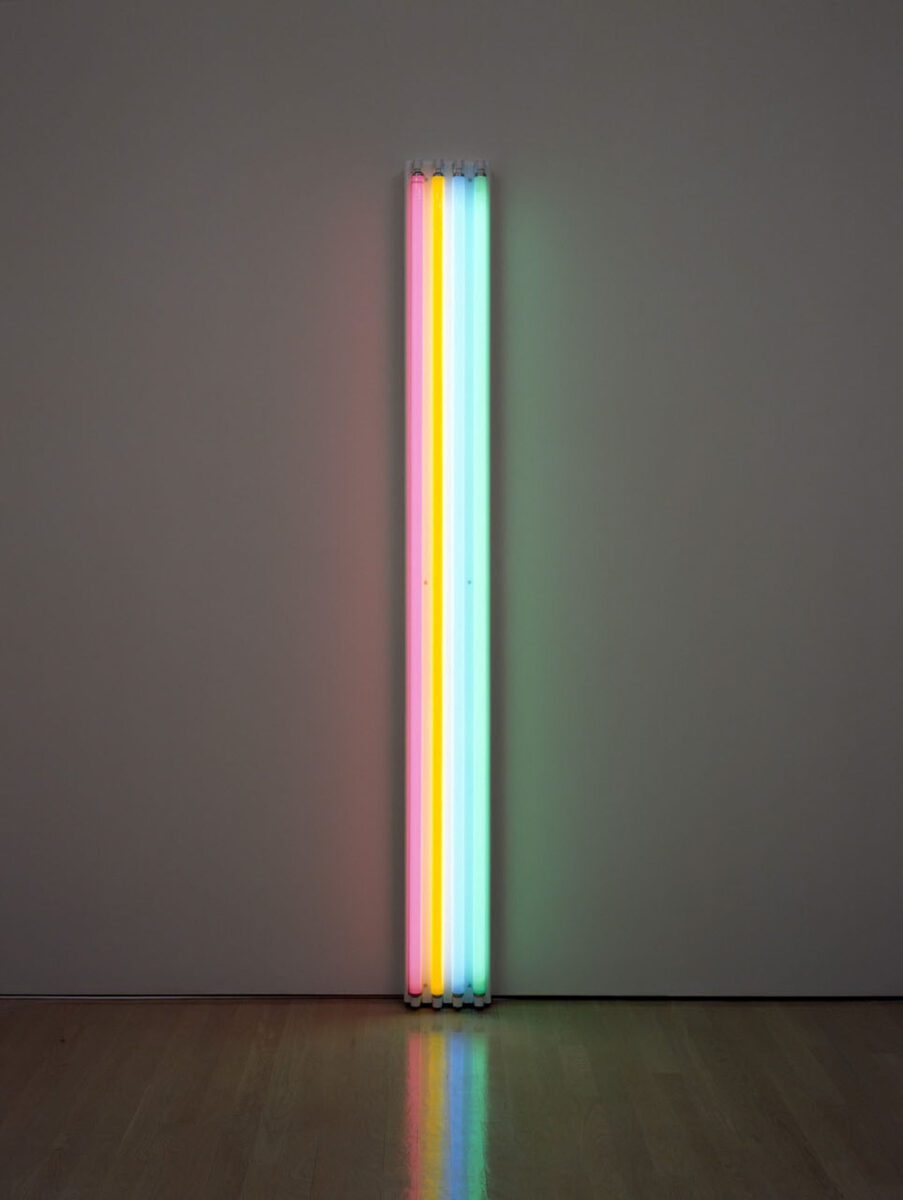
3. Dan Flavin, untitled (to Henri Matisse), 1964. Pink, yellow, blue, and green fluorescent light Edition 2/3 Solomon R. Guggenheim Museum, New York Panza Collection, Gift 92.4113 © Dan Flavin, VEGAP, Bilbao 2026.