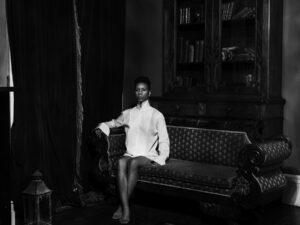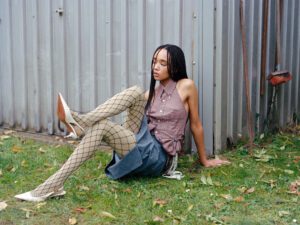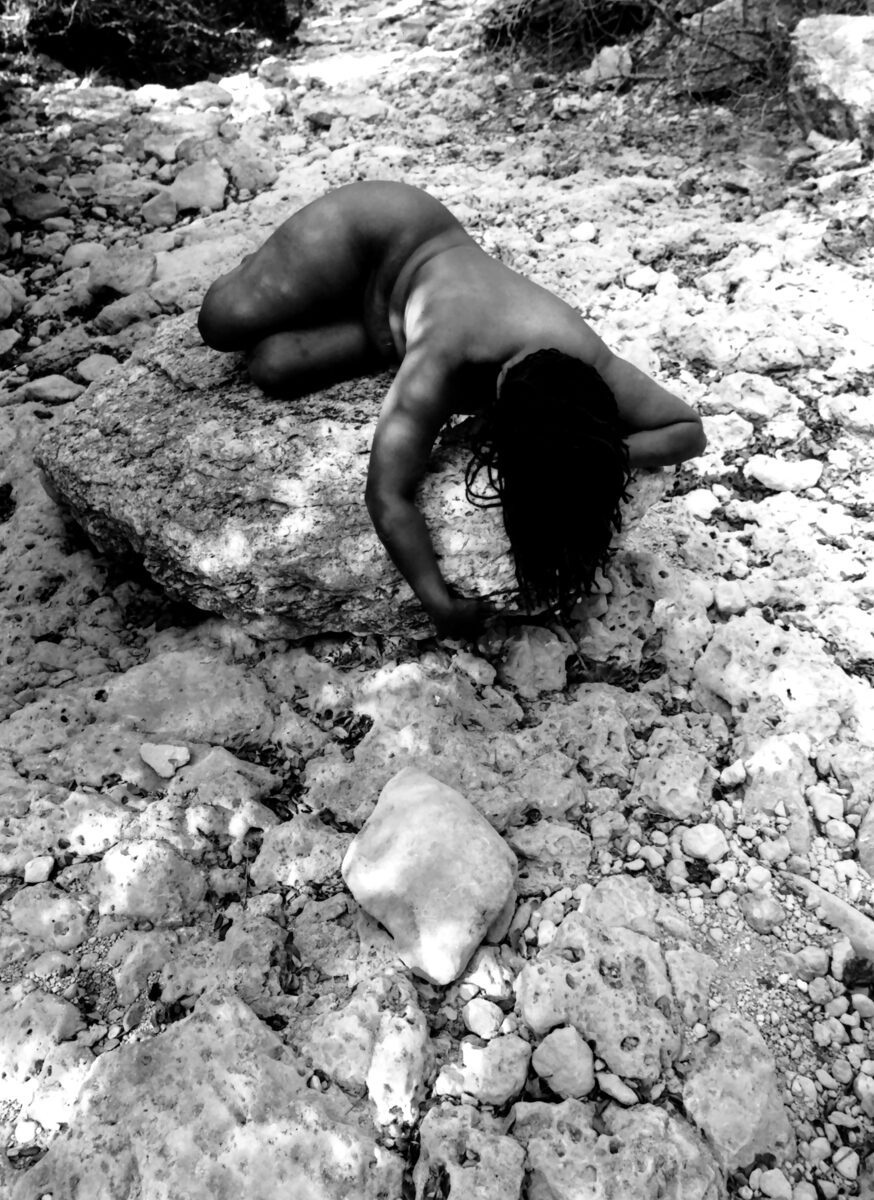
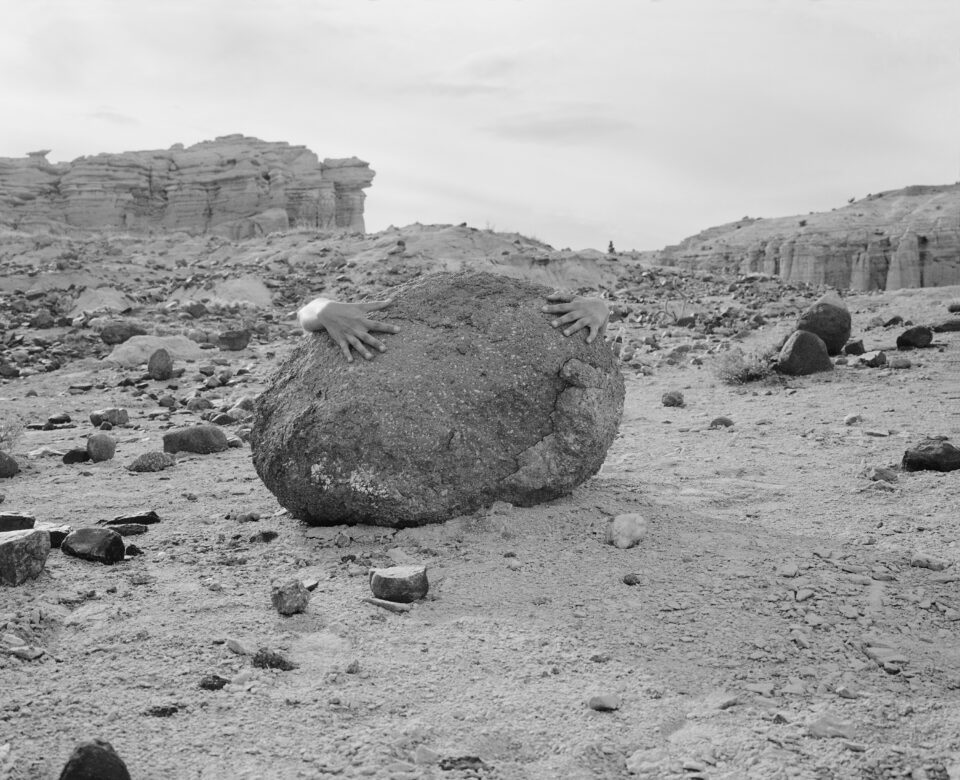
“Our bodies have been bridges. We are the sons and daughters, el destino de mi gente, black brown beautiful.” These are some of the closing lines of Afro-Latina, a poem by Elizabeth Acevedo. The work tells the story of the writer’s rejection of her Spanish roots as a child to fit in but coming to embrace and take pride in her mixed-race and cultural heritage. The words speak to the celebration of blended cultures and histories. Now, they’re also the name of a new exhibition at Autograph Gallery, London. Our Bodies Have Been Bridges brings together three feminist artists from across the Americas whose work centres on the body. In distinct ways, each use their body to bridge personal and collective memory, Indigenous knowledge and relationships to land. Across 65 works made over three decades, Laura Aguilar, Tarrah Krajnak and Koyoltzintli use photography to claim presence and resist fixed ideas of who can be seen.
For Laura Aguilar (1959 – 2018), self-portraits place her queer body in the landscapes of the American Southwest, bringing forward a body rarely seen in dominant photographic histories. The artist was of native Californian, Mexican and Irish decent, with each overlapping identity influencing her creative practice. Aguilar was a pioneer of intersectional feminism, which aims to separate itself from white feminism by acknowledging women’s differing experiences and identities and her practice was connected to her own experiences as a working class, queer woman of colour.
Upon the acquisition of her work by the V&A in 2025, Christopher Velasco and Sybil Venegas, Co-Trustees of the Laura Aguilar Trust, wrote that: “Laura’s work, simply put, was ahead of its time. While her work was exhibited in the United States and internationally, and at times collected by private collectors and friends, few significant institutions acquired her work. She was the subject of many scholarly works and essays during her lifetime, but her work was not on the mainstream radar. Institutional racism, homophobia, the un-critiqued male gaze, and the objectification of the female body all contributed to the lack of interest in her work.” At Autograph, this is set right, as Aguilar’s work takes centre stage. Here, she continually places herself in the frame, naked and exposed to the elements. In doing so, she resists erasure.
Tarrah Krajnak’s work is also on display, exploring the gaps in her personal history against the backdrop of Peru’s political upheaval. The artist uses a temporary darkroom, multiple projections, large format cameras and re-photography to imaginatively “return,” her body to Lima in 1979, the year she was adopted from an orphanage there. In 2022, she described the project: “The resulting series of self-portraits emerge from the intersections between the city’s fraught history and my own, making visible the ways that violent or traumatic histories can be held in bodies and excluded from archives. I am interested in the multi-temporality of the photographic medium, and the potential of the darkroom itself as a site of performance or spectro-poetics – a way of conjuring the ghosts that haunt a life.” By placing herself in dialogue with archival photographs, she imagines a past that remains fragmented and unresolved.
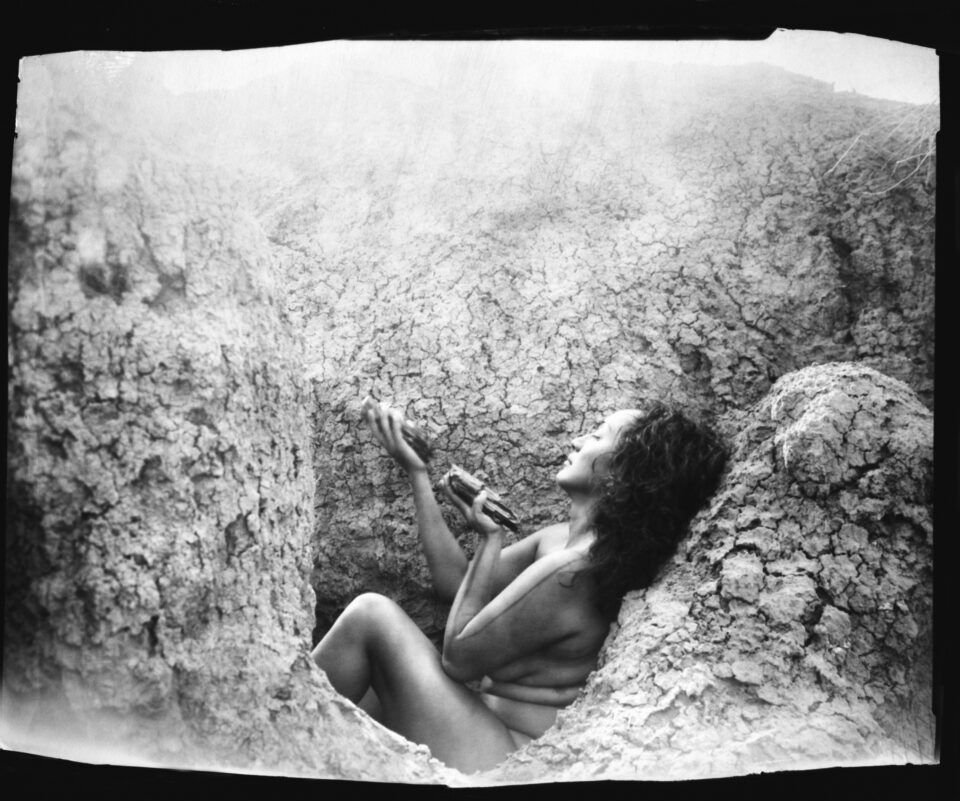
Koyoltzintli completes the trio of artists, with a series that reflects on how Indigenous origin stories and cultural transitions sustain connection across generations. The interdisciplinary artist creates work that revolves around sound, ancestral technologies, ritual and storytelling, blending collaborative processes with personal narratives. Other Stories / Historias Bravas focuses on her relationships with the women in her extended family, especially her mother and grandmother. The images are ones of tenderness and dignity, incorporating symbols and visual elements that draw upon the artist’s Ecuadorian heritage. Throughout her work, the land holds living relations between memory, ceremony and ancestry.
Together, their work forms an intergenerational conversation about how the past is carried through the body. Photography becomes an act of resistance – insisting that the politics of the body cannot be separated from the politics of the image.
Our Bodies Have Been Bridges is at Autograph, London until 13 February: autograph.org.uk
Words: Emma Jacob
Image Credits:
1. Laura Aguilar, Motion #50, 1999. Courtesy of Light Work and The Laura Aguilar Trust of 2016.
2. Koyoltzintli, Spider Woman Embrace from the series Meda, 2019. Courtesy the artist.
3. Koyoltzintli, Obsidian woman from the series Meda, 2019. Courtesy the artist.