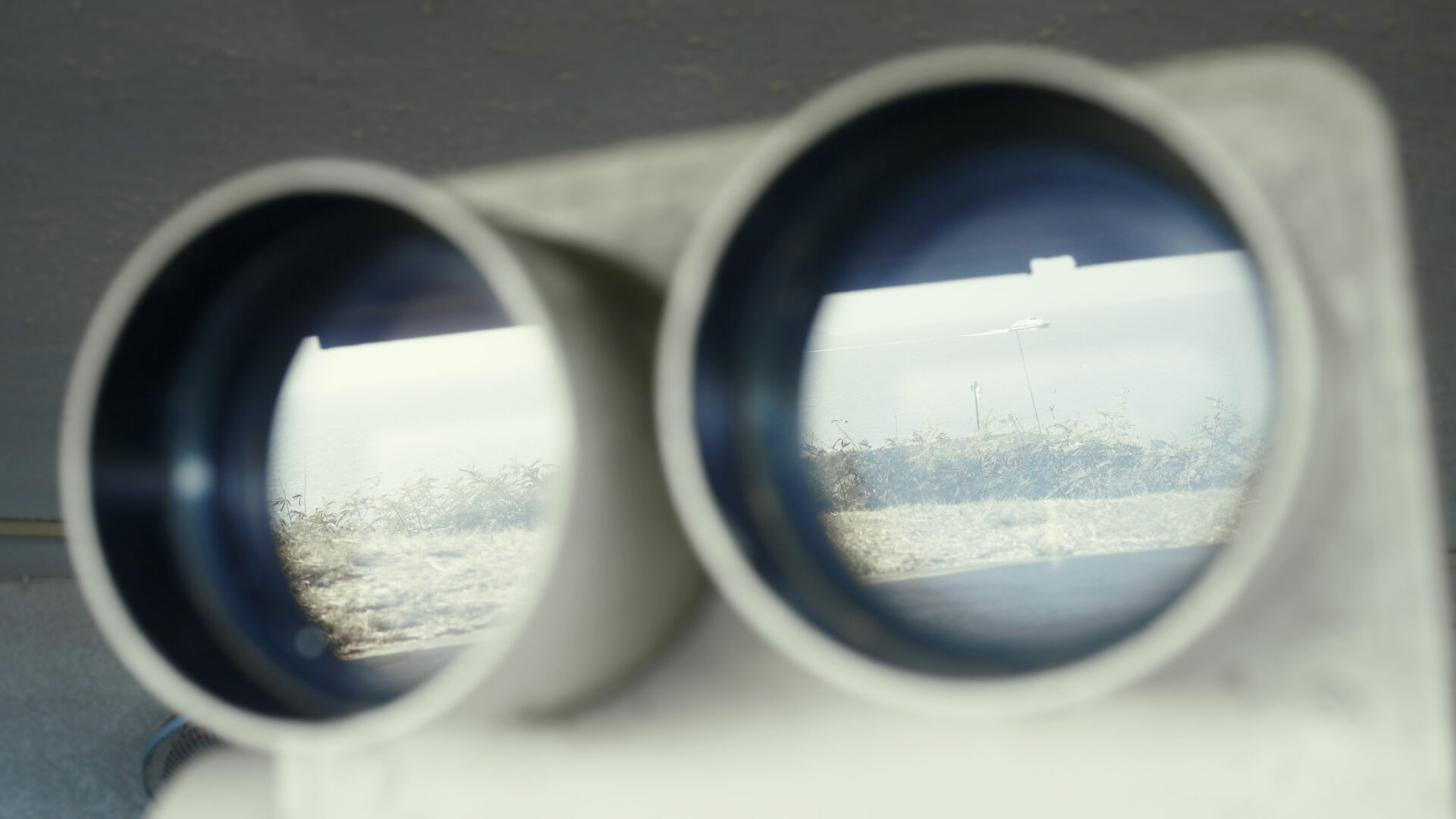
What does a landscape remember when the conflict that shaped it has never really ended? On Taiwan’s Kinmen Islands, military bunkers, deserted beaches and radio transmissions belong to a history that remains suspended between past and present. Tiffany Sia’s Overt Listening, opening at Kunsthalle Wien this November, begins with that tension, using film, sound and installation to consider how geopolitical power persists in places long after its most visible confrontations have passed. The exhibition’s focus is a new film made on Kinmen, where the aftermath of the Cold War is registered not through grand historical narratives but through fragments of landscape, broadcast media, military exercises and competing accounts of the past. Sia is interested in what particularly happens when history refuses to stay historical – when it continues to organise the ways a place is heard, pictured and understood.
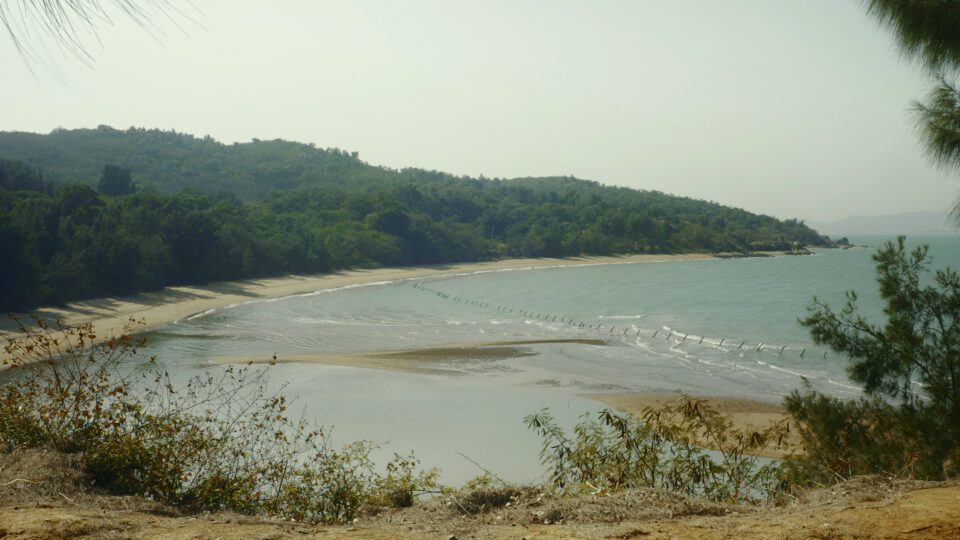
Kinmen is a unique setting for this enquiry. Situated only a few kilometres from the Chinese coast, the islands became a frontline during the Chinese Civil War and remained heavily militarised during decades of confrontation between Taiwan and the People’s Republic of China. Bunkers and military sites therefore exist alongside beaches and settlements as part of an everyday environment in which the memory of conflict is also a physical presence. Sia’s film moves between these locations, combining historical sites with deserted coastlines and a soundtrack incorporating radio broadcasts and military exercises. Oral narratives, official histories and popular culture enter the same field, with the purpose of creating a deliberately unstable account of a place whose history has never belonged to a single voice.
That instability is vital because Overt Listening does not approach the archive as a storehouse of facts waiting to be recovered. Sia’s practice has long questioned how images, films and other media participate in the construction of political realities, a concern that runs through her writing as well as her moving-image work. On and Off-Screen Imaginaries, published in 2024, brings essays concerned with geopolitics, image circulation, cinema and the ways histories of Hong Kong are produced and contested. Instead of separating the document from the apparatus that produced it, Sia considers the conditions under which something becomes visible, legible or transmissible in the first place. That makes Overt Listening less a film about Cold War history than a film about the mechanisms through which history acquires meaning.
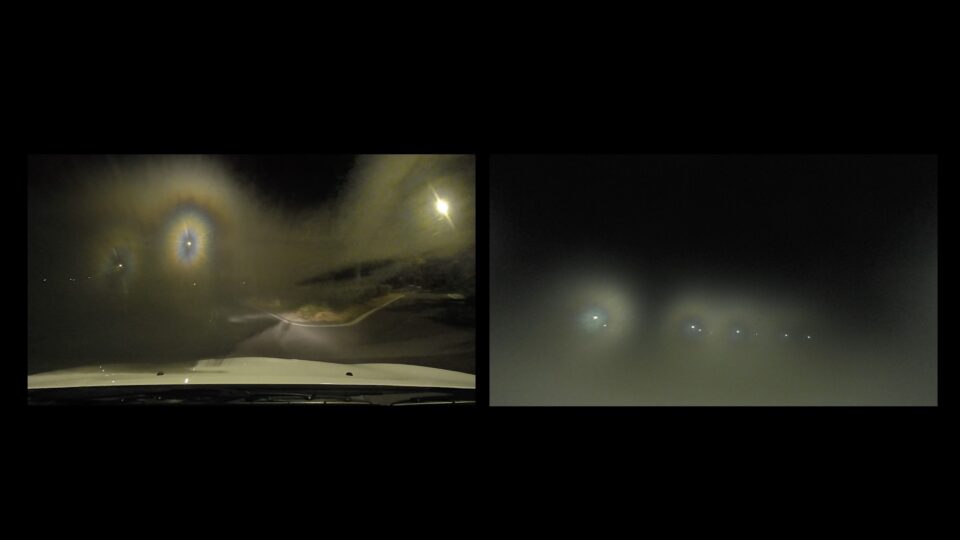
Listening gives that proposition a particularly physical dimension. Lawrence Abu Hamdan’s practice offers a useful contemporary parallel, having repeatedly examined sound as testimony and listening as a political act. His work Walled Unwalled, for instance, considers the relationship between sound, architecture, borders and privacy, while his wider practice has developed what he calls forensic listening – an approach in which apparently incidental sounds can become forms of evidence. Sia is doing something less forensic, but the connection is revealing both artists ask what becomes available when attention shifts away from the image and towards what can be heard around it. A radio broadcast, like the echo of an event through a wall, can establish a form of proximity without offering the reassuring completeness of a photograph.
Radio also introduces a question of authority. A broadcast can carry a political message across a territory while concealing the structures that produced, edited and transmitted it; its apparent immediacy can make mediation difficult to perceive. Sia’s interest in interrupted television broadcasts similarly directs attention towards the machinery behind communication, asking how political narratives are assembled and sustained. Hito Steyerl’s work provides another point of comparison here, particularly in its examination of the relationship between technology, data and systems of power. Her projects have repeatedly challenged the idea that technological mediation is neutral, exposing the social and political structures embedded within systems that appear merely functional. Sia’s emphasis is more historical and atmospheric, but the shared concern is with making the infrastructure of perception completely visible to one another.
The interruption may be more telling than the broadcast. Seamless communication invites the viewer to forget that information has passed through institutions, technologies and decisions before arriving as coherent content. A break in transmission briefly exposes those conditions, creating a gap in which the authority of the message can be reconsidered. Contemporary art has repeatedly exploited such gaps, from experimental documentary to video essays that interrupt archival footage with testimony, speculation or silence. Sia’s method belongs to this tradition, but the Kinmen material gives it a distinct geopolitical charge: here, communication is inseparable from territory, surveillance and the chance of conflict. What appears as a technical problem can become a reminder that information occupies contested ground.
An-My Lê provides a different but closely related precedent. Her photographs have repeatedly approached war through its peripheral spaces – military training grounds, reenactments, landscapes and preparations for combat – rather than through the spectacle of battle itself. Small Wars photographed Vietnam War reenactors in the United States, while 29 Palms turned towards Marines training in a simulated Middle Eastern landscape; more recent work has continued to consider how military histories are inscribed into American terrain. Sia’s Kinmen footage similarly looks towards the spaces around conflict, where bunkers and beaches retain the psychological and material consequences of political violence. Both artists resist the assumption that war is best represented by its most dramatic images, instead asking what happens when conflict becomes rehearsal, architecture or atmosphere.
Lê’s work also raises a problem for Sia: the relationship between beauty and violence. A sweeping landscape can be visually seductive even when the history it contains is brutal, and contemporary art has never entirely escaped the difficulty of turning political trauma into aesthetic experience. Lê has deliberately worked in the conventions of landscape photography, allowing the viewer to be drawn into an image before confronting the military histories embedded in it. Sia’s deserted beaches and fortified coastlines create a comparable tension, although the addition of sound makes the encounter more unstable. The question is not whether these landscapes should be beautiful, but what their beauty conceals – and whether art can make that veiling perceptible without simply replacing one spectacle with another.
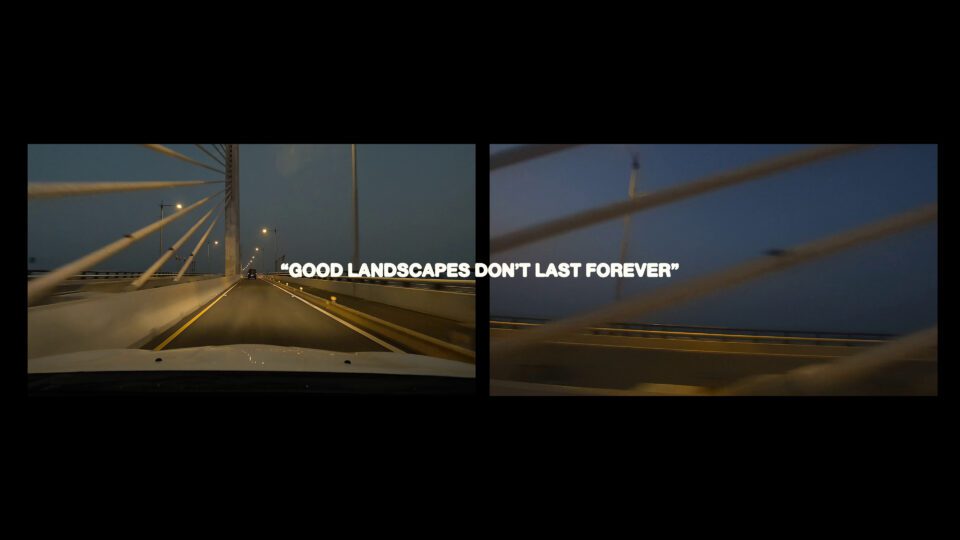
The spatial installation at Kunsthalle Wien extends this problem beyond the screen. Overt Listening unfolds across the ground floor of the Museumsquartier in interconnected chapters, asking visitors to encounter the film as an environment rather than occupying a fixed position in front of a single projection. Such an arrangement matters because Sia’s subject is not only what images represent but how bodies move through systems of representation. A viewer may hear a broadcast before locating its source, encounter a landscape after hearing the history attached to it, or move between fragments that refuse to settle into a chronological sequence. The exhibition therefore reproduces something of the experience it describes: history arrives obliquely, through partial signals and accumulated traces rather than a definitive account.
Austria introduces another set of historical residues into that structure. One newly conceived work considers the material traces of the Cold War in the Austrian landscape, including Vienna’s Flak towers – enormous reinforced-concrete structures built during the Second World War for anti-aircraft defence and civilian shelter. Their continued presence complicates the distinction between historical monument and ordinary urban architecture: the buildings remain, while the political conditions that produced them have receded from everyday consciousness. Set against Kinmen’s military infrastructure, they create a conversation between two very different geographies shaped by twentieth-century conflict. The comparison does not make their histories equivalent; instead, it proceeds to asks what it means for structures designed particularly for war to become part of the scenery of peace.
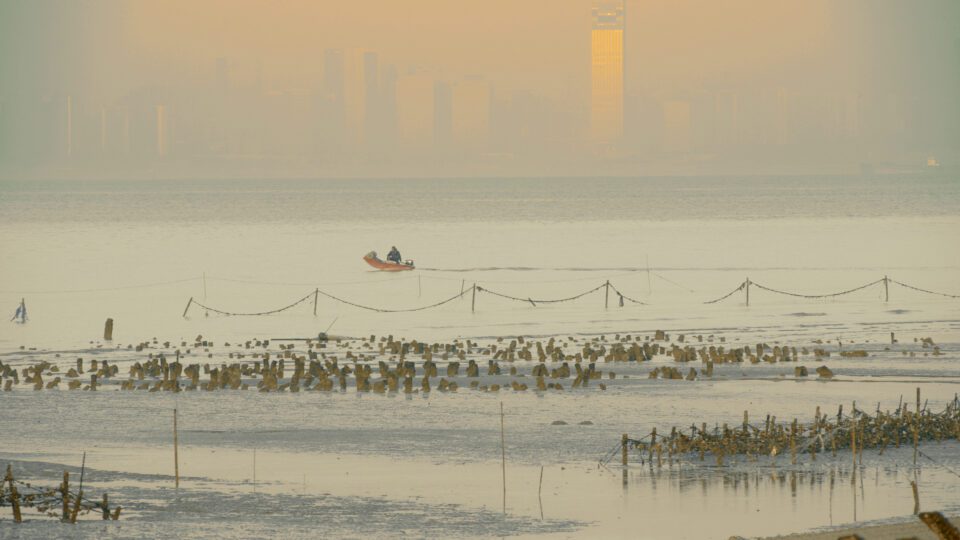
That question belongs to a wider strand of contemporary art concerned with landscapes as witnesses. Forensic Architecture has shown how buildings, environmental traces and spatial data can become forms of evidence, especially where official accounts of violence are incomplete or disputed. Sia takes a less evidentiary route, allowing uncertainty and contradiction to remain in the work instead of resolving them through forensic reconstruction. Yet both methods challenge the assumption that political history exists only in documents, testimonies or usual imagery. A bunker can be an archive without containing an archive; a coastline can retain the consequences of militarisation without visibly announcing them. Such places demand a form of attention slower than news media and less settled than historical narrative.
This may explain the significance of Sia’s title. Overt Listening brings together two impulses that do not immediately belong together: listening suggests receptivity, ambiguity and duration, while ‘overt’ suggests exposure and declaration. The phrase proposes a form of attention that is deliberately active, making listening itself visible as a method of inquiry. That distinction is relevant to a practice concerned with histories of censorship, surveillance and political disappearance, where the demand for greater visibility is not always politically innocent. Sia’s own writing has questioned visibility as an uncomplicated political goal, favouring forms of filmmaking that can remain oblique, fugitive and resistant to easy categorisation.
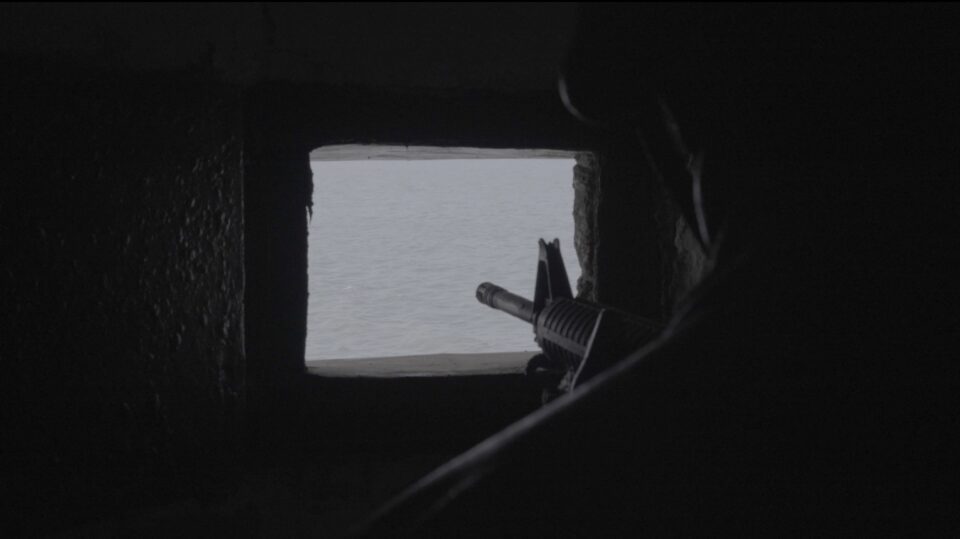
What makes Overt Listening compelling, then, is not simply its subject matter but its refusal to treat geopolitical history as a closed field of knowledge. Kinmen is neither reduced to a symbol of Taiwan–China tensions nor presented as an exoticised ruin of the Cold War; its landscapes become places through which competing temporalities overlap. The Austrian material adds another layer, suggesting that the political geography of the twentieth century persists through structures that have been absorbed into contemporary life. Radio, television and film complicate those physical traces by demonstrating that history also survives through systems of transmission. Across these different registers, Sia asks what it means to live among histories that have been declared over while their infrastructures remain present.
This exhibition makes a case for historical attention rather than historical resolution. Its fragments do not promise to restore an intact past, and its cinematic language does not pretend that competing narratives can be reconciled into one authoritative version. Instead, Sia creates conditions in which the viewer must notice the intervals between voices, images and places – the points where memory becomes uncertain and political power becomes tangible. That approach places Overt Listening within a wider contemporary conversation about documentary, landscape and the technologies through which knowledge is produced, while retaining a distinct interest in the sensory experience of history. What remains after the conflict, Sia suggests, is not silence but a dense field of signals – some amplified, interrupted and waiting to be heard.
Tiffany Sia: Overt Listening is at Kunsthalle Wien Museumsquartier from 12 November – 24 January
Words: Simon Cartwright
Images courtesy of Tiffany Sia, Overt Listening (still), 2026