The London 2012 Olympic Games closing ceremony. The 2022 Super Bowl halftime show. Beyonce’s Renaissance world tour. Lady Gaga at Coachella. The Weeknd’s After Hours Til Dawn. U2 at The Sphere in Las Vegas. All of these productions have one thing in common: Es Devlin (b. 1971). She is one of the world’s most sought after set designers. The British artist’s career began in small scale theatre in the 1990s, with a first commission from the Octagon Theatre in Bolton. Now, her genre defying works are experienced by millions in the world’s most prominent arenas, galleries, museums, opera houses and stadia. Her innovative approach, which spans from sculpture and architecture to stage, has not gone unrecognised. She received the London Design Medal in 2017, as well as multiple Olivier, Tony, Emmy and Critics Circle awards. Devlin also holds a CBE for services to design.
Now, following the major show An Atlas of Es Devlin in New York, she arrives at London’s Design Museum with Other Worlds, her first retrospective in Europe. The focus is process, offering a behind the scenes look at how these landmark projects have come to life over the past three decades. “I am moving my studio and practically my entire 30 year archive into the Design Museum for this show,” she says. “It’s an immense privilege to have this opportunity to share my working process and practice with visitors.” Audiences start their journey by being welcomed into a replica of her South London workshop. Shelves will be filled with her books, objects and maquettes, surfaces covered with drawings, tools and paints.
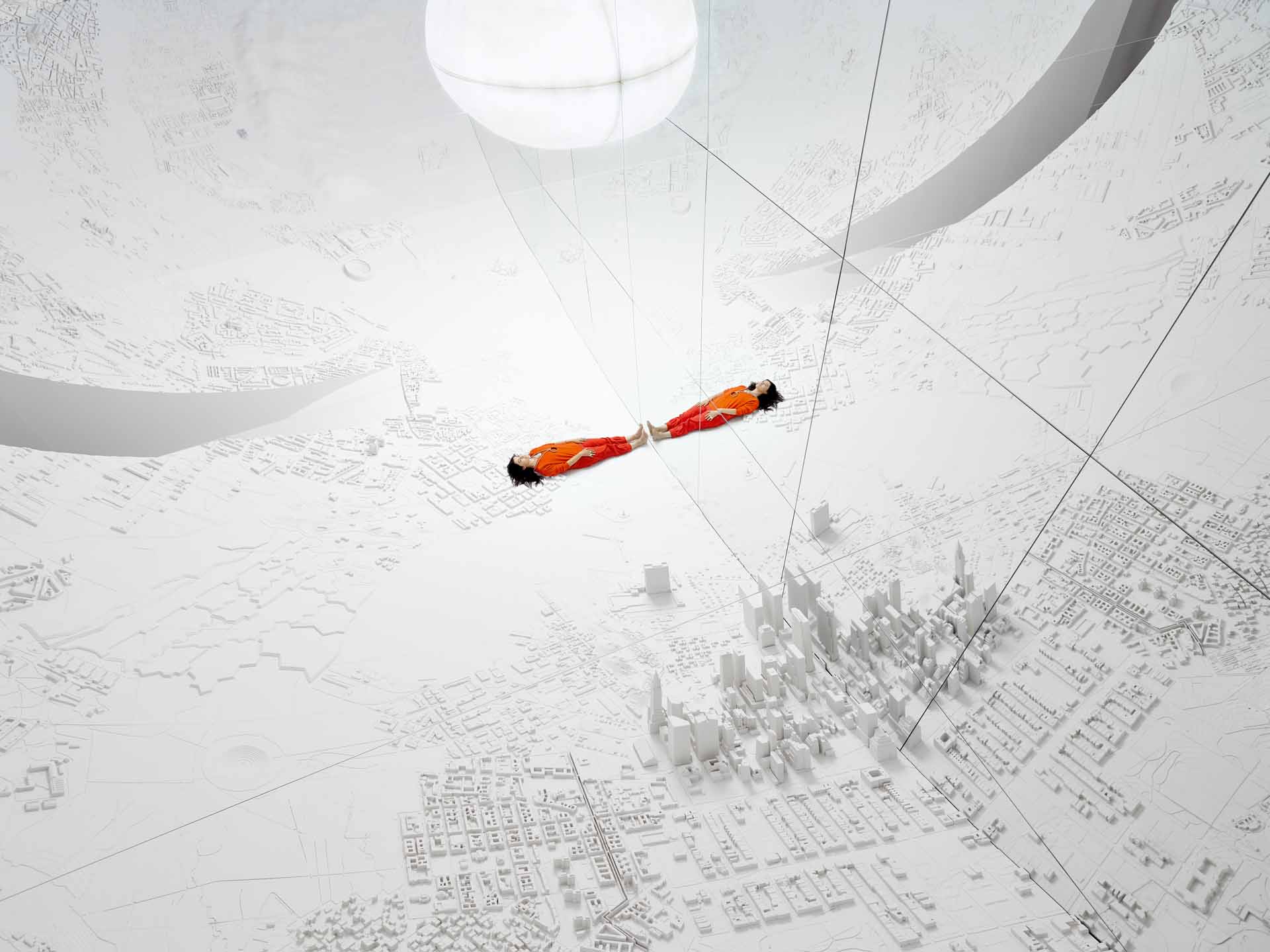
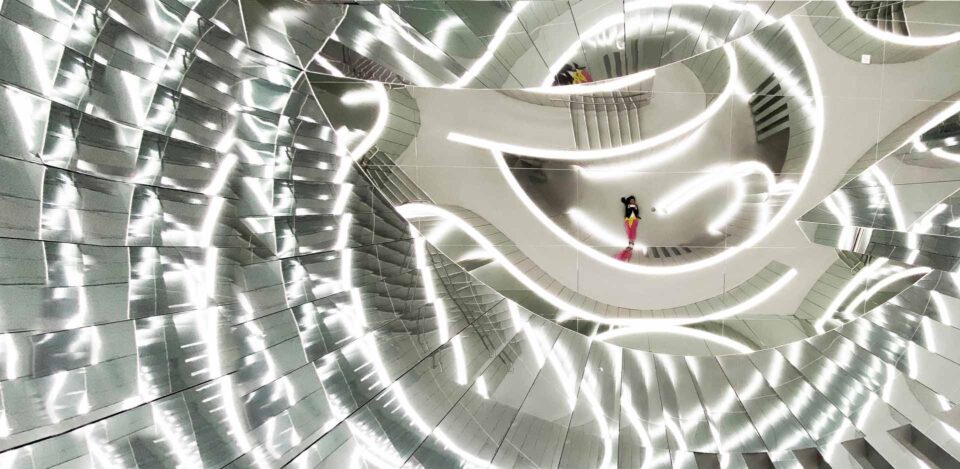
The most significant part of the presentation is probably 30-Year Desk, a newly conceived display with hundreds of items, photographs and models, many of which have never been seen in public before. Included is a close up look at her acclaimed set design for Sam Mendes’ The Lehman Trilogy theatre production in 2018, as well as art projects such as Forest of Us (2021), the mirror maze Devlin made for Superblue – a 50,000 square foot immersive space in Miami, which is home to large scale works by the likes of teamLab and James Turrell. This particular piece is inspired by the similarities between the structures of trees and those in our lungs.
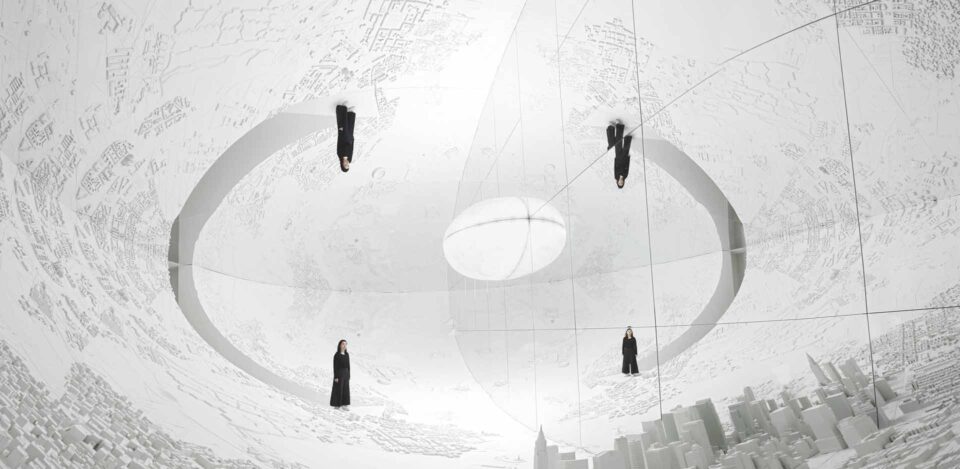
Nature is also the starting point for Come Home Again, an installation first shown at Tate Modern in 2022. A new iteration is on view at the Design Museum this winter; the original featured a cross section of the dome of St Paul’s Cathedral with illuminated cut-out sketches of endangered, birds, beetles, fish, fungi, moths and wildflowers, This is one of several site-specific works developed for London. Perhaps the most anticipated is the latest of her awe-inspiring rotating libraries.
Other Worlds spans the full breadth of Devlin’s creative evolution. The Archive Unboxed presentation runs the length of the gallery walls and features early collages, diaries, paintings, prints and sketches produced at school, university and art college, which Devlin has continued to create throughout her career. At the heart of the show is a strong desire to reveal the craftsmanship behind these large-scale visual spectacles.
Johanna Agerman Ross is the Conran Foundation Chief Curator at the Design Museum and curator of Other Worlds. In this interview, she speaks to Aesthetica about how the exhibition came to life, working closely with Devlin with the aim of immersing visitors into her imaginative and communal world.
A: Let’s start with an introduction to Es Devlin. How would you describe her practice to someone who is unfamiliar?
JAR: Devlin is an artist and designer who has a very specific focus: creating experiences that bring people together. That might be through an immersive installation, a music performance, an opera or a theatre production. For her, it’s about the idea of creating spaces and moments in which to gather.
A: Why does the present moment feel like the right time for the Design Museum to launch a show about Devlin?
JAR: She has retained an archive of works from the past 30 years, and also from her student days. It’s a rich material to delve into. As an institution, we felt that it was the right moment to visit that archive, to look at the practice of stage design together and explore what that means within the context of our museum. It’s a new experience, because we haven’t really put together a show dedicated to a practitioner who focuses on the stage before. We have hosted recent exhibitions dedicated to film directors, Wes Anderson, but this field is still quite new to us. It goes hand-in-hand with our desire to further expand the idea of what design is, and what it can do.
A: How do you envision visitors engaging with the show?
JAR: We decided to focus on Devlin’s practice. As such, we wanted it to feel almost like one of her installations. So, it’s not a straightforward retrospective. You’re experiencing her works through structures that she’s built for you to encounter them in. You’re walking into an artwork, which happens to contain the archive. Her output is usually temporary – taking place across an evening or a few days. We’ve created a sense of permanence by putting this exhibition on for six months.
A: What are some of the common threads that emerge?
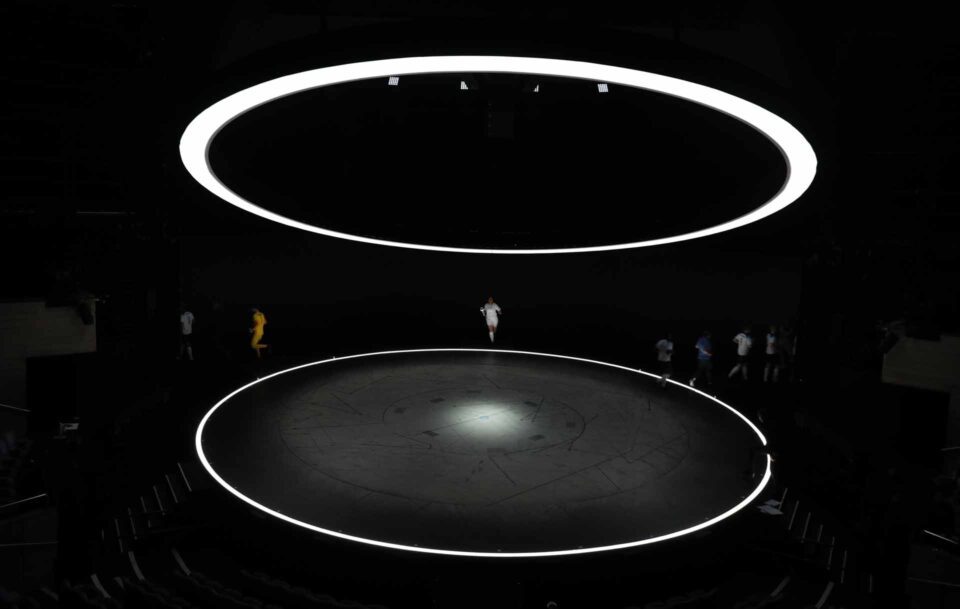
JAR: One is to do with form. Devlin has various recurring motifs: circles, spheres, cubes, squares or lines of light. These shapes appear even in her very early pieces. It was also important to give a sense of where the work happens and the magic takes place, whilst also noting her studio members. She’s not on her own. So, the first piece that you experience in Other Worlds is a recreation of her Peckham studio. She is always collaborating with people, so that’s where we wanted It’s very much about to start. The 30-Year Desk is the backbone of the exhibition, where you can see 23 models and around 80 projects. It represents the hard work that goes into making them a reality.
A: Could you tell us about the earliest pieces included?
JAR: Archive Unboxed goes further back into her childhood and teenage years. It reveals how she’s always had an art practice, but it’s taken different shapes. We have a lovely little sketchbook of costumes from her very first play, Edward II, made when she won the Linbury Prize in 1995. You can see the first steps of her practice and where it’s grown from there.
A: How important is it to reveal the research and experimentation that sits underneath these finished spectacles?
JAR: If you attend a Devlin production, you will be awed by the technology and the beauty of the presentation. But, really, the way she works is hands-on. It’s very much about paper, scissors, pens, pencils and cutouts. The “process of getting there” is a key part of who Devlin is, and it is fundamental to her practice. Moreover, as a museum dedicated to design, we would like to inspire everyone – young and old – to consider what the profession can enable and entail.
A: Were there projects that you felt you “had “to include? Why were they important to the story you wanted to tell?
JAR: The 30-Year Desk. Through it, you start to understand what a laborious yet incredible process these projects have been for Devlin. To have a small and intimate representation of her practice – drawings, maquettes – alongside models that represent the finished work is a really important juxtaposition. Tony Award-winning design for The Lehman Trilogy, for which she is extremely well known, is also represented.
A: What do you think will be a stand out visitor moment?
JAR: The show takes viewers behind the scenes, through the personal and the handmade. Then, they exit through an artwork that lets them see what that all looks like in its finished form. This is Infinite Library: the first time Devlin is presenting one of her revolving libraries inside. She did it in the courtyard of Pinacoteca di Brera in Milan, and then on the beach in Miami for Art Basel last year. We’ve been working with her and Penguin to bring together some key readings and texts that have inspired her over the years. There are 2,000 books displayed in an eight-metre-long by four-meter-tall library.
A: Can you explain the thinking behind the show’s title?
JAR: We want the exhibition to feel like you are in a space that you recognise, but is somehow different, transformed. Devlin speaks of her audiences as “a temporary society”, and it is important to invite people into a collective adventure. The plural “worlds” was crucial, as Devlin takes us to multiple places: whether that’s set designs, or the world of the stage where she’s produced amazing stadium tours, or the installation works such as Mirror Maze, which really challenge you.
A: Devlin’s practice is often described as “genre-defying.” What shifts or stays the same between different contexts?
JAR: The idea of changing perceptions is always a starting point – whether that’s questioning what a large language model tool can do, or our understandings of overlooked species that surround us in London, like with Come Home Again. Elsewhere, in Congregation, she’s thinking about the stories of people who come to the UK to seek refuge. Devlin is interested in making us look at something with fresh eyes.
A: What kind of impact has Devlin had on the world of stage design, and beyond, over the past three decades?
JAR: She has brought a curiosity continued engagement with new technologies to the table. Devlin has challenged what can be done on stage, and how you can use sleight of form hand to dazzle an audience. She is very good at finding ways to transform space, for it to be experienced as something different than what it really is. Her inquisitiveness and appetite for learning has made some of these things possible.
A: Finally, what’s next for you and the Design Museum?
JAR: Other Worlds ties neatly together with us turning 40 in 2029. We started out as a museum dedicated to industrial design, because there was no other space that gave that any attention in the late 1980s. This show points to where we have grown and moved as an institution. Design has really expanded, and I hope we will always remain at the forefront – not staying static or looking back, but always pointing forward and being excited about what the future may bring. That is why it’s so thrilling to have worked with Devlin on this, and to be able to present her retrospective at this moment in time.
Image Credits:
1) Es Devlin photographed in Memory Palace, (2019). Photo credit Peter Mallet.
2) Memory Palace by Es Devlin, (2019). Photo credit Peter Mallet.
3) Forest of Us at Superblue Miami, (2021). Photo credit Es Devlin.
4) MASK IN MOTION, (2018), a projection-mapped sculptural installation by Es Devlin for Photo London at Somerset House. Photo credit Es Devlin.
5) DEAR ENGLAND, (2025). Photo by Es Devlin.