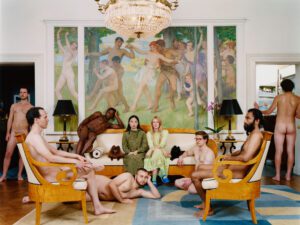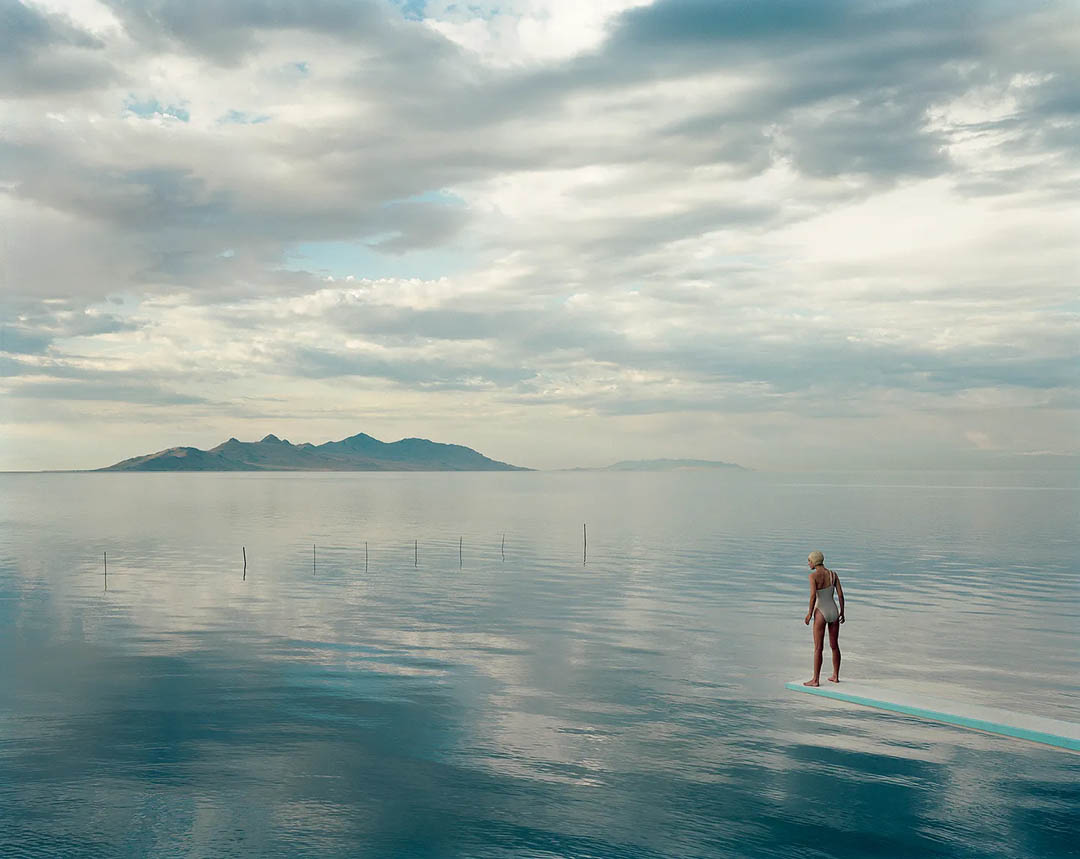
Photography is often treated as a form of visual evidence, its authority resting on the belief that what the camera records can be understood as fact. However, every photograph is shaped by selection, perspective and interpretation, complicating the certainty it appears to offer. Nadav Kander works within this tension, creating images of striking precision that resist definitive interpretation. Across more than four decades, his practice has moved between portraiture, landscape, still life and the human figure, using each form to examine the distance between what can be seen and what can be known. The Edge of Things, at Amsterdam’s Foam, brings these strands together, but Kander’s significance extends beyond any single exhibition; his work offers a sustained examination of what photographic authority can achieve.
That question is particularly pressing in a culture where images are consumed at extraordinary speed. A photograph can identify a person, establish a location or appear to document an event, yet none of these functions guarantees understanding. Kander’s images frequently exploit the gap between recognition and comprehension, allowing information to remain present without becoming the whole meaning of the picture. His landscapes may be geographically specific while seeming psychologically displaced; his portraits may identify their sitters whilst leaving their inner lives inaccessible. The effect is not obscurity for its own sake, but an insistence that looking is an active process rather than the passive receipt of facts.
Kander’s career makes this position especially interesting because he has worked so successfully within both art and editorial photography. London-based, he began taking photographs at 13 and has developed an international practice encompassing fine-art photography, portraiture and moving image. His honours include the Prix Pictet for his Yangtze River photographs, an Honorary Fellowship of the Royal Photographic Society, the Sony World Photography Organisation’s Outstanding Contribution to Photography award and a 2025 Pollock-Krasner Foundation Grant. In 2009, The New York Times Magazine commissioned him to make 52 portraits of members of Barack Obama’s administration – the largest number of portraits by a single photographer published in one issue – whist his sitters have also included Rosamund Pike and David Lynch. His work is held in collections including London’s National Portrait Gallery and the Museum of Contemporary Photography in Chicago and has been shown at institutions including the Barbican Centre, Somerset House and Palais de Tokyo.
Editorial photography usually depends upon immediate recognition: the image must establish its subject quickly, whether that subject is a politician, actor or cultural figure. Kander’s portraits satisfy that requirement while simultaneously undermining it, turning the familiar face into something less secure. In a 2019 exchange with Kander, curator David Campany described a portrait as “a fragment from an ongoing life”, pointing to the impossibility of fully knowing the person represented. That distinction matters because a portrait activates the viewer’s assumptions about who that person might be. Kander’s photographs become compelling precisely where identification gives way to projection.
Kander himself offers a useful counterpoint to the conventional idea of the photographic storyteller. “I don’t photograph to tell stories,” he tells Campany, “I photograph to make stories possible.” The distinction shifts responsibility from photographer to viewer, suggesting that meaning is completed through looking rather than delivered by the image. It also explains why his portraits can feel intimate without becoming confessional: the photograph does not claim privileged access to another person’s interior life. Instead, expression, posture and lighting create conditions in which the viewer imagine what cannot be seen.
This becomes particularly evident in Kander’s portraits of public figures. Barack Obama arrives already burdened with an enormous accumulation of photographs, speeches and representations, meaning that the sitter is never encountered without the weight of an existing public image. Kander’s 2009 portraits therefore operate within a space between historical document and individual encounter. David Lynch presents a different but related problem: the cultural associations surrounding his name are so strong that the photograph must negotiate an image of the artist that already exists in the imagination. Kander introduces stillness and distance, allowing the recognised figure to become momentarily unfamiliar.
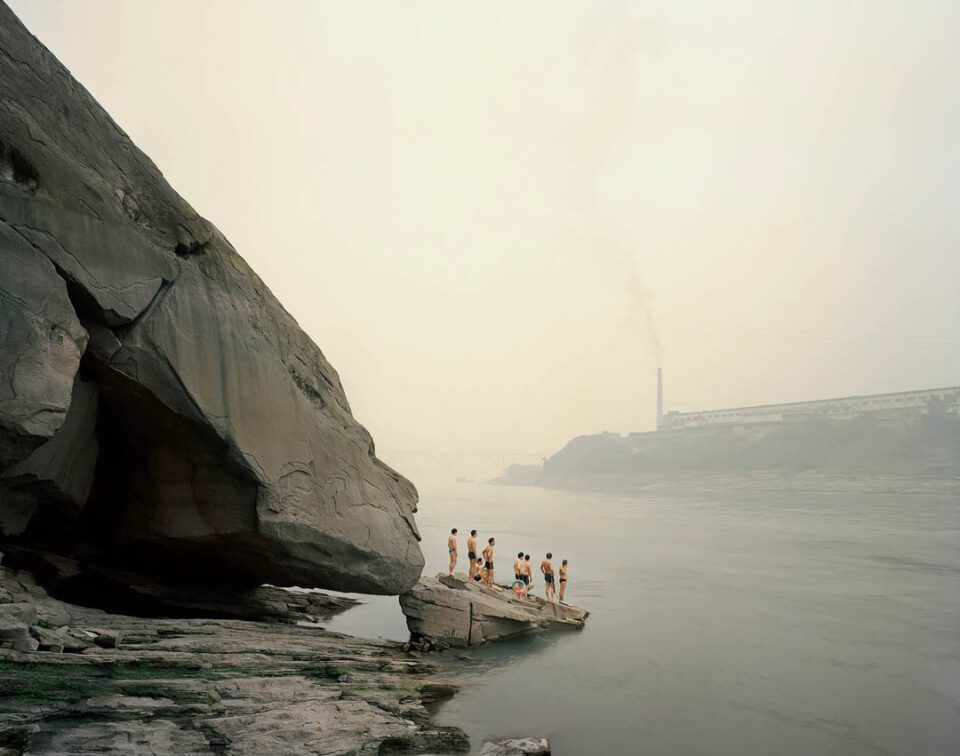
Landscape removes the pressure of celebrity but not the problem of interpretation. Kander’s photographs of the Yangtze River were made during a period of rapid industrial and social transformation, bringing together human activity, altered environments and the immense scale of the river itself. Yibin I (Bathers) places small human figures against water, rock, industrial structures and atmospheric haze, producing a scene that is neither straightforward document nor pure abstraction. The factory and smokestack provide evidence of transformation, but composition and light prevent the photograph from becoming a simple statement about industrialisation. What matters is the instability between these readings.
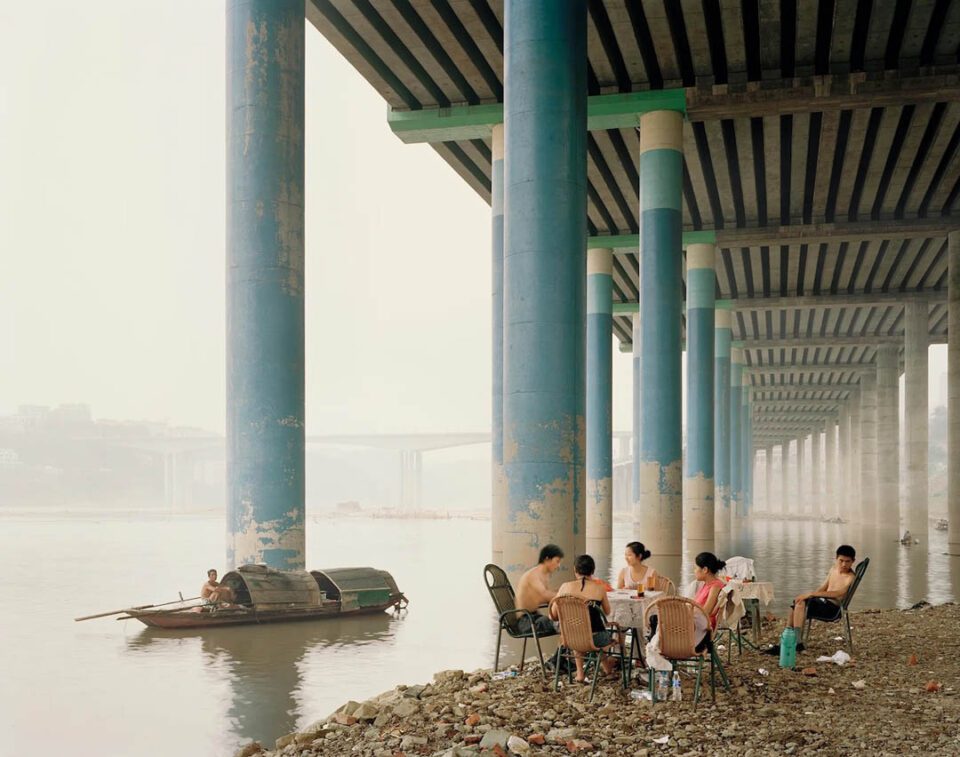
Environmental photography has increasingly questioned the assumption that showing damage is sufficient to communicate ecological crisis. Images of polluted rivers, collapsing habitats and industrial landscapes can provide powerful evidence, but they can also reduce complex histories to familiar visual symbols. Kander’s approach is less declarative, allowing the altered landscape to remain visually seductive while retaining its political implications. The Yangtze pictures are therefore not simply about environmental degradation; they ask how a viewer reads a landscape in which natural and human histories have become inseparable. This ambiguity makes the work relevant to a broader shift from documentary photography towards practices that acknowledge the camera’s role in constructing the world it depicts.
The same tension runs through Kander’s photographs of the Thames and Chernobyl. These are locations already saturated with history, but photography does not automatically make that history visible. A place may carry political, industrial or personal significance without offering an obvious visual language. Kander responds by attending to atmosphere and physical detail. The resulting images leave room for history to operate as a pressure within the frame rather than a caption imposed upon it.
Such an approach places Kander within a wider post-documentary conversation without requiring him to abandon the documentary function of photography. His pictures remain grounded in actual people and places. Light, scale, colour, framing and sequencing determine what becomes visible and what recedes. The photograph consequently records reality while acknowledging that recording is already an act of interpretation. This is where Kander’s editorial experience becomes significant: his practice demonstrates that an image can communicate clearly without pretending that clarity is equivalent to truth.
Curator David Campany’s role at Foam provides a useful structure for seeing these connections across Kander’s career. The exhibition brings together landscape, portraiture, still life, studies of the human body and moving image, with Campany serving as guest curator in collaboration with the Foundation for the Exhibition of Photography and Foam. Rather than treating these forms as separate specialisms, the selection makes it possible to consider the relationship between surface and depth. A face, a stretch of water and an industrial site can all become subjects through which Kander tests the limits of photographic description. Curation therefore matters as a means of placing visual questions beside one another.
The inclusion of moving image extends that investigation into duration. Alongside photographs, The Edge of Things includes video accompanied by music composed by Max Richter and a projection incorporating Kander’s own voiceover. These works introduce sound and movement into a practice often associated with highly controlled still images, making time itself part of the encounter. Yet the shift is not as radical as it first appears: Kander’s photographs have always depended upon the viewer. A still image may stop the clock mechanically, but interpretation continues to unfold long after the shutter has closed.
That demand for attention has force within contemporary image culture. Digital photography has made visual production almost continuous, while platforms reward speed, familiarity and immediate response. Kander’s work operates according to a different rhythm, one in which the first impression is deliberately insufficient. His photographs can initially attract interest through their formal control – the precision of light, the measured compositions – but visual pleasure becomes an entry point rather than a conclusion. The longer the encounter lasts, the more the photograph reveals its refusal to settle into a single meaning.
Kander’s achievement lies in making that uncertainty productive. His photographs do not abandon evidence, but neither do they allow it to become the final word; instead, they move between the recorded world and the meanings viewers construct. Campany’s extensive scholarship on photography provides a valuable critical context for Kander’s approach to portraiture, particularly its tension between observation and interpretation. Kander’s own assertion that photographs “make stories possible” extends this principle across the wider practice. At a moment when the medium is increasingly asked to deliver certainty at speed, Kander’s work offers a more demanding possibility – images can remain open, allowing viewers not simply to receive meaning but to participate in its construction.
Nadav Kander: The Edge of Uncertainty opens at Foam, Amsterdam on 18 September: foam.org
Words: Shirley Stevenson
Image Credits:
1. Diver, Salt Lake, Utah, USA, 1997 (from the series God’s Country) © Nadav Kander. Courtesy Howard Greenberg & Flowers Gallery. © Nadav Kander
2. Yibin I (Bathers), Sichuan Province, China, 2007 © Nadav Kander. Courtesy Howard Greenberg & Flowers Gallery.
3. © Nadav Kander, Courtesy Howard Greenberg & Flowers Gallery | Chongqing IV (Sunday Picnic), Chongqing Municipality, 2006, from the series Yangtze, The Long River