Step onto any bus or tube in the UK, and you’re likely to be greeted by a seat coated in a moquette fabric. The durable wool, often designed in intricate patterns and contrasting colours, has adorned the UK’s transport network for almost a century. The figure behind the iconic seats is Enid Marx, a textile designer who was tasked by London Transport in 1937 to create something that “looks fresh at all times, even after bricklayers had sat on it.” The first three creations focused on muted tones – “we all thought at first that the best was of disguising dirt was to use colours which would more or less tone in with the dirt” – before moving into the more vibrant shades we know today. Marx’s designs would be discontinued in the 1960s, but their influence continues to be felt throughout the city. In fact, walk into the London Design Museum shop and you’ll be greeted with moquette cushions, socks, scarves, glasses cases and even pyjamas.
Compton Verney presents The Pattern of Life a retrospective of this definitive figure, tracing her influence on Modern British Design. The exhibition goes way beyond her work on the Underground, expanding to include her output as an illustrator of children’s books and prolific hand block-printed textiles. Made up of major loans from the V&A and other national galleries, the show charts Marx’s life through fabric, tracing the geopolitics of British design and her lasting impact Audiences begin with early work, when in 1925 she began collaborating with textile designers Phyllis Barron and Dorothy Larcher in their studio in Hampstead. At the same time, she attended the Royal Collage of Art, part of a flurry of young voices that were described by a tutor as an “outbreak of talent.” Despite this, Marx failed her final diploma – often cited as due to her abstract tendencies – and began working as a pattern designer. Some of these very early artworks are on display at Compton Verney, where visitors become acquainted with her signature style of small-scale repeating patterns. The 1928 Braden piece is remarkable intricate, both emblematic of the artist’s characteristic style and clearly a forebearer to the iconic London Transport work.
Her influence on the Underground is an integral part of the show, forming the heart of her practice and reminding viewers why she holds such a central place in British design history. The iconic London Undergound era then give way to her post-war work, which saw Marx enter a new phase of artistic output, creating book illustrations, pattern papers and jacket covers. Perhaps most high profile was the 1953 design of a postage stamp for the new queen’s reign, but Compton Verney also draws attention to the quieter pieces. Her enduring and lifelong relationship with historian Margaret Lambert comes to the fore here, with Marx designing the covers for many of Lambert’s books. These included When Victoria Began to Reign (1937), English Popular and Traditional Art in England (1946) and English Popular Art (1951). This print work often featured animals, leading the London Zoo to adopt two of her prints for their posters in 1957.
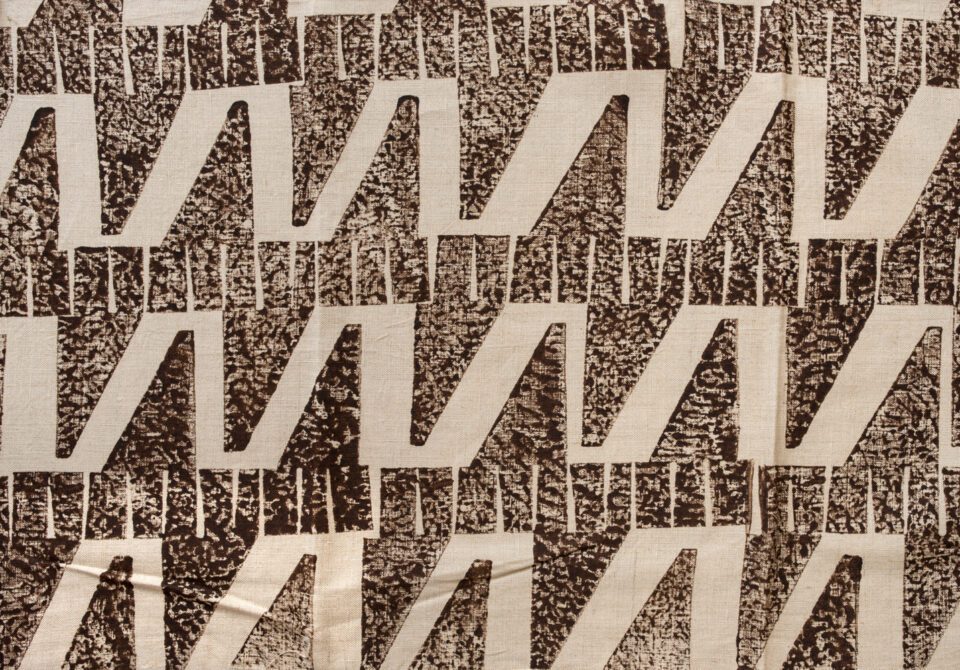
The exhibition uses Marx as a launching off point, rather than a sole focus, in a way that feels particularly interesting. Works of the designer’s contemporaries at the Royal College of Art, St. Ives School and Bloomsbury Group, such as Eric Ravilious, Paul Nash, Bernard Leach, Michael Cardew and Roger Fry are well known, but her close community of craftswomen and designers, including Ethel Mairet, Phyllis Barron, Dorothy Larcher, Katherine Pleydell-Bouverie and Norah Braden have sometimes been sidelined. Their approaches to handmade pattern and textile show how design acted as forms of personal, national and imperial expression, as well as embodying a series of double meanings reflecting queer identifications, intimacy and kinship. This show places these female pioneers back into the canon, offering equal attention and regarding their contributions as just as vital as their male contemporaries.
The Pattern of Life is a major achievement, documenting a figure that has shape the very foundations of 20thcentury British design but whose influence is often overlooked. In this show, she rightfully takes centre stage, allowing audiences to become acquainted with every facet of her output. But the show goes beyond that, opening doors and asking questions that encourage visitors to widen their perspective, consider the other female figures who have shaped design and, perhaps, look at the familiar designs around us and wonder who which artists dreamed them up in the first place.
The Pattern of Life: Enid Marx and Modern British Design is at Compton Verney, Warwickshire until 3 January 2027: comptonverney.org.uk
Words: Emma Jacob
Image Credits:
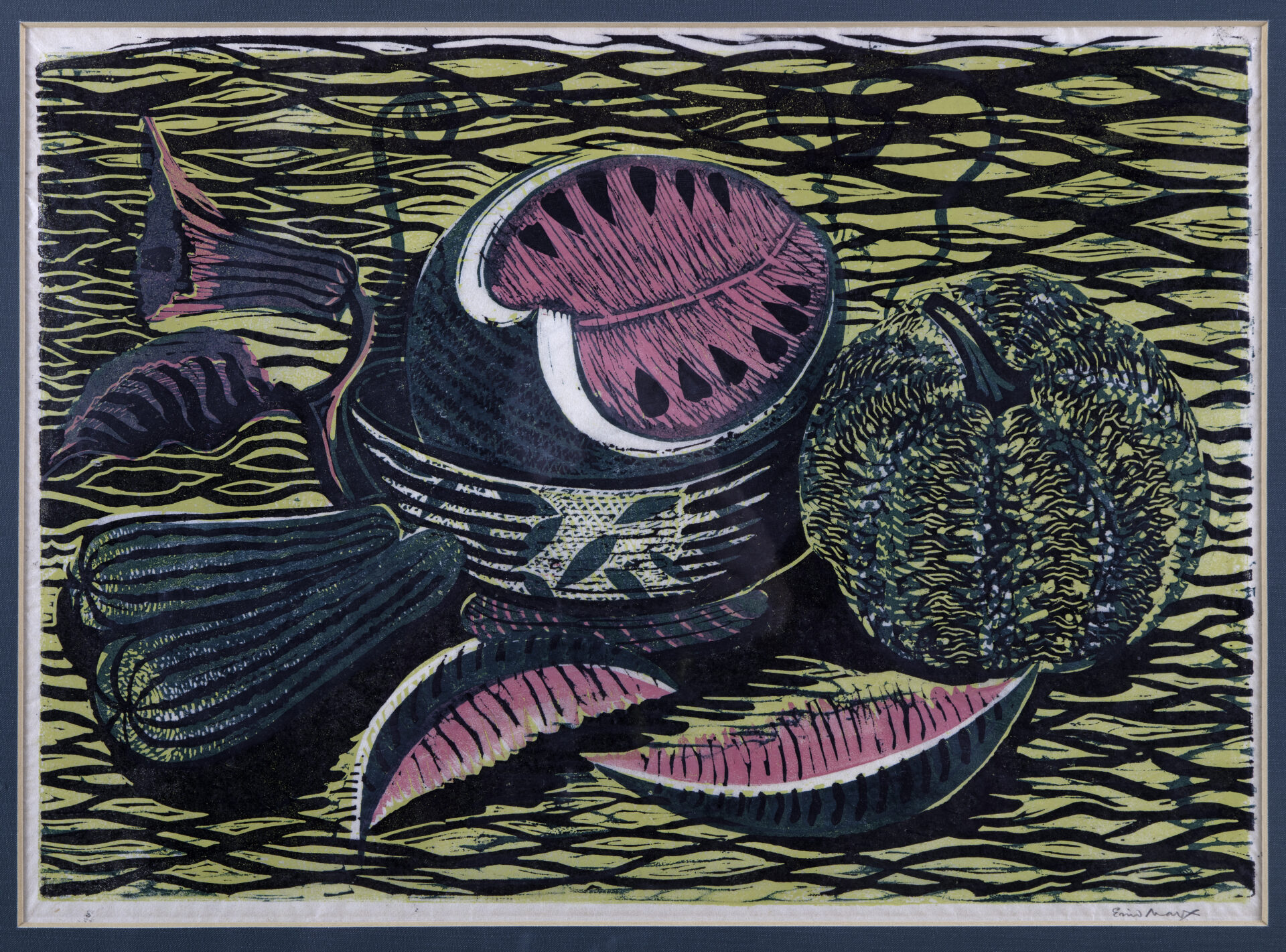
1. Enid Marx – Watermelon, pumpkin and cucumber, 1950s, three colour linocut on paper © Compton Verney, photo by Jamie Woodley.
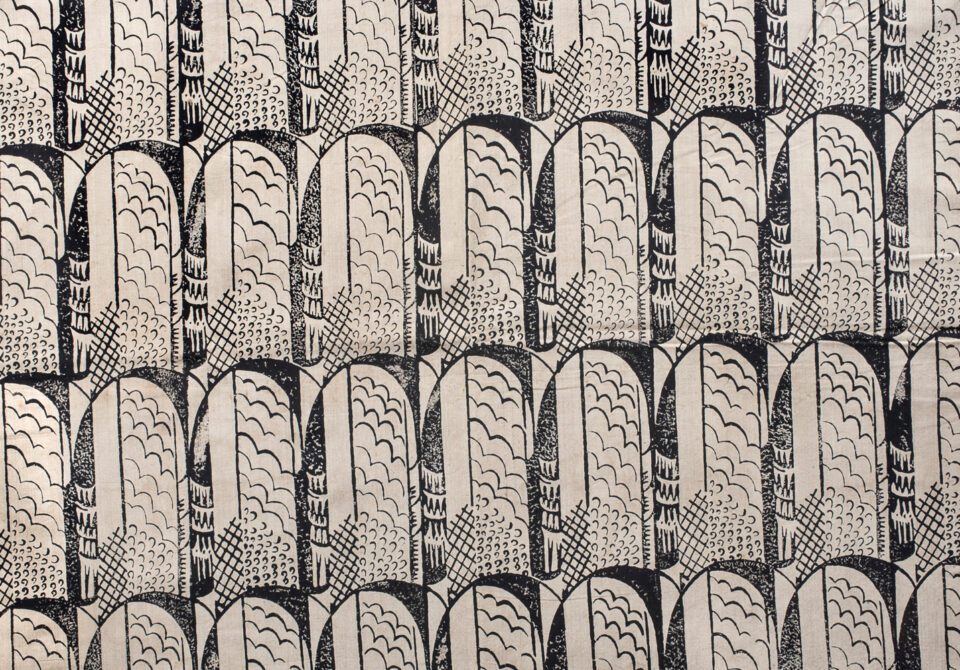
2. Enid Marx (1902-1998), Arches Fabric sample, 1930s, handblocked textile, Victoria and Albert Museum, © The Estate of Enid Marx.
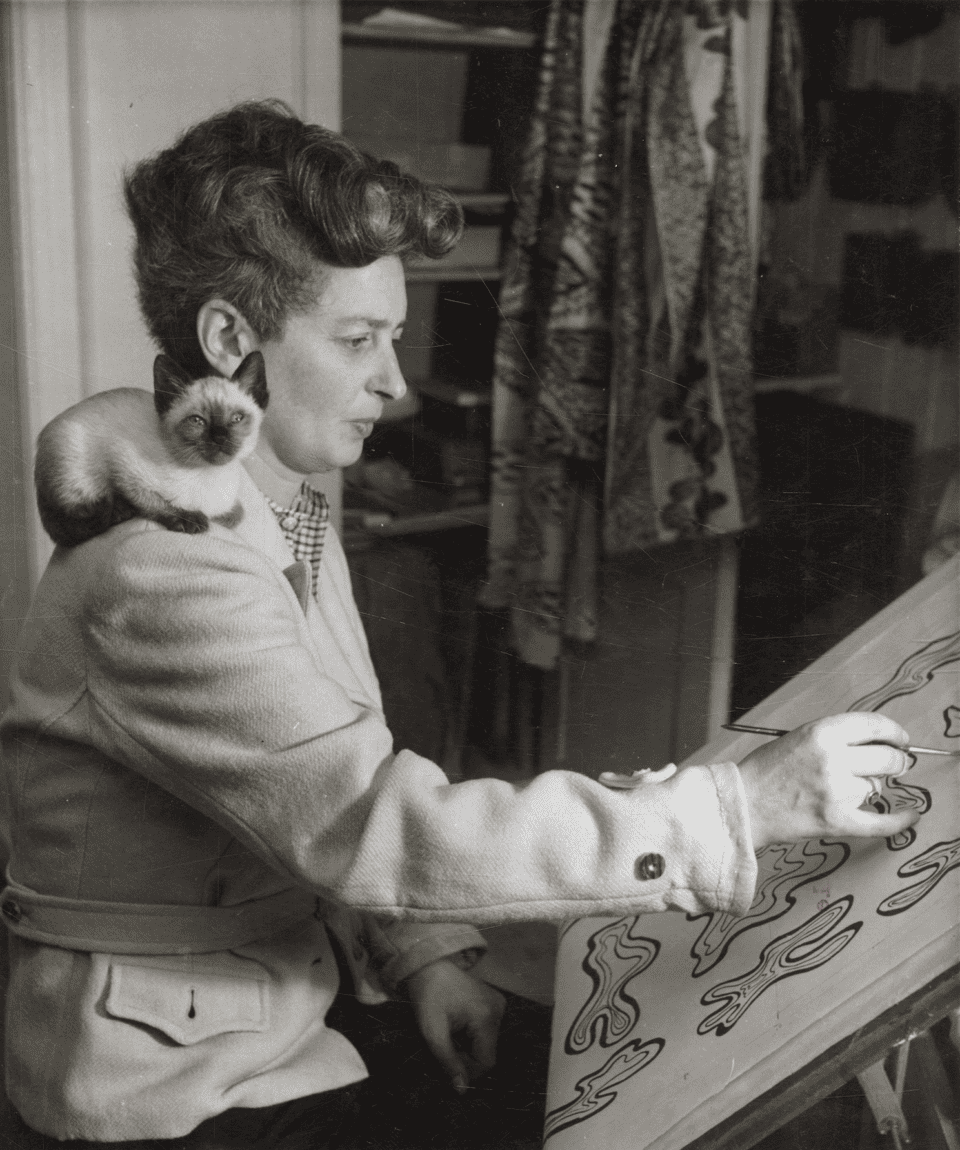
3. Photograph of Enid Marx carving blocks, date unknown, after 1945, © The Estate of Enid Marx.
4. Enid Marx, Ziggurat, 1933, handblocked textile, Victoria and Albert Museum, © The Estate of Enid Marx.