

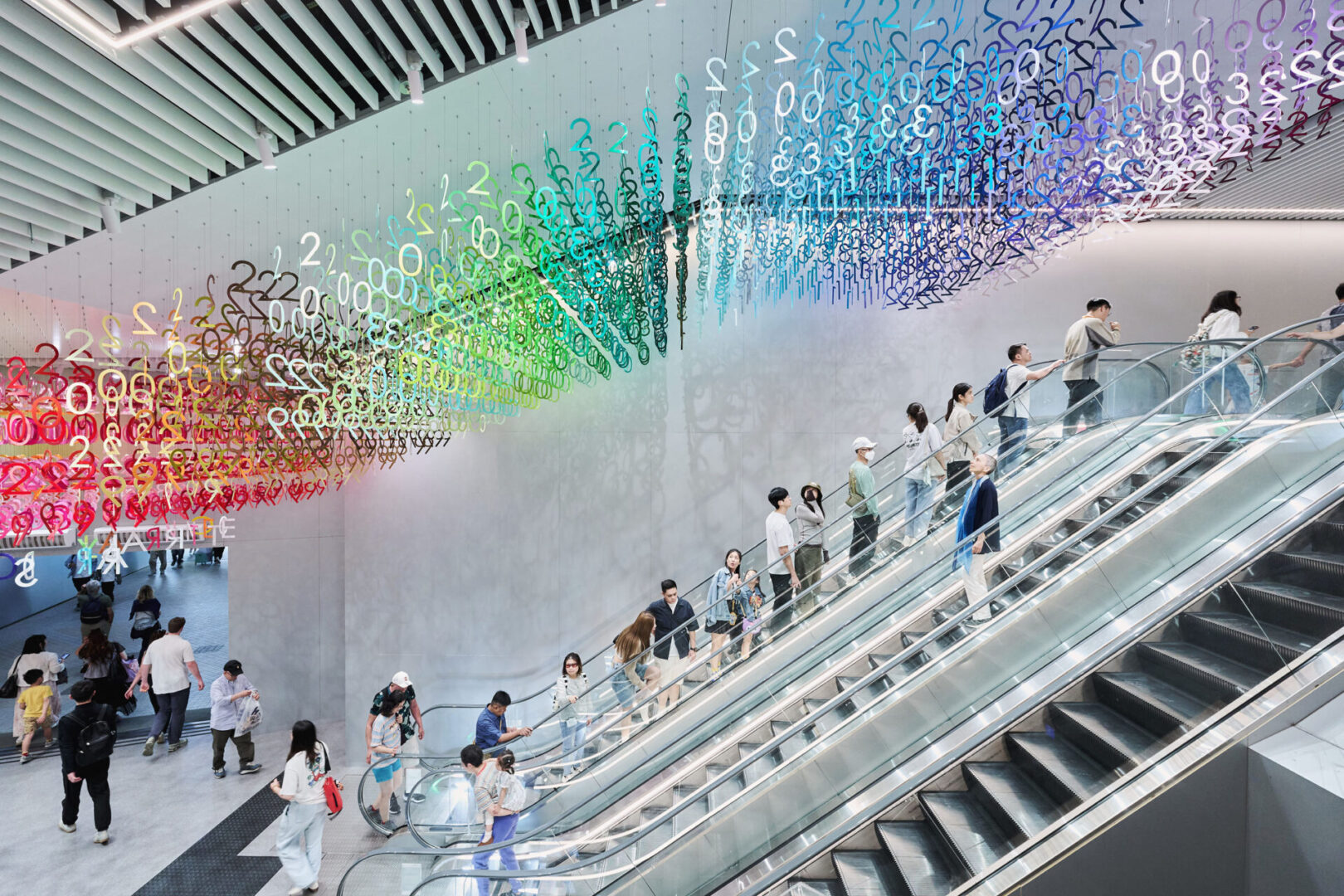
Colour has long occupied an ambiguous position within contemporary art – simultaneously immediate and elusive, emotional and structural. Beyond its decorative associations, it has become a means of communication, a language through which artists examine memory, identity, environment and the ways in which bodies encounter the world. Emmanuelle Moureaux’s 100 colors no.54 “FLOW”, a permanent installation at Central Yards in Hong Kong, continues this enquiry by transforming colour into an architectural medium. Suspended along one of the city’s most active pedestrian routes, the work considers how movement, duration and perception intersect. Rather than treating colour as a surface applied to form, Moureaux constructs a structure in which colour itself becomes the organising principle.
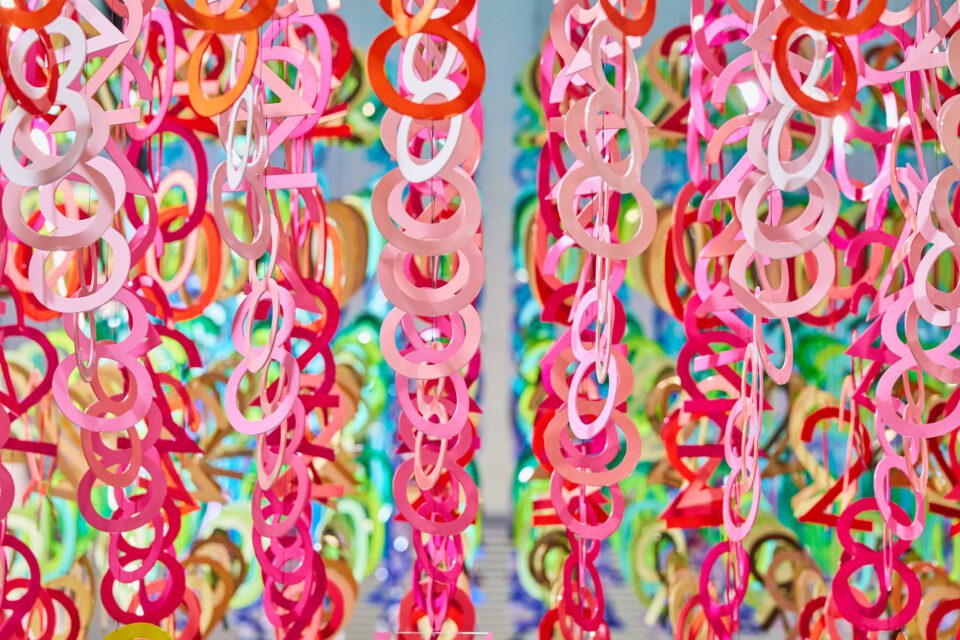
Within Hong Kong’s dense urban landscape, 100 colors no.54 “FLOW” reimagines everyday passage as a moment of contemplation. Installed between the city’s commercial district and the Central Ferry Piers, the work occupies a route shaped by constant movement and exchange. Composed of vertical lines formed from one hundred distinct colours, the installation incorporates sequences of future years – 2027, 2028, 2029, 2030, 2031 and 2032 – as a timeline suspended within the environment. These numbers do not operate as conventional markers of chronology. They suggest a future that is continually approaching, arriving and disappearing. As visitors move around, layers of colour overlap and separate, revealing a changing composition shaped by viewpoint and motion. The vertical elements create a shifting threshold between transparency and density: from one angle, the work appears as a precise architectural grid; from another, the colours dissolve into a fluid spectrum that interrupts the surrounding geometry of the city.
Born in France and based in Tokyo since 1996, Emmanuelle Moureaux has developed a practice that locates itself between architecture, art and spatial design. Her arrival in Japan became a defining moment, as she encountered a city layered with colour, signage, infrastructure and architectural fragments that challenged conventional ideas of visual order. These observations led to the development of shikiri, a concept that describes her use of colour as a three-dimensional element capable of dividing, creating and redefining space. Rather than applying colour as merely a decorative finish, Moureaux treats it as an architectural material – one that has the ability to shape movement, atmosphere and emotional response. Through her Tokyo-based studio, emmanuelle moureaux INC., she has expanded this approach across permanent artworks, architectural projects and large-scale installations internationally.
The ongoing 100 colors series, launched in 2013, represents the most recognised expression of this philosophy, transforming one hundred colours into changing environments that explore time, rhythm and spatial relationships. Each iteration responds to its location, demonstrating how colour can alter the relationship between bodies and their surroundings. Earlier works, including Forest of Numbers at The National Art Center, Tokyo, transformed numerical sequences into immersive fields of suspended colour, inviting visitors to navigate through layers of form and repetition. Her architectural commissions, including sculptural entrances for Google headquarters and designs for Sugamo Shinkin Bank, reveal her ability to integrate artistic thinking into functional environments. Collaborations with UNIQLO and ISSEY MIYAKE further demonstrate her interest in how colour communicates in different contexts. Across her practice, colour is not simply something seen; it is a structure where space, time and atmosphere are organised.
Public art has increasingly moved beyond the traditional monument, exploring how creative interventions can alter everyday encounters with shared environments. Within this context, 100 colors no.54 “FLOW” reflects a broader shift in installation practice towards works that do not simply occupy public space but actively transform its meaning and how it is understood. The installation introduces a moment of interruption within a fast-moving urban landscape without attempting to completely separate itself from that environment. Its suspended forms coexist with the movement of pedestrians, creating a dialogue between the rhythms of the city and the slower act of looking. Moureaux’s work suggests that attention itself can become a meaningful artistic experience within increasingly accelerated urban conditions.
Emmanuelle Moureaux is also a part of the wider Aesthetica Art Prize community, having been shortlisted in 2018. Her inclusion sits within a network of artists whose practices continue to and have expanded the possibilities of contemporary visual culture, bringing together approaches that cross installation, photography, film, sculpture and socially engaged practice. The Prize’s alumni include artists such as Larry Achiampong, whose multimedia works place under examination colonial histories, technology and identity; Jenn Nkiru, whose films are the exploration of cultural memory, spirituality and archival imagery; and Ellie Davies, whose photographic landscapes consider the relationships between humanity and the natural world. Alongside practitioners including Julia Fullerton-Batten, Jane and Louise Wilson and Baff Akoto, Moureaux’s work is the reflection of a shared interest in expanding how audiences encounter images, environments and ideas. Her presence within this community reinforces the interdisciplinary nature of a practice that has consistently moved between architecture, installation and public art.
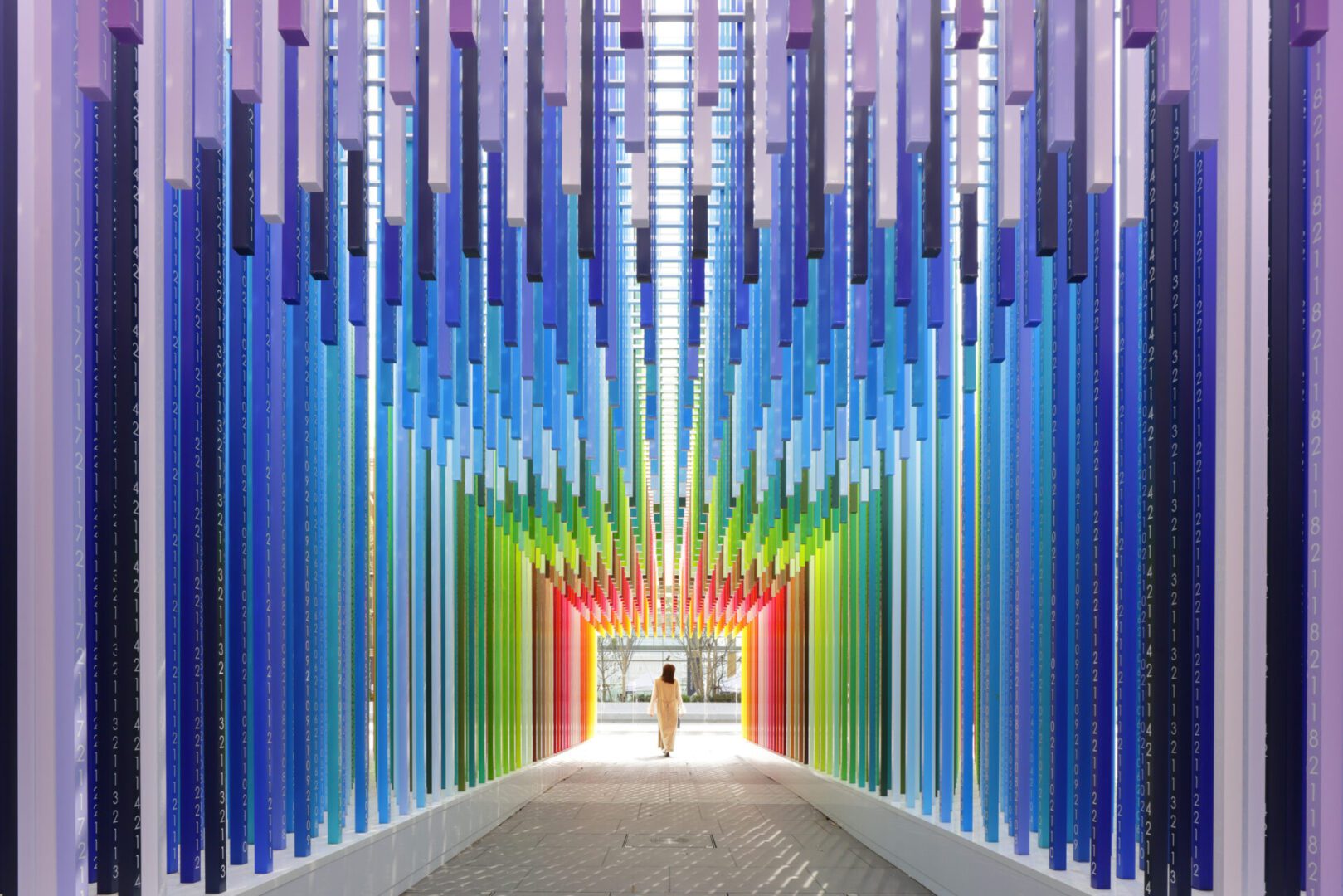
Installed within the everyday movement of Hong Kong’s Central district, 100 colors no.54 “FLOW” demonstrates how public artworks can reshape familiar environments without interrupting their existing rhythms. The work does not separate itself from the city around it; instead, pedestrians, architecture, light and movement become part of its changing composition. As viewers pass through the suspended colour fields, the installation shifts between transparency and density, revealing different arrangements of numbers and hues from each perspective. This fluid relationship between artwork and audience reflects a broader movement in contemporary installation towards works that exist through interaction rather than passive observation. Moureaux transforms a functional urban route into a place of heightened awareness, where an ordinary journey becomes an encounter with colour, time and the changing character of the city.
Contemporary installation has increasingly questioned the boundaries between object and environment, asking how artworks can exist beyond traditional forms of display. Across recent decades, artists including Olafur Eliasson, Chiharu Shiota and Ryoji Ikeda have explored how carefully constructed environments can transform perception, memory and the experience of time. Eliasson’s investigations into light and optical phenomena, Shiota’s intricate installations of thread and suspended forms, and Ikeda’s translation of data and numerical systems into immersive audiovisual environments each demonstrate how contemporary artists make invisible structures tangible. While these practitioners approach space through different materials and systems, Moureaux’s distinctive contribution lies in treating colour itself as the primary architectural element. In FLOW, the suspended forms create a sense of order while simultaneously revealing instability, as colours shift according to perspective and the movement of bodies around them.
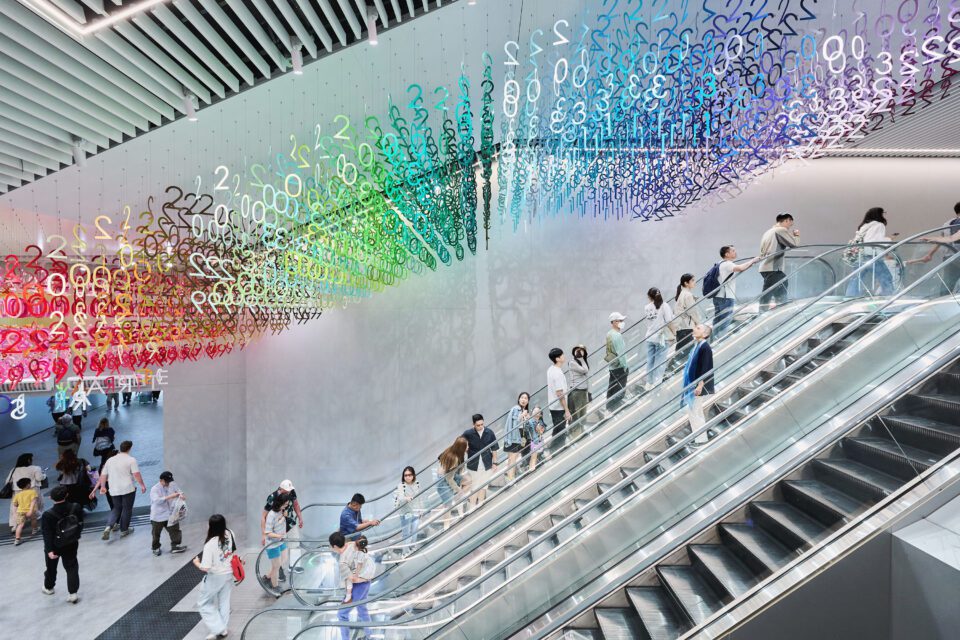
The significance of colour within Moureaux’s work connects to wider debates around visual culture and attention. In cities saturated with commercial imagery, digital screens and competing signals, 100 colors no.54 “FLOW” proposes a slower, more contemplative encounter with seeing itself. The work does not overwhelm through visual excess. It creates concentration through repetition, rhythm and subtle variation. Its one hundred colours encourage viewers to recognise qualities that remain unnoticed in everyday surroundings. By this means, Moureaux reconnects colour with curiosity, awareness and the act of looking.
100 colors no.54 “FLOW” extends Moureaux’s ongoing investigation into how colour can shape emotional and spatial narratives. The installation presents time not as a fixed sequence but as something layered, shifting and continually unfolding. Its position within Hong Kong’s urban landscape demonstrates how art can transform ordinary movement into moments of reflection without disrupting the life of the city around it. Through one hundred colours and a series of suspended temporal markers, Moureaux creates a meeting point between architecture, art and perception. Rather than filling space with colour, she reveals that colour was already shaping how space is experienced – waiting to be noticed.
100 Colours no.54 “FLOW” is at Central Yards, Hong Kong: emmanuellemoureaux.com
Words: Shirley Stevenson
Image Credits:
1. Emmanuelle Moureaux, 100 Colours no.54 “FLOW”.
2. Emmanuelle Moureaux, 100 Colours no.54 “FLOW”.
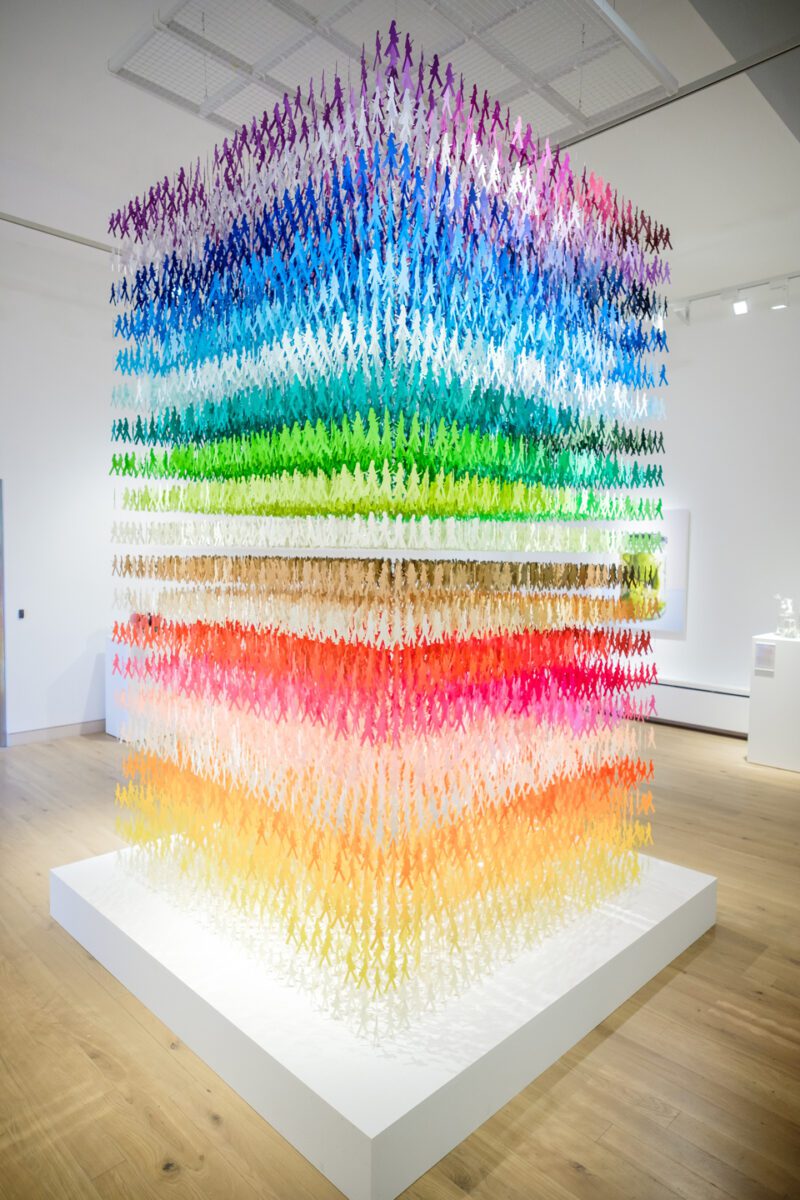
3. Emmanuelle Moureaux, I am here.
4. Emmanuelle Moureaux, 100 colors no.53 “100 colors path”. Photography: Daisuke Shima.
5. Emmanuelle Moureaux, 100 Colours no.54 “FLOW”.


