Since its founding in Zurich in 1992 by Iwan Wirth, Manuela Wirth and Ursula Hauser, Hauser & Wirth has developed into one of the world’s most influential contemporary galleries, with locations across Europe, North America and Asia. Representing a significant roster of international artists and estates, the gallery has established a distinctive model that combines commercial representation with ambitious exhibition-making, publishing, research and public engagement. Over the past three decades, its spaces have increasingly operated as cultural platforms where historical scholarship and contemporary artistic dialogue intersect. The opening of Hauser & Wirth Palo Alto on 3 October 2026 continues this trajectory, introducing a new northern California venue within a carefully restored early twentieth-century post office building. Its inaugural exhibition, Calder | O’Keeffe, sets the tone for the new location through an exploration of two defining figures of American modernism, examining their artistic relationship and shared interest in abstraction, natural forces and the poetics of space.
Art history is increasingly moving beyond fixed narratives of influence and hierarchy, instead examining networks of exchange, overlooked relationships and alternative ways of understanding canonical figures. This shift reflects a broader critical conversation around modernism, where previously established histories are being reconsidered through new archival research and expanded perspectives. Rather than presenting artists as isolated individuals, contemporary curatorial practice often seeks to reveal the intellectual, emotional and cultural connections that shape creative production. Calder | O’Keeffe follows this approach by bringing together two artists whose practices have traditionally been discussed separately, despite striking conceptual parallels. The exhibition proposes that their shared fascination with organic structures, movement and the invisible energy of the natural world offers a new way of understanding abstraction as an active engagement with lived experience.
Organised by Hauser & Wirth Curatorial Senior Director Alexis Lowry in close collaboration with the Calder Foundation and with research undertaken alongside the Georgia O’Keeffe Museum, Calder | O’Keeffe demonstrates the gallery’s ongoing commitment to expanding art historical dialogue. Through carefully considered pairings of sculpture, painting, jewellery and archival material, the exhibition reveals a friendship that has remained relatively unexplored despite decades of mutual admiration. This curatorial approach reflects Hauser & Wirth’s wider programme of reassessing significant artists through new scholarship, challenging the idea that established histories are complete or immutable. The exhibition also extends itself creates a conceptual link to the gallery’s first public presentation in Zurich in 1992, which paired Alexander Calder with Joan Miró and established an early interest in conversations between modernist practices. Across its programme, Hauser & Wirth has consistently returned to the idea that artists’ histories are not simply just singular narratives but evolving networks of encounters.
Alexander Calder transformed sculpture by introducing movement, balance and chance into three-dimensional form, allowing gravity, air currents and spatial relationships to become active elements within his compositions. Georgia O’Keeffe approached abstraction through a different visual language, distilling landscapes, flowers, bones and geological formations into paintings defined by precision, intensity and psychological depth. Despite their contrasting methods, both artists sought to visualise forces that exist beyond direct perception. Calder’s mobiles made invisible currents visible through motion, while O’Keeffe’s paintings translated the rhythms of the natural world into concentrated arrangements of colour and form. Together, their practices challenge conventional distinctions between representation and abstraction, suggesting that abstraction emerges not from rejecting nature but from observing it closely.
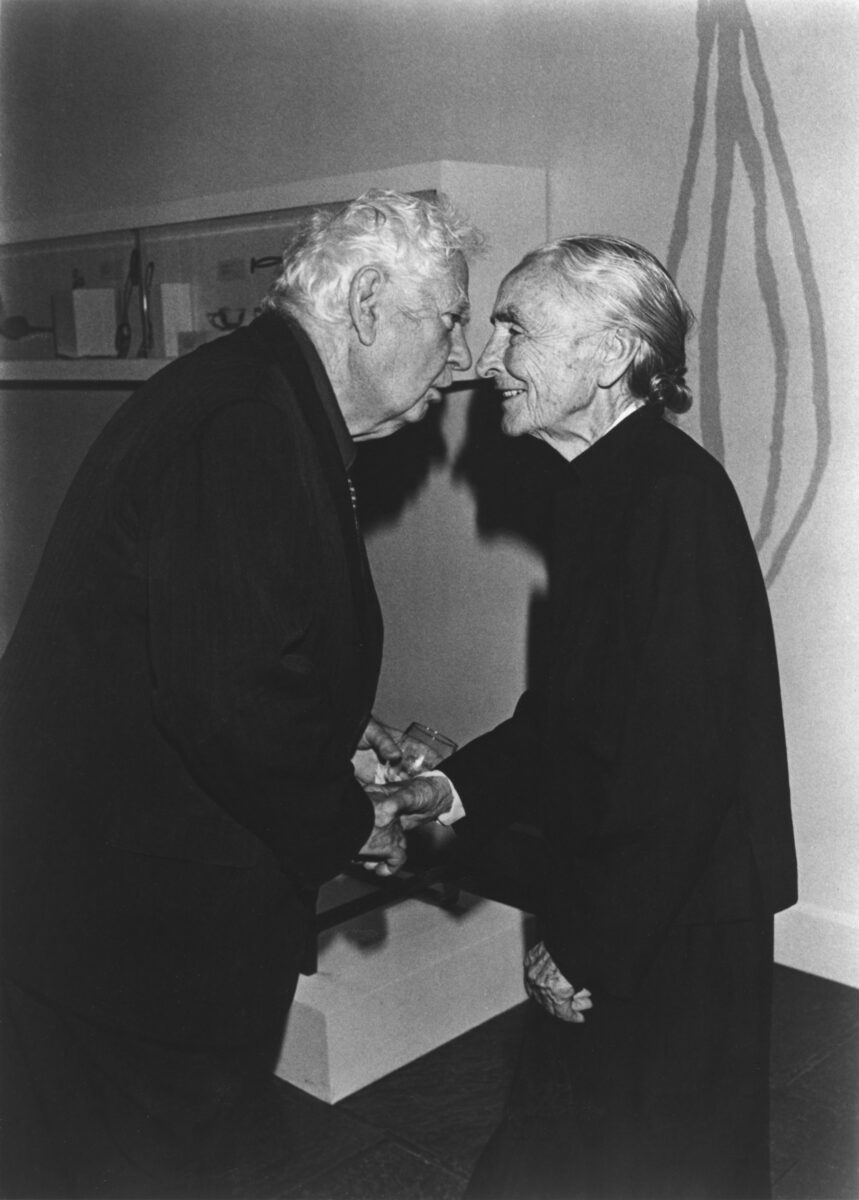
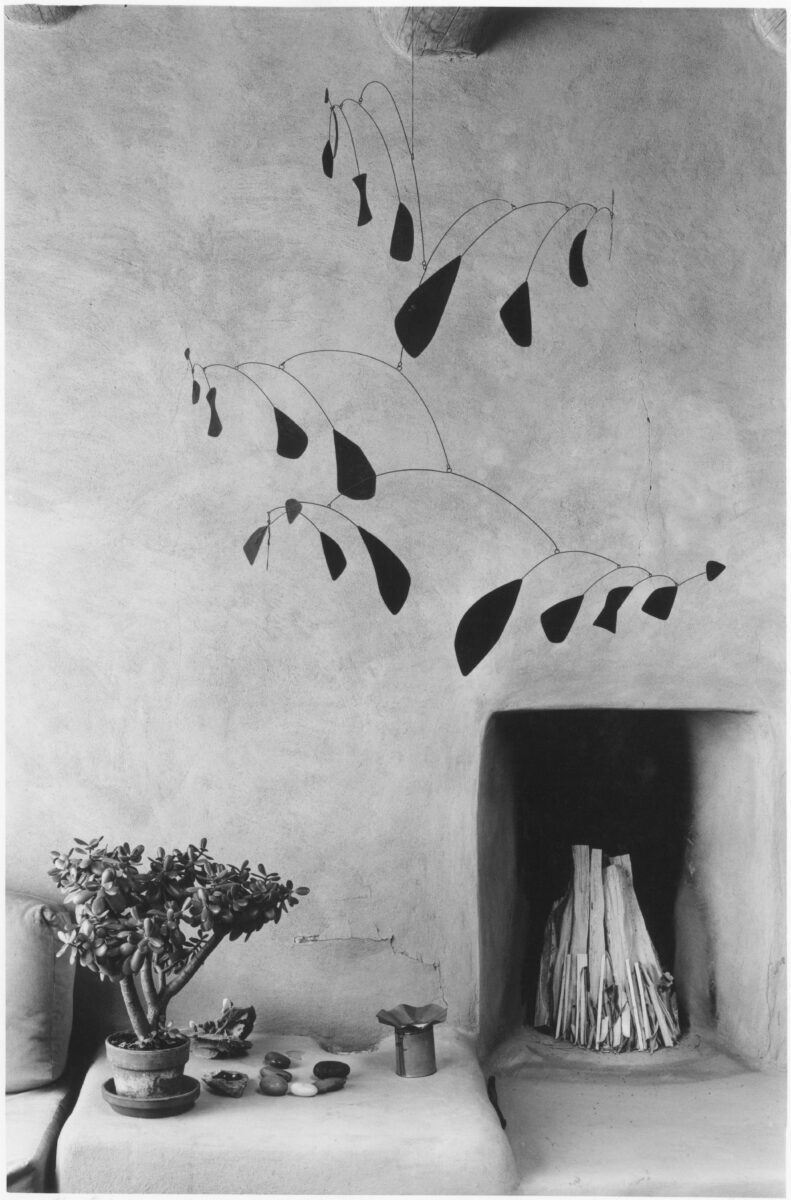
Personal relationships often provide a valuable lens through which artistic practices can be reconsidered, revealing connections that formal analysis alone may overlook. Calder and O’Keeffe’s friendship, documented through photographs, correspondence and personal objects, offers insight into the intellectual affinity between two artists working independently yet responding to similar questions. During the late 1930s, Calder created a brass brooch for O’Keeffe formed from the initials of her surname, transforming a personal gesture into an abstract composition. Worn vertically, with the K suspended from the O, the piece became less a readable monogram than a sculptural arrangement of line and movement that echoed the visual language of both artists. O’Keeffe’s acquisition of Calder’s Untitled (1942), a lyrical black mobile that occupied a central position within her Abiquiú home, further demonstrates how his work became embedded within her everyday environment and visual imagination.
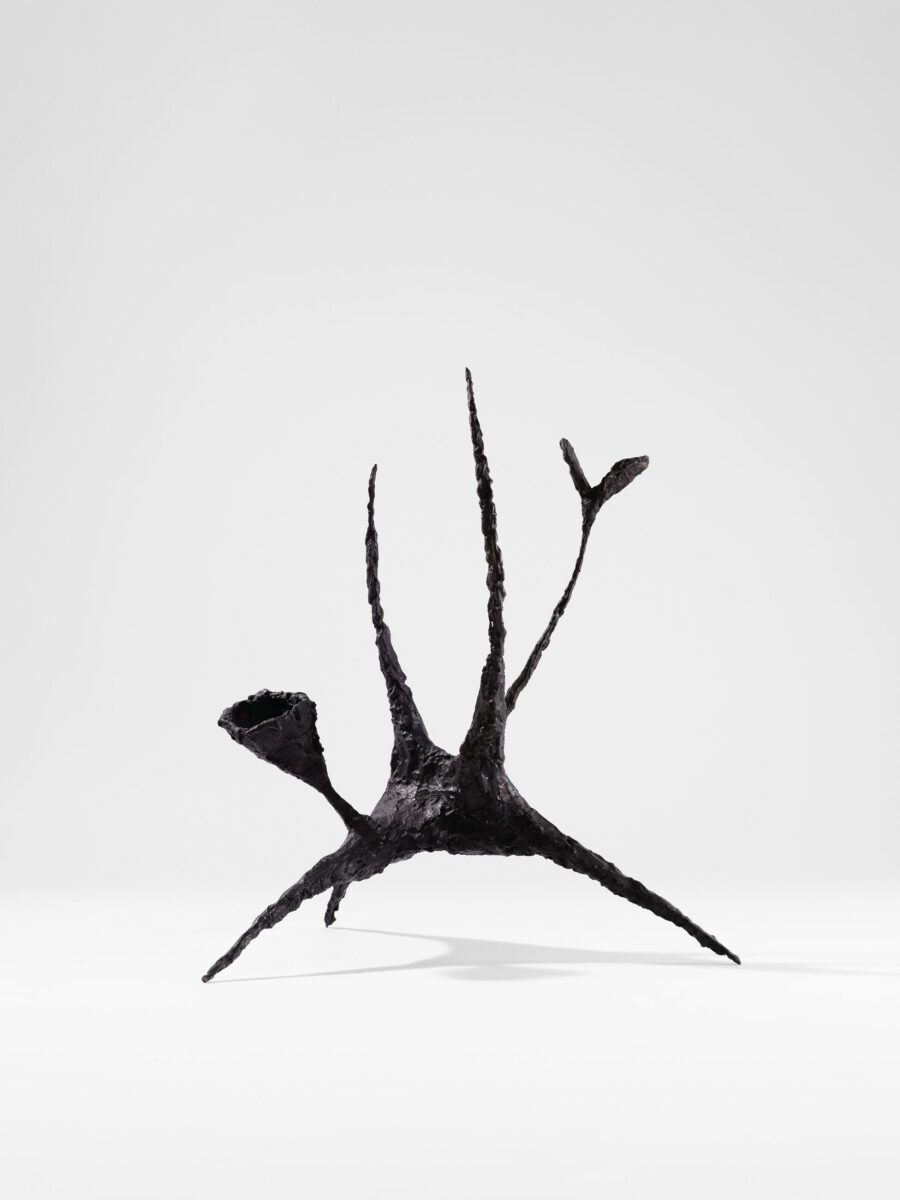
One of the most revealing moments in the exhibition comes from O’Keeffe’s observation that she recognised her own “pelvis bone holes” within Calder’s forms. This remark captures an intuitive understanding of the relationship between their practices, where organic structures become starting points for abstraction rather than subjects to be directly represented. Both artists looked towards the natural world as a source of underlying systems, finding connections between anatomy, landscape, movement and space. Such parallels invite discussions around ecological thinking in art, particularly the ways artists have explored humanity’s relationship with the physical environment. Through this lens, Calder and O’Keeffe appear less as isolated modernist figures and more as artists whose practices anticipate conversations around materiality, perception and the interconnectedness of natural systems.
Contemporary exhibition-making has increasingly embraced these forms of reassessment, questioning how museums and galleries construct cultural memory. The movement away from chronological surveys towards relational displays reflects a wider critical interest in how meaning is produced through dialogue. Rather than attempting to establish direct influence between Calder and O’Keeffe, Calder | O’Keeffe examines a shared intellectual landscape shaped by experimentation, observation and curiosity. This approach aligns with broader efforts within art criticism to reconsider modernism through multiple perspectives, including feminist, ecological and interdisciplinary readings. O’Keeffe’s position within twentieth-century art history, in particular, has undergone significant lengths of reinterpretation in recent decades, transitioning beyond the reductive associations with symbolism or subject matter towards recognition of her rigorous formal innovations and conceptual independence.
Architecture plays a central role in Hauser & Wirth’s expansion into Palo Alto, reflecting the gallery’s longstanding commitment to adaptive conservation and culturally engaged spaces. Located at 201 – 225 Hamilton Avenue in a century-old post office building, the new gallery has been transformed by architect Luis Laplace while preserving the character of the original structure. Alongside exhibition galleries, the space includes a dedicated Bookshop conceived as a centre for ongoing public programming, bringing together publishing, education and conversation. This emphasis reflects a broader shift within contemporary cultural institutions, where exhibitions increasingly exist within wider ecosystems of learning and exchange. The opening festival and future programme of talks and events position the Palo Alto location not simply as a venue for viewing art, but as a community-focused platform for dialogue.
Led by Beatrice Shen, Senior Director of Hauser & Wirth’s West Coast operations, the Palo Alto gallery extends the institution’s longstanding relationship with California’s artistic landscape. The gallery’s engagement with the region dates back to its foundation and includes representation of numerous California-based artists and estates whose practices have shaped the state’s cultural identity. Situated near Stanford University, the new space enters a context where art, technology, research and innovation intersect, creating opportunities for interdisciplinary exchange. Its arrival reflects a broader transformation within the Bay Area’s cultural landscape, where historic architecture is being reimagined as a space for contemporary production and public engagement. Hauser & Wirth positions Palo Alto as both a continuation of its global network and a response to the specific cultural character of its new location.
What distinguishes Calder | O’Keeffe is its commitment to careful looking, historical nuance and the productive possibilities of comparison. At a moment when exhibition culture often prioritises scale, immediacy and spectacle, the presentation instead returns attention to material, form and the subtle relationships that emerge between artworks. Its significance lies not in proposing a new hierarchy between two major artists, but in revealing the complexity of their shared concerns and the continuing relevance of their ideas. By opening its Palo Alto space with an exhibition grounded in scholarship, dialogue and reinterpretation, Hauser & Wirth demonstrates how modernism remains a living field of inquiry rather than a closed historical category. In doing so, the result is an invitation to the reconsideration of how artistic relationships, both documented and imagined, continue to shape the ways culture understands creativity, innovation and the forces that connect human experience with the wider world.
—-
Calder | O’Keeffe is at Hauser & Wirth, palo Alto from 3 October: hauserwirth.com
Words: Anna Muller
—-
Image Credits:
1&4. Calder’s Untitled (1942) in Georgia O’Keeffe’s living room, Abiqiu, New Mexico, 1980 Gelatin silver print © Pikes Peak Library District, 002-2983 Artwork © 2026 Calder Foundation, New York / Artists Rights Society (ARS), New York Photo: Myron Wood
2. Calder and Georgia O’Keeffe at a dinner in Calder’s honor, Whitney Museum of American Art, New York, 1976 Photograph by Abner Symons © Women’s Wear Daily Photo courtesy of Calder Foundation, New York ©2026 Calder Foundation, New York / Artists Rights Society (ARS), New York.
3. Alexander Calder, The Flower, 1944. Bronze 61 x 52 x 47 cm / 24 x 20 1/2 x 18 1/2 in© 2026 Calder Foundation, New York / Artists Rights Society (ARS), New YorkPhoto: Tom Powel Imaging