Ana Mendieta occupies a singular position in postwar art history – one defined as much by disappearance as by presence, and by the body understood not as object but as trace, imprint and terrain. Born in Havana in 1948, she died in New York in 1985 at the age of 36. Her life was shaped by rupture: a childhood exile to the United States following the Cuban Revolution, and a lifelong negotiation with the distance between origin and lived reality. Across performance, photography, film and sculpture, Mendieta developed a radical visual language in which the human form is repeatedly returned to elemental matter. Earth, fire, water and blood are not symbolic embellishments but active agents within her work, shaping a practice in which identity is made and unmade. In the decades since her untimely death, her work has become foundational to contemporary discourse around feminist embodiment, ecological thinking and diasporic consciousness.
This sense of persistence – of work that refuses closure – is at the heart of Tate Modern’s major retrospective, opening this July and continuing until early next year. Rather than framing Mendieta as a fixed historical figure, the exhibition positions her practice as something that continues to resonate in the present. Bringing together over 150 works, the show traces the shifting relationship between body and landscape that defines her oeuvre, moving fluidly across film, photography, sculpture and installation. Structured thematically through symbolic sites and recurring gestures, the presentation resists linear biography in favour of experiential return. Silhouetted forms carved into sand, grass and earth appear alongside remastered films and rarely seen drawings, creating a rhythm of appearance and erosion. What emerges is a sustained meditation on presence as something always on the verge of disappearance.
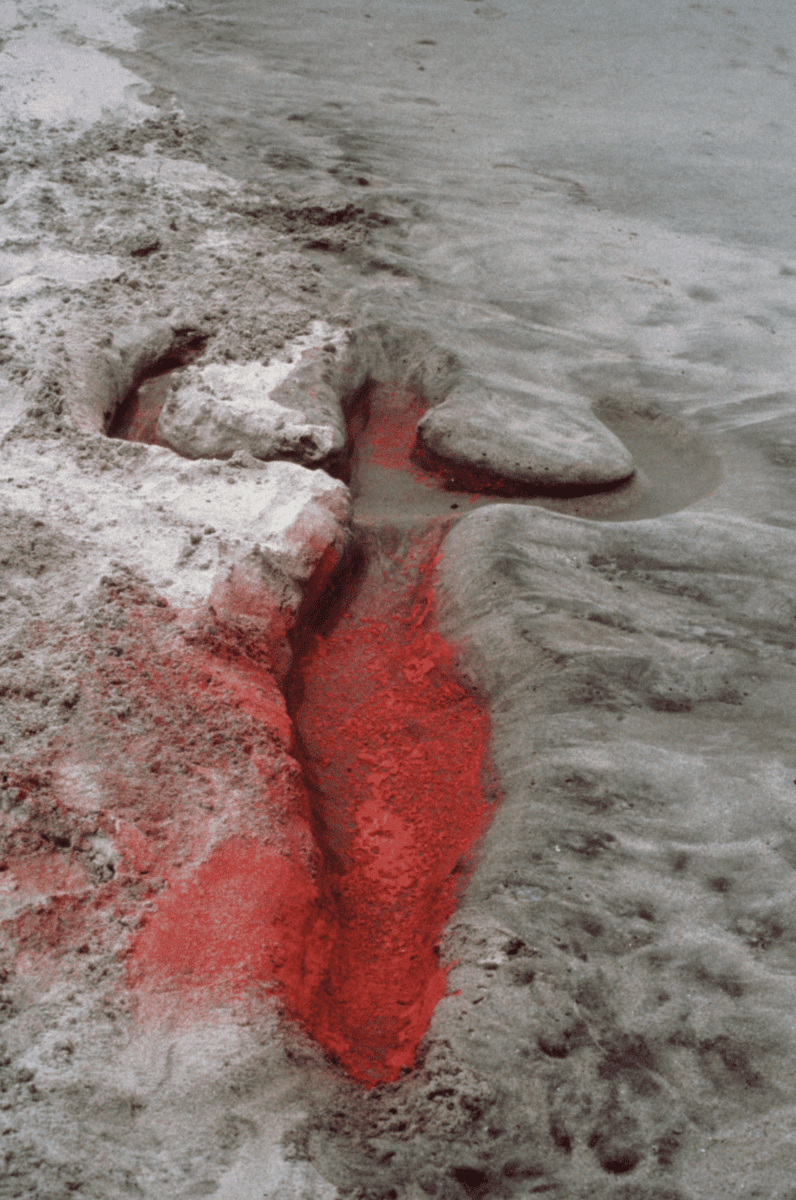
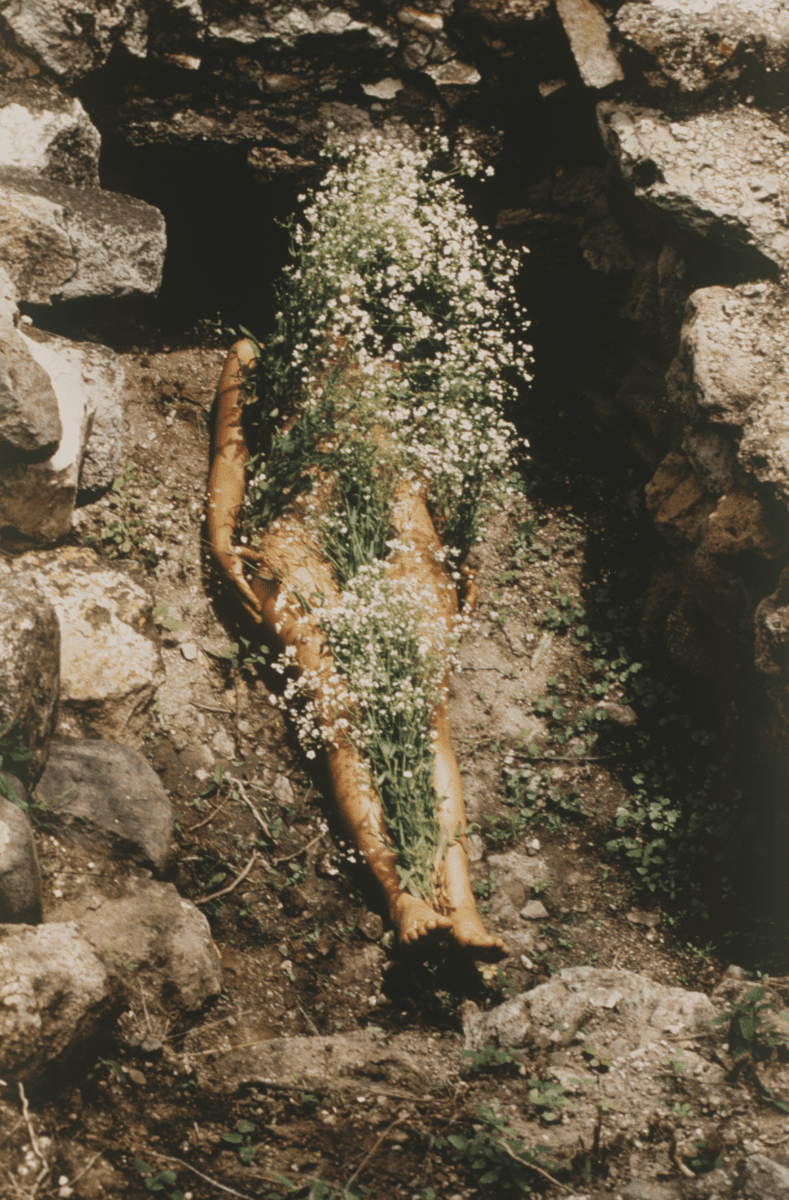
At the centre of Mendieta’s practice is the Silueta series, initiated in 1973 during a trip to Mexico, where she first began inscribing the outline of her body into the landscape. These works – at once intimate and monumental in implication – explore the body as absence made visible, a temporary interruption in the surface of the world. In some, her form is traced in flowers or ash; in others, it is pressed into sand or cut into grass, only to be reclaimed by wind and time. The works exist less as objects than as events, documented through photography and film that preserve what was always intended to fade. Mendieta constructs a language of erosion, where disappearance becomes a generative act rather than a loss.
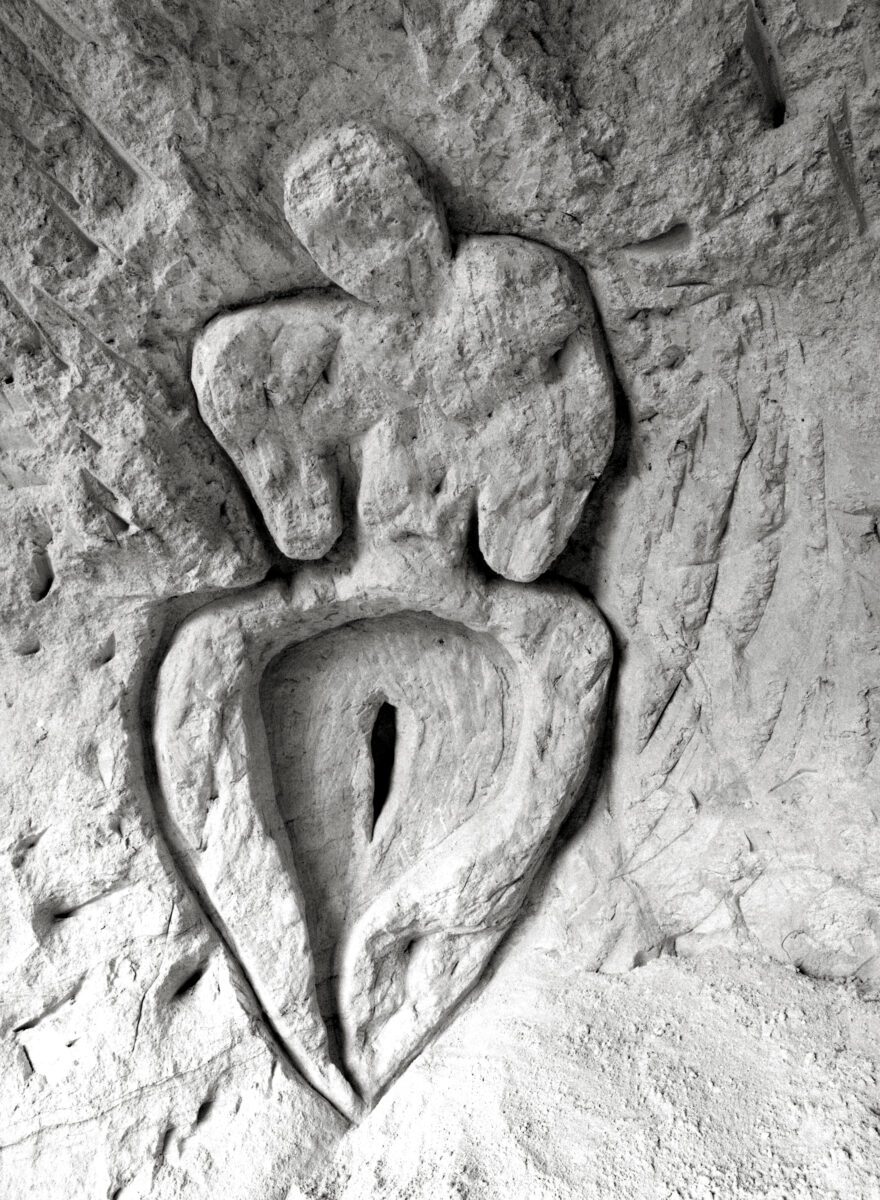
Her engagement with landscape is inseparable from questions of origin and displacement. Exiled from Cuba at the age of 12, Mendieta repeatedly returned to the idea of connection across distance, using natural environments as sites of symbolic return. Works such as Ochún (1981) stage this tension through ritualised gestures that evoke Afro-Cuban spirituality and the mythology of water as passage and memory. In Esculturas Rupestres (1981), created during visits back to Cuba, she carved figures into limestone inspired by Neolithic forms and indigenous Taíno culture, drawing history into direct contact with land. Across these works, the landscape is charged, responsive, and deeply entangled with cultural memory.
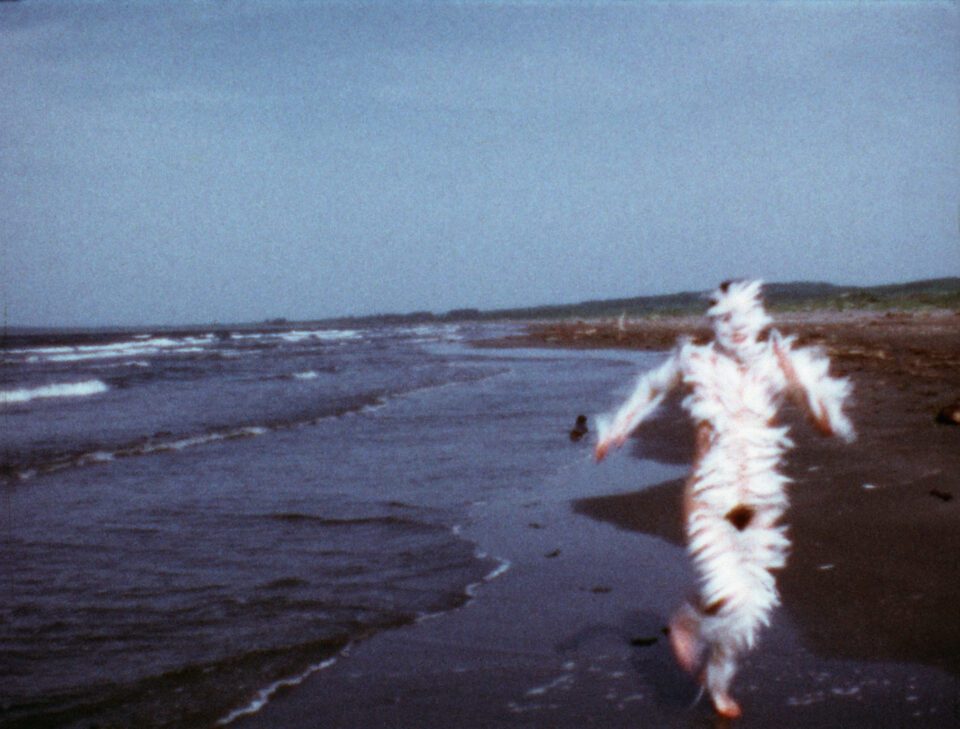
This dialogue between body, nature and transformation extends into Mendieta’s experimental film practice, developed during her studies on the Intermedia programme at the University of Iowa. Here, she pushed the material boundaries of cinema itself, scratching and painting onto celluloid to disrupt its surface. Works such as Bird Run (1974) and Anima, Silueta de Cohetes (1976) capture the body in states of ritual motion, becoming almost indistinguishable from the forces that surround it. In Facial Cosmetic Variations (1972), she alters her own appearance through makeup and expression, fragmenting identity. These films do not document performance so much as enact transformation in real time.
Her move to New York in 1978 placed her within a vibrant network of feminist and experimental artists, including membership of A.I.R Gallery, the first not-for-profit gallery directed by women artists in the United States. Within this context, her work engaged directly with questions of visibility, authorship and institutional exclusion. Yet even amid collective environments, Mendieta’s practice retained a striking solitude, often returning to elemental rituals staged in isolation. Teaching also formed a significant part of this period, with collaborative works such as Parachute (1973) reflecting her interest in pedagogy as shared experimentation. Across these intersecting roles, the body remained both subject and site.
A significant dimension of the Tate presentation lies in its attention to Mendieta’s later sculptural works, produced following her Prix de Rome fellowship in 1983. This period marked a shift towards more permanent materials, without abandoning her concern with organic transformation. Works such as Nile Born (1984) and La Jungla (Totem Grove) (1985) incorporate earth, wood and fire-blackened surfaces, where silhouettes are burned or impressed into material form. Alongside these are delicate drawings on leaves and works from the Amategram series, in which bark paper becomes a surface for totemic imagery. These works remain haunted by impermanence, as though resisting the stability of objecthood.
Crucially, the exhibition also foregrounds Mendieta’s ephemeral and performative works as living propositions rather than archival remnants. Ñañigo Burial (1976), constructed from black ritual candles, is reactivated periodically throughout the run, its flame returning gesture to time. Elsewhere, a reconstructed earth-body environment brings soil, branches, moss and stone into the gallery space, transforming institutional architecture into a temporary landscape. Outside the museum, a tree sculpture first conceived in 1982 extends this logic into the open air, where transformation is subject to weather, growth and decay. These gestures resist containment, insisting on art as process rather than object.

Mendieta’s influence can be traced across generations of artists working with body, land and memory, even when not explicitly cited. In the work of Cecilia Vicuña, fragile material gestures similarly evoke disappearance and ecological entanglement. Firelei Báez extends questions of diaspora through layered cartographies of body and geography, whilst artists such as Marina Abramović explore endurance, presence and the limits of physical experience. Across these practices, Mendieta’s legacy is less a style than a method – a way of thinking through the body as porous, temporal and inseparable from environment.
What makes this retrospective particularly resonant now is the way Mendieta’s concerns intersect with contemporary ecological urgency. Her insistence on the body as part of the natural world feels increasingly prescient within a cultural moment defined by environmental fragility and displacement. The Silueta works read today as meditations on impermanence that extend far beyond their original contexts. They ask how presence might be registered without permanence, and how loss might itself become a form of inscription. In this sense, Mendieta’s work continues to operate as both memory and proposition.
The Tate Modern retrospective confirms Anna Mendieta not just as a figure of historical resolution but also as an ongoing force within contemporary visual culture. Following landmark exhibitions such as the recent Tracey Emin retrospective, Tate Modern once again demonstrates its ability to stage exhibitions that reshape how audiences encounter feminist practice at scale. This is poised to be one of the defining shows of the year – immersive, exacting and emotionally charged. Mendieta’s work returns here not as archive, but as atmosphere: still active, still dissolving, still insistent in its refusal to settle.
Ana Mendieta is at Tate Modern, London from 15 July – 17 January: tate.org
Words: Anna Müller
Image Credits:
1&6. Ana Mendieta, Imágen de Yágul 1973. © The Estate of Ana Mendieta Collection, LLC. Licensed by Artist Rights Society (ARS), New York. DACS 2026. Courtesy Marian Goodman Gallery and Alison Jacques, London.
2. Ana Mendieta, Untitled Silueta Series 1976. © The Estate of Ana Mendieta Collection, LLC. Licensed by Artist Rights Society (ARS), New York. DACS 2026. Courtesy Marian Goodman Gallery and Alison Jacques, London.
3. Ana Mendieta, Bird Run 1974. © The Estate of Ana Mendieta Collection, LLC. Licensed by Artist Rights Society (ARS), New York. DACS 2026. Courtesy Marian Goodman Gallery and Alison Jacques, London.
4. Ana Mendieta, Untitled (Guanaroca [First Woman]) 1981,1994. © The Estate of Ana Mendieta Collection, LLC. Licensed by DACS.
5. Ana Mendieta, Untitled 1977. © The Estate of Ana Mendieta Collection, LLC. Licensed by DACS.