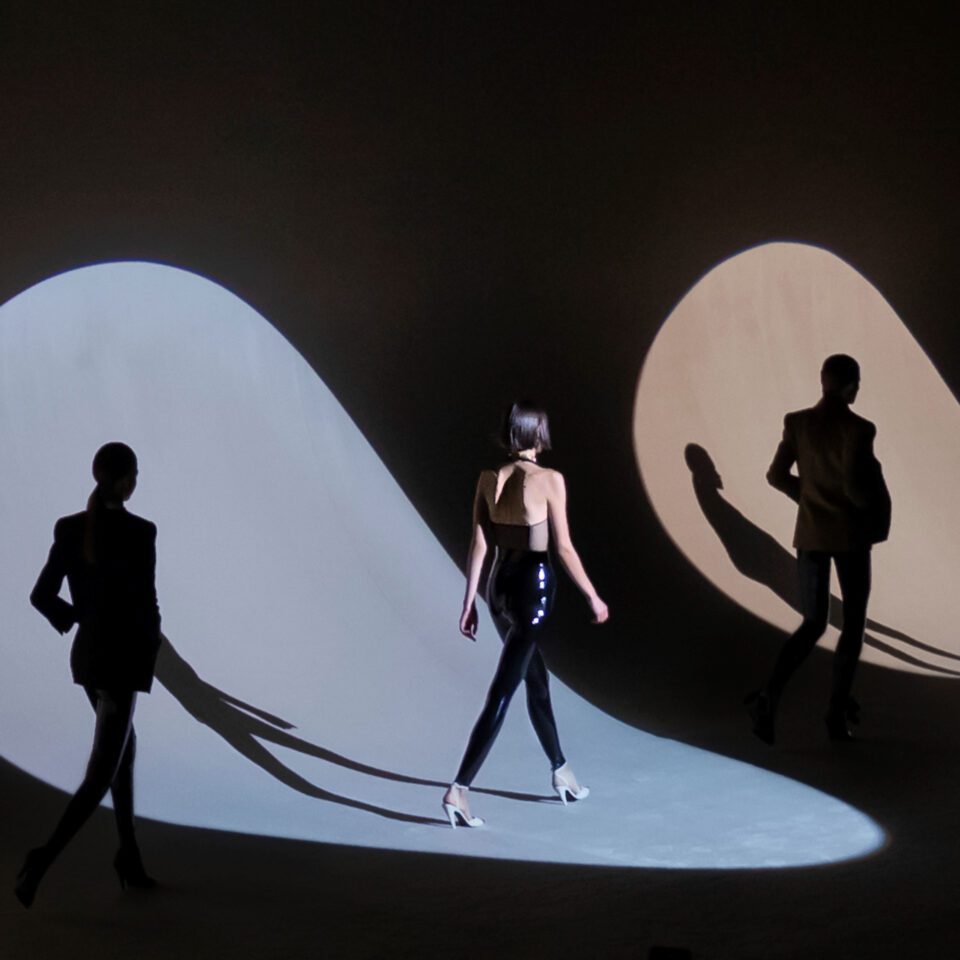
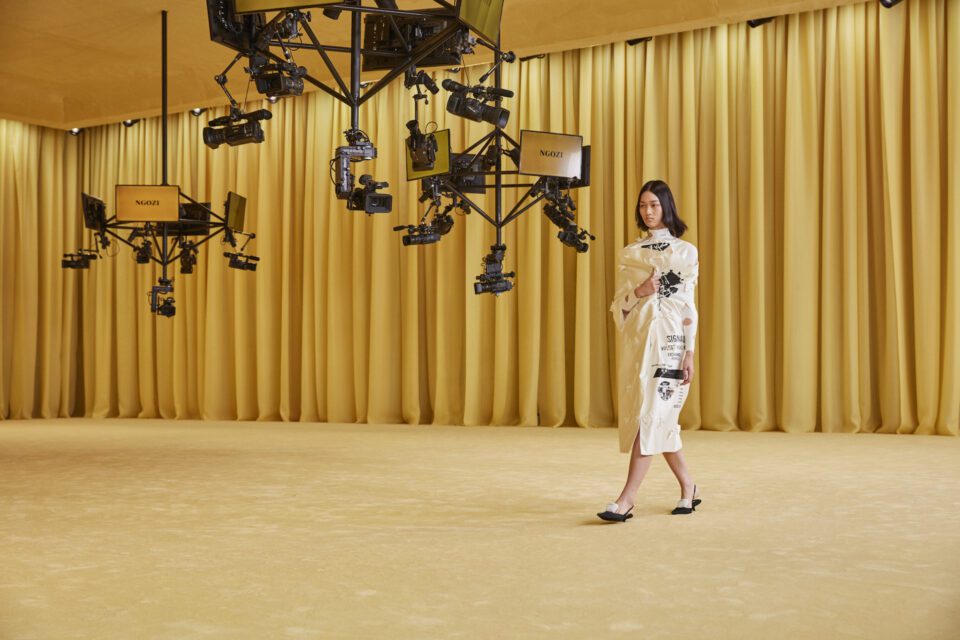
They last barely 15 minutes yet their images ripple across the world, circulating in magazines, on social media, and in the collective imagination. Fashion shows are fleeting spectacles yet enduring cultural phenomena, simultaneously media events, social rituals, and style-defining moments. The Vitra Design Museum’s exhibition, Catwalk: The Art of the Fashion Show, currently on view, is a rare deep dive into this ephemeral yet influential art form. Over four immersive rooms, the exhibition traces more than 100 years of fashion show history from intimate Parisian salons to digitally mediated spectacles of today, presenting over a century of design, choreography and cultural negotiation.
At its heart, the exhibition positions the fashion show as a Gesamtkunstwerk, a total work of art. The catwalk is no longer merely a platform for clothing but a theatre where architecture, scenography, lighting, sound, and movement converge into a narrative that communicates social ideals, artistic ambition, and political commentary. Visitors are invited to explore the evolution of the show as a medium, considering not only aesthetic innovation but also the ideological frameworks that shape each presentation. What myths and values are being told? Which social structures are being reinforced? Which social structures are being challenged? In what ways do fashion shows illuminate the society that produces them?
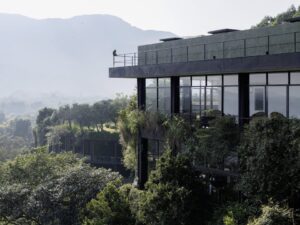
The Vitra Design Museum itself forms a fitting frame for this exploration. Designed by the late Frank Gehry, whose deconstructivist architecture has redefined museum spaces around the world, Vitra is extraordinary in both form and function. Its fragmented, angular surfaces create a sculptural landscape that mirrors the experimental spirit of the exhibitions it houses. Gehry’s layering of materials and dynamic interplay of light and shadow transform the museum into more than a building: it is a theatre for the imagination, a physical manifestation of the dialogue between design, art, and culture. The museum’s intricate architecture resonates with the exhibition’s focus, emphasising that presentation and environment are inseparable from the work that is being shown.
The journey through fashion history begins in the early 20th century, when shows were intimate encounters within Parisian salons. Charles Frederick Worth, often hailed as the father of haute couture, pioneered the use of live models, giving clothes a life that mannequins could not convey. Lucile, with her flair for romantic storytelling, created theatrical tableaux that enthralled audiences, while Paul Poiret liberated silhouettes from corsetry, envisioning clothing as a vehicle for movement and spectacle. Gabrielle Chanel’s dramatic descents of mannequins down mirrored staircases challenged the static nature of presentation, transforming the salon into an arena of visual drama. Historical photographs reveal the transatlantic reach of these exhibitions, from department stores in the United States to fashion displays on ocean liners, which would later inspire the cruise collections that continue to captivate audiences.
A highlight of this period is the Théâtre de la Mode, a travelling miniature exhibition conceived in 1945 to revive French couture after the devastation of war. Over 40 Parisian couturiers presented scaled-down collections on intricate wire mannequins, surrounded by meticulously crafted stage sets. Several original mannequins from the Balenciaga archive are featured, alongside film footage by Tom Kublin, capturing the elegance and innovation of Balenciaga shows in the 1960s. Cristóbal Balenciaga, often described as the “master of us all” by contemporaries, is celebrated for his architectural approach to garment construction. His work demonstrates that fashion is not only performance but also structural artistry.
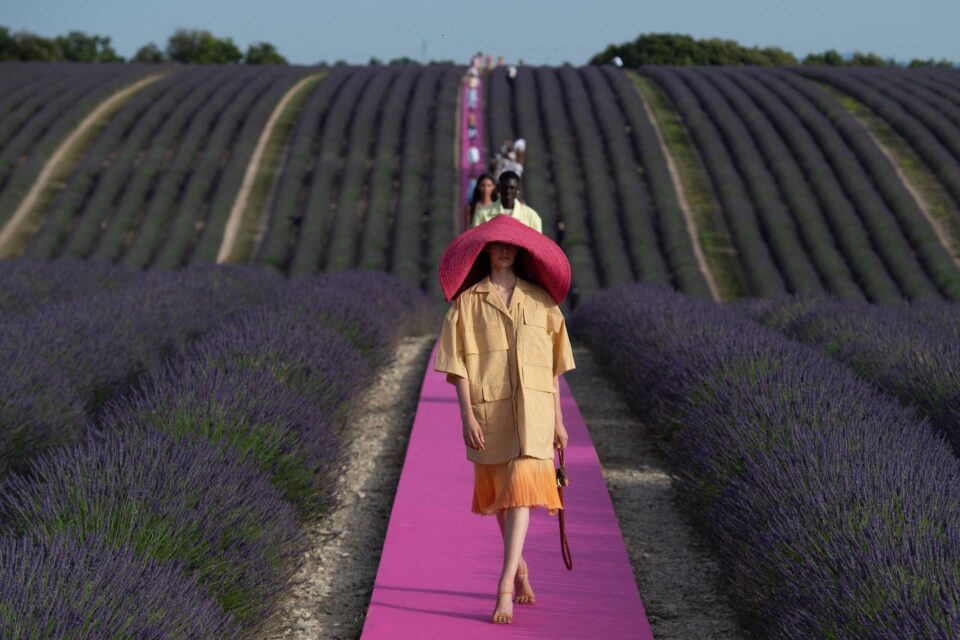
The second section traces the era when fashion moved beyond private salons into urban spaces, propelled by the rise of prêt-à-porter and its engagement with subcultures. In 1958, Chloé, led by Gaby Aghion, invited audiences to the Café de Flore, merging fashion with the artistic avant-garde. André Courrèges, with his futuristic, geometric designs, reimagined the body in motion, while Paco Rabanne pushed materials to the extreme, experimenting with metal, plastic, and unconventional textures to create movement as sculpture. Kenzo Takada’s colourful spectacles blurred the lines between fashion show, party, and performance – a playful and multicultural sensibility that presaged contemporary shows.
The seminal Battle of Versailles in 1973 marked a watershed moment. American designers Bill Blass, Anne Klein, Oscar de la Renta, Halston, and Stephen Burrows challenged the dominance of French haute couture, creating a moment of unprecedented cultural exchange. Black models such as Pat Cleveland, Bethann Hardison, and Alva Chinn reshaped the catwalk, signalling a new era of inclusivity and visibility. Invitations and show programmes began to show as an artistic experience rather than mere display.
By the 1990s, the supermodel era transformed fashion shows into global spectacles. Gianni Versace’s 1991 runway event, featuring Cindy Crawford, Naomi Campbell, Linda Evangelista, and Christy Turlington performing together, epitomised this moment. Their presence signalled power, confidence, and glamour, embodying contemporary ideals of femininity and self-possession. Simultaneously, designers such as John Galliano and Alexander McQueen introduced narrative and theatricality in unprecedented ways. Galliano, known for his historical reimaginations and flamboyant storytelling, blurred fact and fantasy, while McQueen, the enfant terrible of British fashion, used the runway as stage for provocative, emotionally charged performance, challenging notions of beauty, mortality, and spectacle.
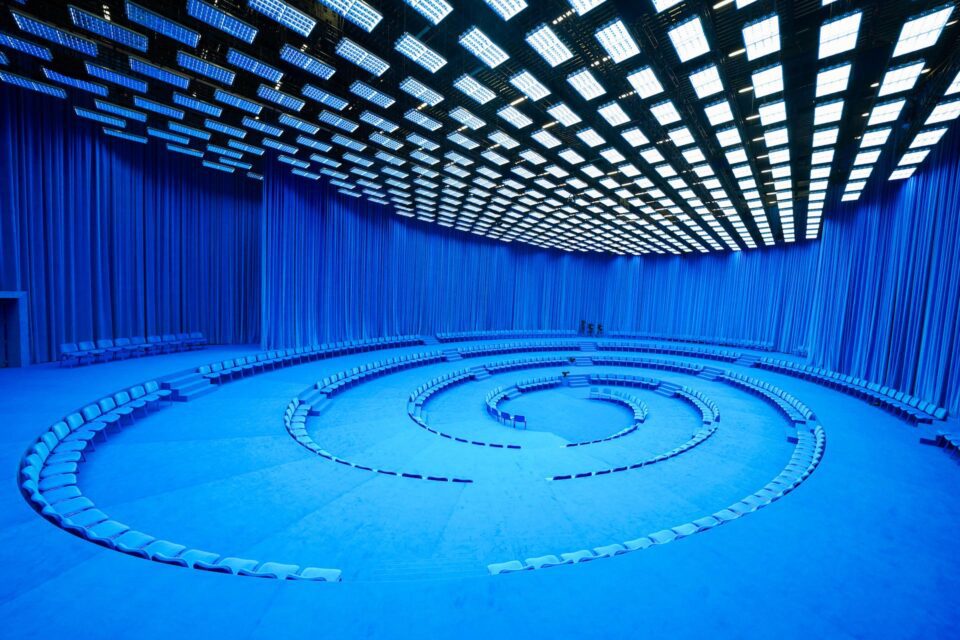
At the turn of the millennium, fashion shows reached monumental scale. Corporate investment from LVMH and Kering enabled designers like Karl Lagerfeld at Chanel to transform the Grand Palais into immersive worlds: supermarkets, rocket launches, and Parisian boulevards became narrative stages. Lagerfeld’s meticulous attention to detail and sense of theatre elevated fashion to performance art. Simultaneously, designers such as Martin Margiela, Viktor & Rolf, and Hussein Chalayan pursued radical experimentation, relocating shows to parking decks, abandoned hospitals, or industrial spaces, turning the runway into an experimental laboratory. Margiela, in particular, treated clothing as ephemeral performance, leaving traces such as melted ice or coloured footprints that became artefacts of temporality.
The exhibition’s fourth room focuses on the recent past, where the digital revolution and the COVID-19 pandemic accelerated innovation. Dior’s The Dior Myth, a dollhouse collection (Fall/Winter 2020), Loewe’s Show in a Box (Spring/Summer 2021), and Balenciaga’s collaboration with Matt Groening in The Simpsons (Spring/Summer 2022) demonstrate how fashion adapts narrative for new media. Collaborations with choreographers and visual artists have become central: Erwin Wurm’s One Minute Sculptures for Issey Miyake (Spring/Summer 2025) and Sharon Eyal’s dance for Dior (Spring/Summer 2019) merge movement, sound, and costume into immersive experiences, extending the catwalk into interdisciplinary art.
Recent shows foreground the body as a site of social and political exploration. Rick Owens’ Spring/Summer 2016 show featured women carrying other women, exploring interdependence and corporeal dialogue. Alessandro Michele at Gucci (Fall/Winter 2018) referenced Donna Haraway’s Cyborg Manifesto, questioning identity, gender, and technology. Balenciaga’s Parliament Show (Spring/Summer 2020) challenged conventional beauty with prosthetics, while collaborations with architects like Rem Koolhaas and designers such as Virgil Abloh, known for transforming various city skylines into wearable garments, reveal the ongoing dialogue between fashion and the built environment.
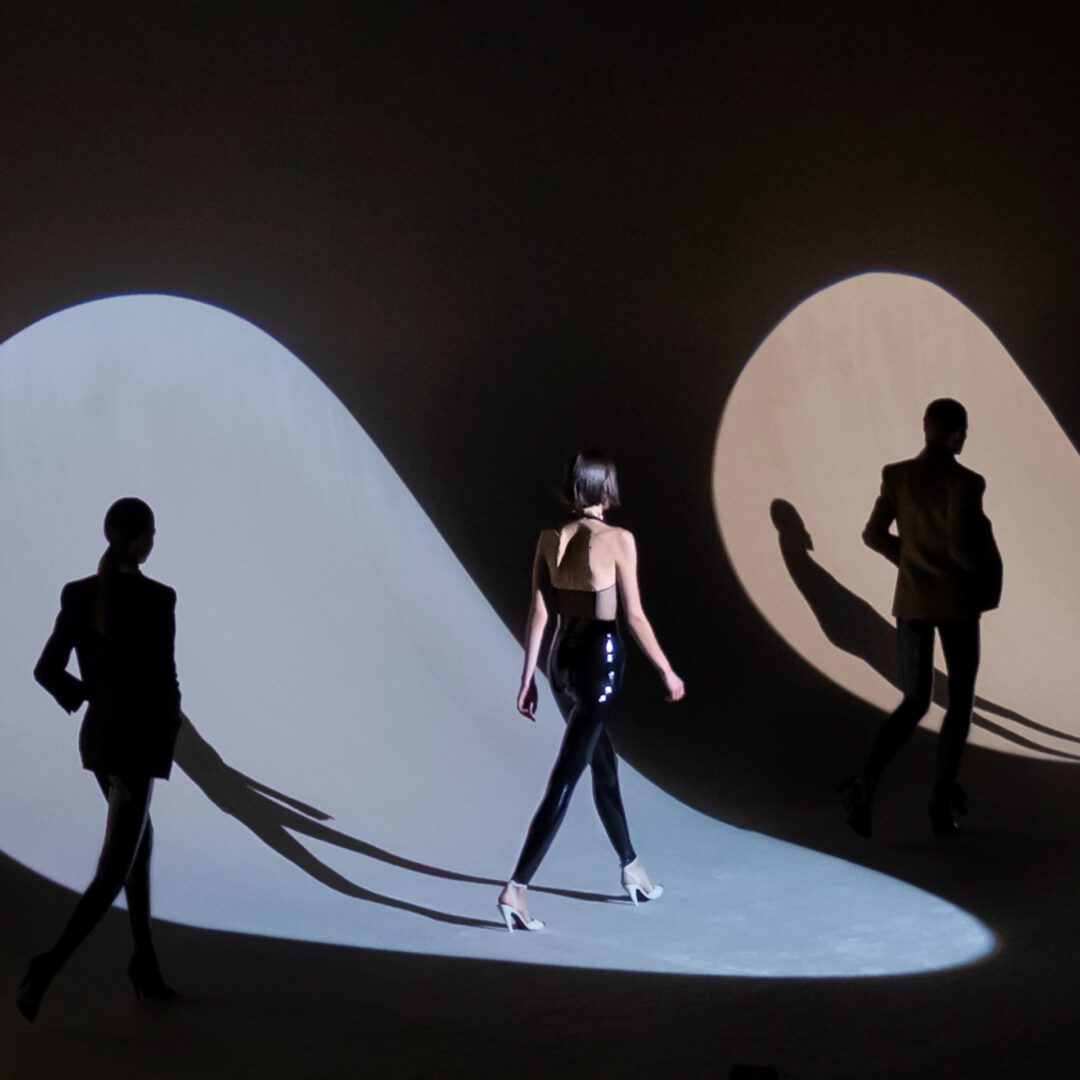
The fourth room also reflects on the industry’s material appetite, incorporating scenographic elements from past shows courtesy of Spazio META, Milan. The return to elaborate live shows after the pandemic underscores the enduring significance of direct, physical experience: fashion’s cultural power persists through ritual, myth, and spectacle even as images circulate instantaneously. From Chanel’s mirrored staircases to McQueen’s mechanised interventions, from Margiela’s abandoned spaces to Balenciaga’s digital parliaments, the exhibition celebrates the audacity, creativity, and cultural power of the fashion show. It is a testament to the transient made permanent, the fleeting elevated to art, and the catwalk as a canvas upon which the ideals, anxieties, and dreams of our times are projected. The Vitra Design Museum, with its extraordinary Gehry architecture, forms a perfect setting for this journey, allowing visitors to experience fashion as theatre, performance, and cultural mirror.
Catwalk: The Art of the Fashion Show continues at Vitra Design Museum, Weil am Rhein, until 15 February 2026. It is a rare opportunity to witness fashion’s most spectacular and thought-provoking moments in one immersive experience, reminding us that the art of presentation is inseparable from the art of design.
Catwalk: The Art of the Fashion Show is at Vitra Design Museum until 15 February 2026.
Words: Anna Müller
Image Credits:
1. Key Visual »CatwaIk: The Art of the Fashion Show« © Vitra Design Museum, graphic design: Haller Brun. based on © Bureau Betak, photo Marie Laure Dutel, Yves Saint Laurent, Autumn/Winter 2020.
2. Prada, Ready-to-Wear S/S 2021, Milan © Prada.
3. Jacquemus, Ready-to-Wear, S/S 2020, »Le Coup de Soleil« © Alamy, Foto: Aurore Marechal.
4. Balenciaga, Ready-to-Wear S/S 2020, »Parliament Show« © Stefan Aït Ouarab.
5. Key Visual »CatwaIk: The Art of the Fashion Show« © Vitra Design Museum, graphic design: Haller Brun. based on © Bureau Betak, photo Marie Laure Dutel, Yves Saint Laurent, Autumn/Winter 2020.